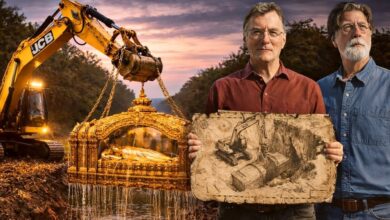
Oak Island’s Mysterious Sand Road May Be Pointing to a Much Older Secret
A New Clue Emerges in the Swamp
The mystery of Oak Island may have taken another intriguing turn as Peter Fornetti, Gary Drayton, and Billy Gerhardt continued their investigation into the strange sand-covered road uncovered in the western region of the swamp.

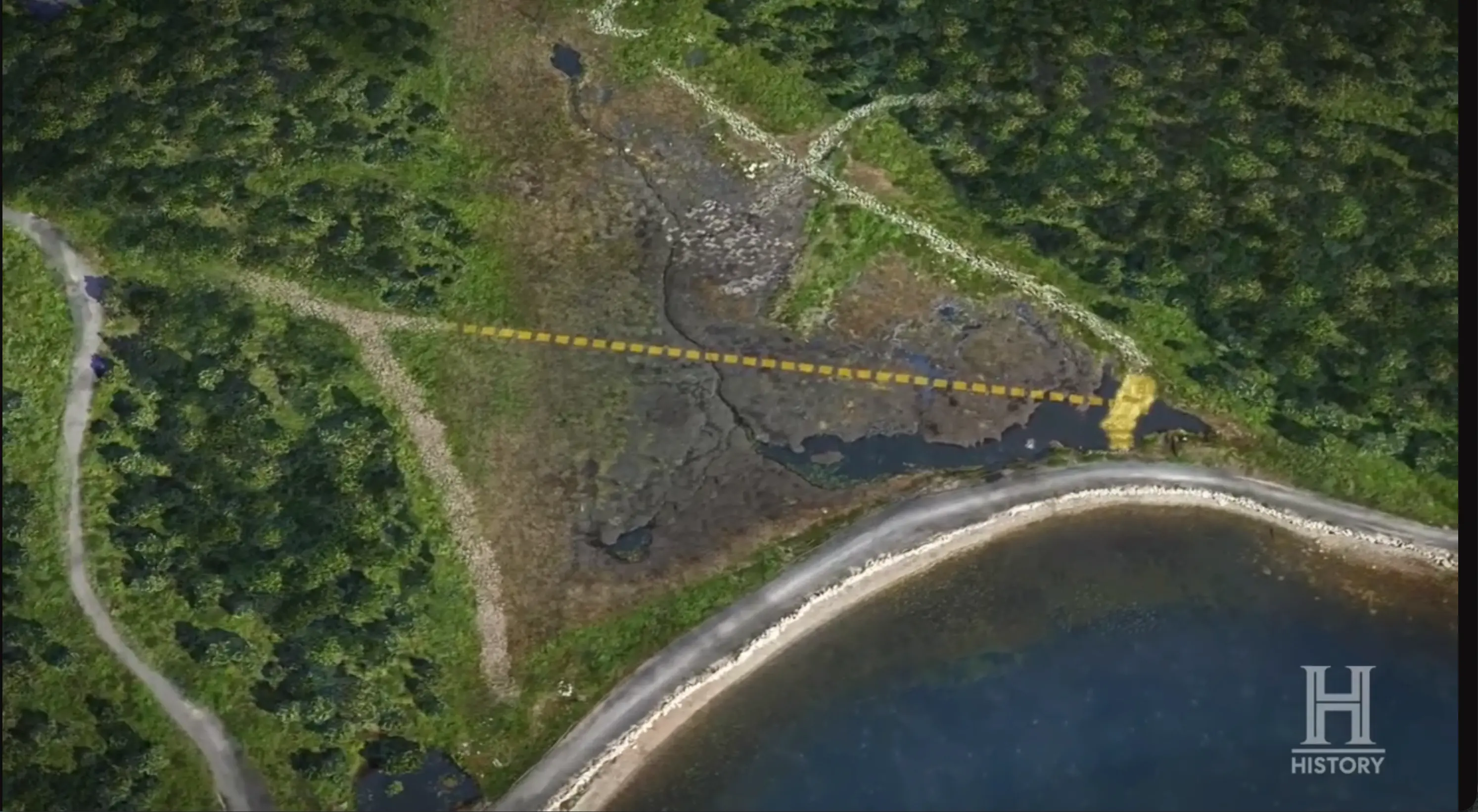
What first appeared to be an unusual feature in the landscape is now beginning to look far more significant. Over the past two weeks, the team has exposed additional sections of the formation, revealing what appears to be a sand-covered cobblestone road lined with wooden survey stakes. Even more striking is the possibility that this road aligns with the already well-known stone road in the southeast corner of the swamp, a feature some believe may be more than 500 years old and possibly linked to Portuguese activity on the island.
For the team, this is no longer just another curious structure. It may be part of a larger route that once connected key areas of Oak Island, perhaps even the Money Pit itself.



The Eight-Sided Stakes Raise New Questions
One of the most compelling aspects of the discovery is the repeated appearance of what seem to be eight-sided wooden stakes along the edge of the sand road.
These stakes immediately drew attention because similar ones found elsewhere in the swamp were previously analyzed by archeoastronomy expert Professor Adriano Gaspani. Based on their alignments with specific stars, he concluded that those earlier stakes may date back to the early 13th century. He also suggested that their deliberate placement could indicate a connection to the Knights Templar.
Now, with more possible eight-sided stakes appearing alongside the sand road, the team is asking whether the two discoveries are related. If they are, the implication would be remarkable. It would suggest that this road was not a later construction created by treasure hunters, but part of a much older and more carefully planned system on the island.
That possibility gives the sand road far greater historical importance than anyone may have expected when the digging first began.
A Deep Find Adds Weight to the Theory
The investigation became even more interesting when Gary Drayton detected iron buried deep within the road itself.
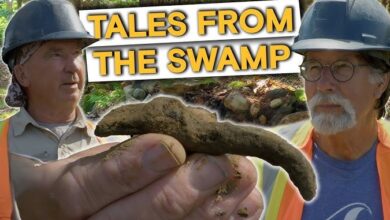
After the team dug down, they recovered what Gary identified as an old ox shoe. The artifact had clearly been buried for a long time, and its position within the sand road suggested that it was not simply recent debris. Instead, it appeared to be connected to the road’s earlier use.
To the team, the ox shoe was more than a small artifact. It was evidence of activity, movement, and transport across this part of the island. Gary suggested that oxen may once have used the route while hauling material toward the Money Pit. While that remains speculative, the find does strengthen the idea that this was a working road rather than a random or natural feature.
For a site where dating evidence is always crucial, the ox shoe also offers hope that further analysis could help place the road more firmly in time. That is exactly the kind of evidence Peter said he wanted to find.
The Road Appears to Continue Toward Center Road
As the team continued exposing more of the sandy layer, a pattern became harder to ignore.
Additional sand and another stake were found in line with the road, leading Gary and Peter to conclude that the feature likely continues beyond the currently exposed area. More importantly, the alignment appears to point directly toward Center Road, the main route that runs through the middle of Oak Island.
This idea immediately caught Craig Tester’s attention. If the sand road truly extends toward Center Road, it raises the possibility that the road now known as Center Road may actually have been built on top of a much older path. That would reverse the usual assumption. Instead of the road being a relatively recent creation tied to later treasure hunting or survey work, the survey itself may have followed an already existing route.
Craig even floated the possibility that the road predates the 1762 division of the island into lots by Surveyor General Charles Morris. If that proves true, it would represent a major shift in how the island’s early infrastructure is understood.
Could the Road Connect Lot 5 to the Money Pit
The implications become even more significant when Lot 5 enters the discussion.
Peter pointed out that the team already has hard evidence suggesting a connection between Lot 5 and the Money Pit area. Since 2022, investigations at the rounded stone foundation near the shore on Lot 5 have produced mortar-like material matching soils from deep in the Money Pit zone, as well as valuable artifacts dated as early as the 14th century.
Those finds have encouraged the theory that Lot 5 may once have served as a base camp for whoever was responsible for creating the Money Pit. If so, the newly uncovered sand and cobblestone road could explain how people, tools, or even valuable cargo were transported across the island.
That possibility transforms the road from an isolated archaeological curiosity into something much larger: a potential logistical route linking one of Oak Island’s most active historical areas to its most famous mystery. For Rick Lagina and the others, that is exactly why this feature has become so important.
The Team Believes the Road May Be Older Than the Survey
One of the most striking ideas raised during the investigation is that this road may not merely connect important locations. It may also predate the official survey history of Oak Island.
Center Road is generally believed to have been created in the early 1800s by treasure hunters, after Charles Morris divided the island into 32 four-acre lots in 1762. But if the sand road beneath it is older, then the accepted timeline may need to be reconsidered.
Craig Tester openly questioned whether the survey was based on the road, rather than the road being created after the survey. That is a major suggestion because it points to organized activity on Oak Island before the standard historical framework normally used to explain the site.
If that line of thinking is correct, the island may have hosted earlier construction, transport, and planning on a much larger scale than many previously assumed.
A Bigger Excavation May Be Coming Next
Although the team reached the edge of their permitted dig area and had to stop work for the day, the investigation is clearly not over.
Rick Lagina, after hearing the latest findings, agreed that the next logical step would be to dig a cross section along Center Road. The hope is that by cutting into the road, they may be able to confirm whether an older path lies buried beneath it.
That next step could prove critical. If an earlier sand and cobblestone road is found underneath Center Road, it would strongly support the growing belief that the island’s transport network is far older than once thought. It could also provide one of the clearest physical links yet between Lot 5, the swamp features, and the Money Pit.
For now, the team believes they have found more than just an old road. They may have uncovered part of the system that once allowed people to move materials across Oak Island in a deliberate and highly organized way.
Another Layer of the Oak Island Mystery Begins to Take Shape
Oak Island has always been a place where small clues can lead to much larger questions, and the sand road appears to fit that pattern perfectly.
An old ox shoe, a line of stakes, a buried cobblestone feature, and a path that may run beneath the modern road system do not, by themselves, solve the island’s mystery. But taken together, they suggest structure, planning, and movement. They point to the possibility that whoever worked on Oak Island did not simply dig a pit and leave. They built routes, marked alignments, and may have created a coordinated system stretching across multiple parts of the island.
That is why this discovery matters. The sand road may not be treasure itself, but it could be the path that helps explain how treasure, tools, or materials once moved through Oak Island.
And in a mystery built on fragments, finding the road may be just as important as finding the vault.