The Political Economy of Clarkson’s Farm
Complaining about the state of modern life has become something of a national habit. And it is not without justification. Systems fail, services break down, and even the simplest tasks often collapse into frustration. Levers fall off. Apps do not work. Processes designed to make life easier frequently do the opposite. It can feel as though we are living through a period of cultural and institutional decline.
Against this backdrop, it is little surprise that many viewers have interpreted Clarkson’s Farm as a confirmation of whatever grievances they already hold. On the surface, the show appears to be another reality programme built on chaos, as Jeremy Clarkson himself jokes that “everything goes wrong against the clock.” Yet beneath the comedy lies a far more interesting and, ultimately, more hopeful message.
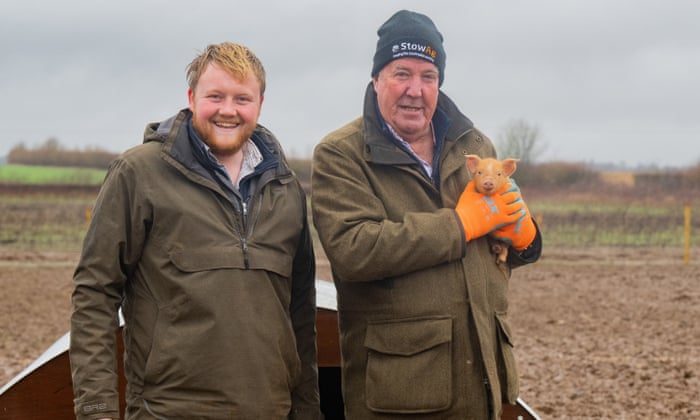
The real lesson of Clarkson’s Farm is not that nothing works, but that it is extraordinary that anything works at all.




A Comedy of Failure — and Learning
Now in its fourth season, with a fifth expected soon, Clarkson’s Farm documents Clarkson’s attempt to run a working farm after the previous farmer retired in 2019. He bought the land years earlier—openly admitting that tax considerations played a role—but only later faced the practical question of what it actually takes to make a farm function.
Clarkson’s confidence is the joke’s starting point. How hard can farming be? Buy the land, hire some workers, use some machines, and let the profits roll in. The show’s humour is built on how comprehensively that assumption collapses.
What emerges instead is a prolonged education in humility. Clarkson learns—often painfully—about weather, timing, regulation, ecology, community, and sheer physical labour. The laughter comes easily, but the lessons accumulate slowly and convincingly.
Beyond Buffoonery: Unexpected Depth
What surprises many viewers is how far the show moves beyond Clarkson’s familiar on-screen persona. Over time, he is confronted with realities that resist his instinctive certainties: the fragility of ecosystems, the moral weight of animal welfare, the dependence of modern life on underappreciated labour, and the gap between theory and practice.
One episode is openly described as emotionally harrowing, and not without reason. The programme increasingly reveals farming not as a lifestyle choice or romantic ideal, but as a relentless confrontation with uncertainty.
This is why Clarkson’s Farm has earned praise even from audiences previously sceptical of Clarkson himself.
A Parable of Political Economy
Perhaps the most valuable aspect of the show is its unintended role as a parable of political economy.
On the political left, there is often an assumption that wealth flows easily once land and capital are acquired. Ownership, in this view, is itself the primary obstacle. Remove it, or redistribute it, and prosperity will naturally follow.
Clarkson, interestingly, begins with a similar assumption—minus the moral framing. He owns the land. He has capital. He can hire labour. Surely success is inevitable.
The reality, documented in excruciating detail, proves otherwise.

The £144 Revelation
After a year of exhausting labour, regulatory compliance, financial risk, and repeated setbacks, Clarkson’s first-year profit totals just £144.
This figure is not a punchline—it is a revelation.
Despite technological sophistication, government subsidies, modern logistics, and Clarkson’s personal resources, the margins are almost nonexistent. Farming emerges as a system balanced on a knife edge, vulnerable to weather, market prices, fuel costs, global politics, and bureaucratic intervention.
That the farm survives at all is not evidence of exploitation or ease, but of resilience bordering on the miraculous.
Why Anything Works at All
Seen through this lens, Clarkson’s Farm delivers a quietly profound message. Modern society depends on systems so complex, regulated, fragile, and interdependent that their continued operation is astonishing. Food appears in shops not because the system is efficient or fair, but because countless people absorb risk, uncertainty, and loss so that others do not have to.
Rather than reinforcing cynicism, the show invites gratitude—and caution. If we treat functioning systems with contempt, demand perfection, or burden them with endless rules and ideological expectations, we may destroy what little margin they have left.
A Timely Lesson
As the New Year approaches, Clarkson’s Farm offers something rare: not optimism without realism, but realism without despair. It suggests that progress is not guaranteed, systems are not self-sustaining, and competence is hard-won.
Yet it also reminds us that cooperation, effort, and practical knowledge still matter—and that when things do work, even imperfectly, it is worth noticing.
In an age defined by frustration, that may be its most political insight of all.