A 230-Foot Gamble: Oak Island’s Most Aggressive Money Pit Dig Yet
As The Curse of Oak Island moves into Episode 15, titled “Swamped,” the Fellowship of the Dig prepares for what could become one of the most decisive operations in the island’s modern history. Heavy machinery is returning to the Money Pit with a singular objective: reach 230 feet and investigate the base of the so-called solution channel.
For the first time, scientific data, historical records, and engineering strategy appear to be aligned toward one clearly defined target depth.
Why 230 Feet Matters
The decision to dig to 230 feet is not arbitrary. Over the past several episodes, sonic drilling has mapped a deep subterranean void beneath the bedrock plateau—known as the solution channel. The prevailing theory suggests that when the original Money Pit collapsed due to engineered flood tunnels, any treasure vaults may have fallen into this natural cavity.
Recent boreholes, particularly I9.5 and K9.5, reached depths exceeding 200 feet. At approximately 217 feet, XRF testing conducted under Dr. Ian Spooner revealed elemental silver attached to clay particles at highly concentrated levels. Unlike dissolved trace metals, elemental silver in this context strongly suggests a non-natural source.



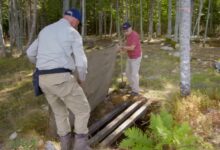
If the silver concentration increases toward the base of the channel, the logical target becomes the deepest reachable point—around 230 feet.
The Historical Connection: The 174-Foot Zone
Science is only part of the equation. Near the 174-foot level, the team previously recovered a fragment of 1850s drill rod—believed to be linked to early searcher James Pitblado. According to island lore, Pitblado’s drilling allegedly brought up artifacts including precious metals before he abruptly left the island.
If that drill rod marks a historical silver-bearing zone, and modern testing shows elevated silver levels deeper below, the implication is compelling: the source may lie just beyond that 174-foot horizon.
Engineering Strategy: The Telescoping Method
Previous attempts at deep excavation were halted by gypsum and anhydrite bedrock, which created friction and structural resistance against single large caissons.
In Episode 15, Vanessa Lucido (ROC Equipment) and Adam Ableton (SBC Canada) introduce a telescoping casing strategy:
- An 8.5-foot outer caisson will be sunk to approximately 130 feet.
- A 7-foot inner casing will then continue from 130 to 230 feet.
This reduces friction and structural stress while maintaining bore stability.
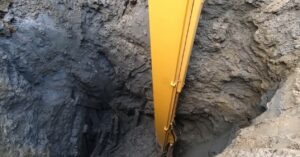
At the center of the operation is a 35-ton rotary drill rig fitted with an 8-foot-wide auger equipped with hardened cutting teeth designed to penetrate dense gypsum ledges. Unlike previous hammer grab systems, this method combines rotary cutting with controlled spoil extraction.
The scale of machinery reflects the seriousness of the target.
Parallel Discovery: The Swamp Clue
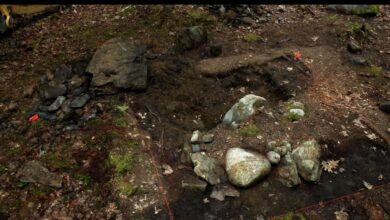
While drilling intensifies at the Money Pit, Episode 15 also highlights a discovery in the northern swamp: an early-period key found near the cobblestone pathway and previous vault-like structure.
The swamp has increasingly revealed industrial-style features—stone paving, wooden kegs, lead weights—suggesting logistical operations rather than random activity. If the key predates modern searchers, it could connect to cargo storage or transport systems associated with the original depositors.
The episode’s structure appears to juxtapose two investigative approaches:
- Industrial-scale excavation at the Money Pit
- Archaeological reconstruction in the swamp
Both may ultimately intersect in a unified narrative.
What Could Episode 15 Reveal?
Three developments appear likely:
- Intense scrutiny at 170–175 feet, revisiting the Pitblado depth.
- High-volume spoil processing, potentially revealing metallic artifacts.
- Further clarification of the swamp’s operational purpose, especially if the key is dated definitively.
Whether Episode 15 produces treasure, structural confirmation, or simply another piece of the puzzle, the convergence of science, engineering, and history makes this one of the most strategically focused digs in recent seasons.
For the Fellowship, 230 feet is no longer just a depth marker—it represents the intersection of theory and proof.