The Final Push: A Season of Discovery Culminates
As another momentous year draws to a close on Oak Island, the Fellowship of the Dig prepares for one last major operation. The team has completed the installation of their sixth and final seven-foot-diameter steel shaft, named TOT-1, short for “The One Thing.” Reaching down to 195 feet, the shaft penetrates a vast underground cavity in the bedrock known as a solution channel—a void that may now house both collapsed debris and, potentially, the legendary Money Pit treasure.
With weather closing in and the season nearing its end, the team is racing against time to extract and examine the spoils from TOT-1.

Digging into the Depths: Analyzing TOT-1 Spoils
At Smith’s Cove, Rick Lagina, Gary Drayton, Craig Tester, and the team begin combing through the dried spoil materials from the bottom of the caisson. Their metal detection efforts soon uncover a small but well-preserved iron artifact: the end of a pickaxe. This tool is reminiscent of a previous find from TOT-1—a fragment identified as a tunneling tool, possibly dating back to the 16th century.



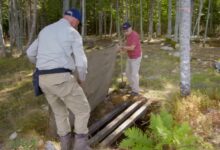
These artifacts are compelling clues, suggesting human activity deep underground—possibly connected to historical treasure deposition.
Scientific Analysis: Emma Culligan Dates the Tools
In a final War Room presentation, metallurgical expert Emma Culligan delivers a scientific analysis of the two key artifacts: a chisel-like piece and the pickaxe head. Both are composed of clean iron and show similar compositions, with potassium content indicative of charcoal-based manufacturing, a method phased out in the mid-1700s.
Her verdict: the tools likely date back to the early-to-mid 1700s, and possibly as far back as the 1650s. This places the artifacts well before the so-called “official discovery” of the Money Pit in 1795—lending credibility to the idea that secretive digging occurred on Oak Island centuries earlier.
The Fellowship Reflects: Treasure of Knowledge
The team gathers one last time at the Oak Island Museum to reflect on a season filled with effort, challenges, and progress. Although no treasure was recovered this year, the team feels they’ve uncovered something equally valuable: knowledge.
They successfully installed six large caissons in the Money Pit area and uncovered critical new evidence pointing to early tunneling and possible treasure-related activities. A particularly promising theory arises: the original Money Pit contents may have collapsed into the solution channel, hidden deeper than previously searched.
This explains why previous boreholes might have missed the target—and why hope is far from lost.

Looking Ahead: The Honeycomb Strategy
With renewed purpose, the team discusses a future plan: the honeycomb method, involving a tightly packed grid of large caissons reaching up to 230 feet deep. This would allow for a systematic and thorough excavation of the entire Money Pit region—particularly the solution channel, now viewed as a likely location for the original deposit.
The approach is ambitious but reflects the team’s dedication to solving the Oak Island mystery once and for all.
An Emotional Farewell
As the season closes, Rick Lagina gives an emotional speech, reflecting on his lifelong belief in Oak Island’s mystery and the joy of pursuing it with family and friends. He shares heartfelt gratitude for the team’s unity, perseverance, and shared dream. It’s a poignant reminder that the real treasure may be the journey itself—and the bonds formed along the way.
With that, the Fellowship wraps another chapter—but their resolve is stronger than ever.
The Mystery Continues…
Though winter halts the digging for now, the work is far from over. With new artifacts in hand, scientific validation on their side, and a strategic plan in motion, the team prepares for what could be the most groundbreaking season yet.
Could the solution channel be hiding the truth behind the Oak Island legend?