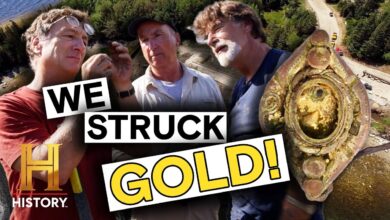
Oak Island’s Enduring Mystery: The U-Shaped Structure and the Hunt at Smith’s Cove
Introduction: A Legend That Refuses to Die
For more than two centuries, Oak Island has been the epicenter of one of the world’s longest-running treasure hunts. Located off the coast of Nova Scotia, the island’s reputation is steeped in legends of hidden wealth, elaborate flood traps, and a curse that warns the treasure will not be found until seven lives are lost. So far, six searchers have perished in pursuit of the prize. Yet, despite the dangers and decades of failure, the quest for Oak Island’s secrets continues with unwavering determination.
The latest chapter in this ongoing saga centers around an enigmatic discovery at Smith’s Cove—a U-shaped structure buried beneath the sand and mud. For the Lagina brothers and their team, it could represent either a breakthrough or just another frustrating detour in a centuries-old puzzle.

Smith’s Cove: Where Clues and Confusion Collide
Visitors to Canada often imagine Toronto’s skyline or the charm of Quebec City, but Oak Island draws a different crowd: adventurers, historians, and dreamers. At Smith’s Cove, the Lagina brothers uncovered fascinating artifacts—stone slabs etched with strange symbols, human bone fragments, and even a medieval lead cross that some believe connects to the Knights Templar.




Alongside these artifacts, the team has found sophisticated engineering features, such as French drains—stone filtration systems designed to manage water flow. Combined with the U-shaped structure, these discoveries suggest that whoever engineered Oak Island centuries ago possessed knowledge far ahead of their time.
Yet for every clue, another complication arises. The variety of materials and the complexity of the structures only add to the mystery, leaving the team to wonder: are these signs of treasure defenses, or simply the work of earlier treasure hunters?
Historical Records: Old Stories, New Questions
While some of the crew excavated Smith’s Cove, others turned to history for answers. Alex Lagina, Doug Crowell, and Paul Troutman traveled to nearby Chester to study records preserved by the Municipal Heritage Society. Among dusty letters and faded maps, they uncovered a 1936 letter describing a timber structure marked with Roman numerals—eerily similar to the U-shaped formation rediscovered in modern times.
Another document, a newspaper article from 1850, spoke of finger drains—stone tunnels designed to converge into a central flood system protecting the infamous Money Pit. A second article from 1863 repeated the same claims. These documents didn’t offer solid proof, but they did suggest that advanced waterworks were once part of Oak Island’s underground labyrinth.
The frustration is familiar to any Oak Island researcher: every time new evidence surfaces, it often circles back to what treasure hunters already suspected but could never prove.
Curse, Clues, and the Cycle of Hope
Oak Island’s lore includes more than engineering marvels—it carries with it a dark legend. The curse warns that seven must die before the treasure can be claimed, and with six deaths already recorded, the island’s danger feels all too real.
Despite this grim backdrop, the Lagina brothers press forward. Each discovery, no matter how small, injects new energy into the hunt. The U-shaped structure and French drain suggest deliberate construction rather than natural formation, fueling speculation that the Money Pit’s elaborate defenses are real.

The Technical Challenge: Precision Drilling and Dangerous Depths
To chase these clues deeper underground, precision is everything. At a crucial meeting on the island, drilling expert Tor Magnusson brought gyroscopic surveying equipment to ensure the team’s boreholes remained straight as they pushed past depths of 100 feet. A deviation of even a few feet could mean missing a tunnel, shaft, or vault entirely.
The concern is not just technical. Oak Island’s history includes catastrophic collapses. In the 1860s, a massive cave-in swallowed one shaft and forced treasure hunters to abandon work. Modern drilling, though aided by advanced tools, still carries the same risks. Water seeping into pits and unstable soil threaten to undo months of effort in seconds.
The Triangular Gap: A New Clue Emerges
During excavation at Smith’s Cove, the team uncovered a triangular gap in the muddy terrain. Water trickled out, resembling descriptions of the legendary box drains from old newspapers. The discovery electrified the team. Nature rarely produces such perfect shapes, and the presence of coconut fiber—an imported material used historically as filtration—strengthened the case for human engineering.
Could this triangular drain be part of the system that has kept the Money Pit flooded for centuries? If so, controlling it might finally give the Laginas the upper hand in their battle against Oak Island’s most infamous trap.
Between Hope and Frustration
Still, veterans of Oak Island know better than to celebrate too soon. For every promising find, there has been disappointment. Artifacts like pottery shards and rusted metal tools confirm human activity, but they don’t point directly to treasure. Documents repeat old theories without offering clear solutions. And the island itself seems determined to mock those who try to uncover its secrets.
Rick Lagina often reminds the team—and the audience—that the real reward is in the pursuit itself. Each discovery, however small, adds to the mosaic of history. Whether treasure is ever found or not, the search reveals a story of human ingenuity, perseverance, and obsession.
Conclusion: Treasure or Just the Chase?
The question lingers: is Oak Island hiding a fortune in gold and jewels, or is the true treasure the centuries of adventure it has inspired?
The Lagina brothers remain undeterred. Armed with cutting-edge technology, historical research, and sheer determination, they continue to chase the answers buried beneath layers of mud, stone, and myth. Each day brings another chance to prove—or disprove—the legends.
For now, the U-shaped structure at Smith’s Cove stands as both a promise and a puzzle. It may be a key to unraveling Oak Island’s defenses, or just another chapter in a saga where every solution opens the door to more mysteries.