Oak Island’s Enduring Mystery: Inside the Money Pit, New Leads, and the Show’s Biggest Finds
A Legend That Refuses to Settle
For more than two centuries, Oak Island—off Nova Scotia’s south shore—has pulled in dreamers, engineers, and historians with a single question: what, if anything, lies buried beneath its soil and tides? The Money Pit sits at the center of that mystery. Generations have invested fortunes, risked life and limb, and even lost both in pursuit of an answer. Whether the latest leads are a stepping stone to “true treasure” or simply the next chapter in an evergreen puzzle, Oak Island remains one of history’s most compelling cold cases.
The Money Pit: A Booby-Trapped Puzzle in Layers
The story circles back, again and again, to the Money Pit—first noted in the 18th century as a curious depression in the ground. Unlike a typical shaft, the Pit presented diggers with layered defenses: platforms of wooden logs, bands of stone and clay, and reported flood mechanisms that seemed designed to protect whatever lay below.



Over the years, searchers have recovered scattered clues—coins, pottery fragments, and small devotional items. Individually, these finds are modest. Together, they function like breadcrumbs, hinting at a more complex historical footprint and keeping hope alive that a bigger cache—or a decisive explanation—waits deeper down.
The Templar Connection: Romance, Records, and a Lead Cross
Among the most head-turning theories is the Knights Templar hypothesis. The medieval order’s dramatic downfall in the early 1300s left myths of hidden wealth and sacred relics. On Oak Island, a lead cross discovered near the surface reignited this idea: some observers note stylistic echoes of Templar symbology—Latin mottos, sword imagery, and cross forms—although direct, indisputable provenance remains elusive. As with many Oak Island signals, the cross is a tantalizing piece, not a final proof.
Coconut Fiber: A Tropical Outlier in a Northern Swamp
One of Oak Island’s stranger clues is the presence of coconut fiber—material not native to Nova Scotia—found at Smith’s Cove and in Money Pit contexts. Historically, coconut fiber was used as packing or filtration, which fuels speculation: Was it imported as part of an engineered flood system, or as protective wrapping for cargo? Either way, its very existence here implies deliberate, well-planned maritime activity.
The Crossbow Brooch: A Tiny Object with a Long Shadow
A crossbow-shaped brooch, likely dating to the 1500s–1600s, adds a human face to the timeline. Small, portable, and personal, a brooch points to people on the island, not just systems and shafts. Even without a name attached, it widens the window on possible visitors—soldiers, sailors, merchants, or explorers—well before modern hunts began.
The 90-Foot Stone: An Inscription Wrapped in Mystery
Few Oak Island artifacts have sparked as much debate as the 90-foot stone, reportedly found in the 19th century with enigmatic markings. The purported inscription has been transcribed differently over the years, fueling competing translations—treasure maps, warnings, or misreadings. Whether the original stone survives, and what precisely it said, remain open questions—yet its legend continues to influence search strategy.

The “Hatch”: Engineering or Enigma?
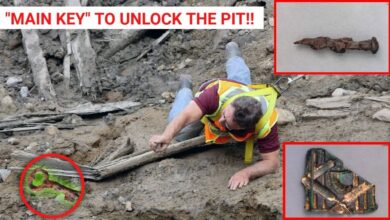
Reports of a timbered hatch—complete with pins, holes, and a heavy stone cap—suggest sophisticated planning underground. Some researchers speculate the stone may have acted as a cipher key or structural control. Others see it as a robust access point to subsurface works. Either way, it reads less like random debris and more like purpose-built infrastructure.
The Gold Fragment: A Spark that Rekindles Hope
The recovery of a small fragment containing gold electrified the team and viewers. On Oak Island, any verifiable trace of gold—however tiny—carries symbolic weight. It doesn’t prove a hoard, but it revalidates the search, encouraging further coring, chemical assays, and tight-area excavations.
The Swamp Anomaly: A Ship Shape Beneath the Muck?
Remote sensing and excavation in the island’s swamp revealed a stone pattern suggestive of a hull outline. If the geometry truly belongs to a vessel—natural formations can mimic man-made shapes—it could redefine Oak Island’s story as a maritime operation with staging, offloading, or concealment functions. A buried ship would knit together theories of pirates, privateers, or Templar-era logistics with a physical anchor.
Subsurface Tunnels: A Labyrinth Underfoot
Oak Island’s subsurface appears to host interlaced tunnels and voids, a pattern more complex than random sinkholes. Whether these routes were designed as flood tunnels, smugglers’ passages, or engineered access lines to protected chambers, their scale suggests organization, labor, and intent beyond casual digging.
Show Highlights: The Finds That Shaped the Modern Hunt
The TV era has produced a steady cadence of artifacts that sustain interest and refine hypotheses:
- Spanish 8-Maravedí Coin (Season 1 finale / Season 2 open)
Found in the swamp, later read as 1652, the coin offered early 17th-century context and credibility to deeper history on the island. - 17th-Century Officer’s Button & Small Coin (Season 2)
A military-style button and a smaller copper coin (possibly 2-Maravedís) hint at military or naval presence and steady activity across decades. - Two Britannia Coins (King Charles II)
Recovered along the shoreline, these 17th-century pieces strengthen the English footprint in or around the island’s waters. - “Templar” Coin Motif (Season 2)
A cross pattern raised the Templar question anew. Stylistic echoes are not proof—but they keep the medieval trail alive. - Grapeshot & Small Horseshoe (Season 5)
Naval ammunition and a mule/pony shoe point to logistics: transport animals on land, and perhaps armed ships offshore. - Garnet Brooch (Season 5)
A hand-cut rhodolite garnet set in silver, dated broadly to the 1500s–1600s, became one of the show’s most valuable personal artifacts. - Gold-Plated Brooch (Season 6)
Though the gem proved leaded glass, microscopy revealed gold elements and medieval stitching, reinforcing the antiquity of high-status items. - Hand-Painted Pottery (Season 8)
Polychrome shards (red/blue/green) along a stone pathway suggest repeated human traffic connected to engineered features. - Trace Gold in Core Spoils (Season 9)
Lab tests identifying measurable gold (e.g., ~0.07% and later ~0.2% Au in samples) encouraged a tighter focus on select boreholes within the Money Pit complex.
What It Could Mean—and What We Still Don’t Know
Taken together, these lines of evidence sketch a portrait of sustained, organized activity: maritime logistics, engineered water control, crafted personal items, and layered subterranean works. They do not, by themselves, prove a single treasure event—or a Templar deposit. But they do justify continuing archaeology, precise geoscience, and conservative excavation.

Oak Island’s power lies in its convergence: colonial coins, possible medieval motifs, engineered features, and anomalous materials (like coconut fiber) all pointing to human design across centuries.
The Road Ahead: Method, Patience, and Provenance
The smart path forward is clear: provenanced artifacts, repeatable lab results, peer-reviewed reports, and context-rich excavation. Each controlled find matters more than a dozen ambiguous ones. The goal isn’t just spectacle; it’s a timeline solid enough to withstand scrutiny.
Whether the Money Pit hides a trove or simply the remains of an audacious engineering feat, Oak Island’s greatest treasure may be the story itself—a layered narrative of sailors, soldiers, merchants, and mystery-makers who turned a small Atlantic island into a centuries-long riddle.