The Curse of Oak Island – Season 13, Episode 4: Layers of Evidence Push the Mystery Centuries Deeper
Season 13 of The Curse of Oak Island continues to accelerate, and Episode 4 is one of the most revealing installments in years. From deep-drilling at the Money Pit to medieval-era artifacts emerging on Lot 5 and engineered structures resurfacing in the swamp, the episode delivers a wave of discoveries that collectively push Oak Island’s story far earlier than 1795.
Several major threads define this episode:
- the evolving “solution channel” theory at the Money Pit,
- the spread of man-made structures across the island,
- and an accumulation of Old World artifacts hinting at medieval European activity.
![The Curse Of Oak Island | Season 13 Episode 4 Preview [HD] [2025]](https://i.ytimg.com/vi/HG5L3udqOO0/hq720.jpg?sqp=-oaymwEhCK4FEIIDSFryq4qpAxMIARUAAAAAGAElAADIQj0AgKJD&rs=AOn4CLD3ksHunWuTwiWuYxRAELe2c4Yghw)
The Money Pit: The Solution Channel Theory Gains Its Strongest Evidence Yet
The episode opens with the team drilling borehole F5.5, strategically placed only seven feet from F4—one of the most anomalous holes ever tested for gold and silver. The hope is clear: if a geological void, or “solution channel,” exists beneath the Money Pit, this new hole might penetrate the cavity into which treasure could have fallen during historic collapses.



Excitement spikes when the drill returns a small, dense metal fragment—initially suspected to be a coin. Although identified as a carbide drill-bit button, its presence proves something far more important:
Heavy metal objects do migrate downward into bedrock voids.
For the team, this is physical proof that treasure—if it ever existed in the upper levels—could have moved into deeper chambers over centuries of flooding and collapse. The find isn’t treasure, but it validates the model of where treasure might be.
The Western Swamp: A New Engineered Structure Emerges
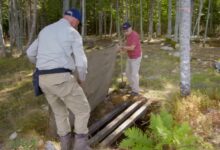
Meanwhile, Rick Lagina, Billy Gerhardt, and Gary Drayton return to the swamp’s western edge—an area historically overshadowed by the stone road and paved area.
What they find is stunning:
- Dozens of wooden stakes tightly clustered within a 50×50 ft area
- A sand layer beneath them—an unnatural presence in this part of the swamp
- And most dramatically, a stone feature resembling both the stone road and the massive paved structure from previous seasons
Dr. Ian Spooner immediately notes the architectural parallels. The stakes and stones look like part of a larger engineered system—possibly the remains of a transportation network, working platform, or medieval-era construction.
With environmental permits pending, excavation will soon push northward. If this feature connects to the earlier structures, the swamp may represent the single largest man-made complex on the island.

Lot 5: Medieval Lead, 17th-Century Tools, and a Mysterious Stone Circle
Lot 5 continues to astonish.
A. Lead Artifact Matches Medieval Patterns
Emma Culligan’s XRF analysis reveals that a lead artifact from the site is free of modern alloys, consistent with pre-1700 metallurgy—and possibly linked to the medieval lead cross and token previously matched isotopically to 14th-century southern France.
Laser ablation testing is now underway.
B. A 17th-Century Tool
Fragments first thought to be medieval horse tack are identified instead as 17th-century iron shear handles, still remarkably intact despite saltwater exposure.
They confirm European presence on Lot 5 at least a century before the discovery of the Money Pit.
C. A Circular Stone Formation
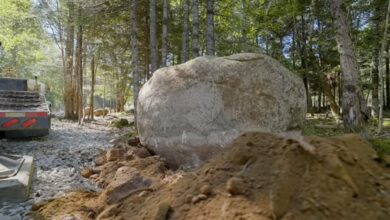
Rick and Gary discover a carefully arranged circular feature with a central upright slab—too deliberate to be natural. Combined with the nearby Roman coins, it suggests ceremonial, navigational, or boundary purposes.
Archaeologist Laird Niven orders a bisected excavation to reveal its function.
A Potential Medieval Firearm Fragment Changes the Tone
One of the episode’s most dramatic finds comes late:
Gary retrieves a heavy iron piece that may be part of a petronel, a short-barreled firearm used between the 14th and 16th centuries—often by cavalry.
If confirmed by CT scanning, it would:
- be one of the oldest weapons ever found on Oak Island
- imply armed personnel were operating on the island
- and potentially connect the site to early Portuguese, French, or Templar-related expeditions
This single find could reshape interpretations of who worked here—and why they needed protection.
The Bigger Picture: A Multi-Century, Multi-Cultural Footprint
Episode 4 doesn’t present a single breakthrough. Instead, it reveals a convergence:
- The Money Pit provides geological proof that dense objects sink into deep voids.
- Lot 5 continues producing medieval and early European artifacts.
- The swamp unveils engineered constructions consistent with medieval-style work.
- Lead artifacts repeatedly match isotopic signatures from medieval France.
- And now, possible firearm components suggest a guarded operation.
Taken together, these finds imply Oak Island was visited not once but multiple times across centuries—by organized, well-equipped European groups.
Far from random clues, the discoveries increasingly suggest intentional occupation, engineering, and possibly treasure deposition long before 1795.
Closing Thoughts: Oak Island’s Story Is Getting Older—and Sharper
As Episode 4 closes, the island’s narrative grows clearer:
Oak Island is no longer merely a rumored treasure site.
It is a layered, engineered, and occupied landscape—home to multiple European visitors over hundreds of years.
And the Money Pit, Lot 5, and the swamp now appear to be connected pieces of a single, far older puzzle.
Season 13 is shaping up to be the year when the question shifts from what is buried here to who was here, when—and why.