Oak Island’s Lot 5 Well May Be Far Older Than Anyone First Believed
Marty and Gary return to a promising area on Lot 5
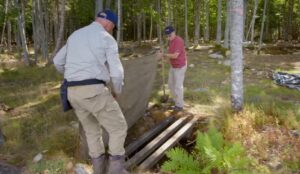
Marty Lagina and Gary Drayton head back to Lot 5 with a clear purpose. The area between the rounded stone feature and the shoreline has already produced clues that hint at unusual age and significance, and now their attention is turning to a covered well nearby. At first glance, it may seem like a secondary feature. But on Oak Island, places that look ordinary often become the ones that matter most.
That possibility has only grown stronger since Professor Adriano Gaspani examined the nearby round feature and suggested that its alignment with the stars may date it to the early 13th century. If that interpretation holds, then the space around the well could become even more important. It would no longer be just an isolated structure. It would be part of a wider medieval-era context on Lot 5.
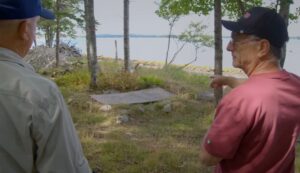
The team already has reason to take that possibility seriously. A bronze button and a spike previously found in the same area have been scientifically dated to the 13th century. That means the ground around the well is already associated with older material than many once expected.



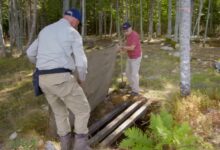
A supposed modern well begins to look much less modern
When the fellowship first acquired Lot 5, earlier interpretations suggested that the covered well was likely a modern feature. That assumption was based in part on records linked to the lot’s former owner, Robert Young. But as Marty and Gary begin examining the site more closely, doubts quickly begin to emerge.
One of the first things Marty points out is how strange the well’s position seems. If it was dug as a water source, why place it so close to the ocean. That question alone does not prove age, but it does make the feature harder to dismiss as a straightforward recent structure. Then comes the deeper surprise. Once Marty steps down inside, he realizes the well extends farther than expected. The floor beneath him is unstable, made up largely of leaves and soft material, and it becomes clear that they are nowhere near the true bottom.
That detail changes the conversation. If the feature is deeper than assumed and still partially filled, then its story is far from finished. It also means that the absence of obvious metal in the upper levels does not settle anything.
A metal find near the well shifts the mood
The real breakthrough comes when Gary gets a strong signal near the well. The sound suggests a deep non-ferrous target, and after moving a rock, Marty begins digging carefully into the spot. The result is a heavy iron object that immediately draws attention. At first, it looks like a hook. But Gary and Marty quickly begin considering another possibility: a pintle.
That possibility matters because the team has already found two other possible pintles elsewhere on Oak Island this season. One came from Lot 15, northeast of the Money Pit, and another from near the boulder feature on Lot 8. If this Lot 5 object belongs in the same family, then it may suggest a larger pattern linking multiple zones across the island.
Even before lab testing, the object feels important. Gary notes that pintles on Oak Island have often been associated with older features, and the fact that this one came from near the well only makes the location look more promising.
The lab confirms the object is old, even if its exact purpose remains uncertain
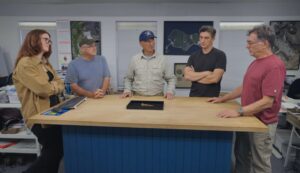
Later in the day, the object is taken to the lab, where Emma Culligan and Laird Niven join Alex, Gary and Marty to evaluate it. The piece has been cleaned enough to allow closer analysis, and while the team leans toward identifying it as a hook rather than a pintle, the more important finding concerns its age.
Emma explains that the iron contains minimal impurities and no modern alloying elements, placing it before the 1800s. More specifically, the lack of potassium in the base metal points most likely to the mid-1700s. That conclusion is significant for two reasons. First, it confirms the object is genuinely old. Second, it suggests the well cannot be brushed aside as purely recent if an item of that age is being recovered from its immediate surroundings.
Marty quickly recognizes the implication. If the metal dates to the mid-1700s, then earlier assumptions about the well’s modern origin are already under pressure. The ground around it is telling a different story.
The well’s stone setting adds to the mystery
Laird then points to another detail that increases interest in the feature. The well is encircled by stones, and that arrangement appears visually similar to the nearby rounded feature that has already produced artifacts ranging from the 13th to 17th centuries. This resemblance may not prove the same date or purpose, but it makes the well harder to separate from the broader pattern emerging on Lot 5.
That matters because Oak Island often reveals itself through association rather than single dramatic discoveries. A hook on its own is only a hook. A well on its own is only a well. But when an old iron object, a stone-ringed formation, medieval-era finds, and an apparently deeper-than-expected shaft begin clustering in the same area, the meaning of each element starts to change.
Laird also raises another practical reason for taking the well seriously. Wells are natural places for objects to fall in. People lean over them, drop items accidentally, and in some cases even use them to conceal things deliberately. That alone makes the base of the well especially interesting from an archaeological point of view.
The bottom of the well may hold the real story
By the end of the discussion, one point is clear: the team has not come close to exhausting the well. Marty and Gary both know they never reached the bottom. The unstable leaf-filled material underfoot suggests there are still deeper levels waiting below, and possibly preserved objects as well.
That is why the potential rewards now seem so important. If the upper portion of the feature can already produce an old iron object and raise serious doubts about the well’s supposed modern date, then the deeper layers may contain much more revealing evidence. Pottery, glass, tools, or additional metal items could all be waiting once the archaeologists are able to explore it properly.
Laird agrees that the well deserves much more attention, and Marty appears convinced. Even if the team is temporarily tied up with work on Lot 8, the conclusion is obvious. They will need to come back, reevaluate the well in a more systematic way, and find out exactly how deep it goes.
Lot 5 continues to become more important
For years, the major focus on Oak Island has centered on the Money Pit and the surrounding core mystery zone. But Lot 5 is steadily becoming one of the island’s most intriguing areas. Each new clue there seems to suggest not random occupation, but repeated activity across multiple centuries.
The possible medieval alignment of the round feature, the earlier 13th-century finds, and now an older-than-expected iron object near a well that may itself be misdated all push the same idea forward: Lot 5 may contain a far more significant historical footprint than first believed.
That does not yet explain exactly who was there or why. But it does mean the old assumptions are weakening. And on Oak Island, once assumptions begin to collapse, the search usually becomes much more interesting.
A simple feature may become a major lead
In the end, the most striking part of this discovery is how ordinary it first seemed. A covered well might not look like the kind of feature that transforms a season. Yet this is exactly the type of place where Oak Island has often surprised the team before.
What began as a quick search around a supposed modern well has turned into a much bigger question. If the iron object is old, if the well is deeper than expected, and if the surrounding stonework connects visually and historically to other important features on Lot 5, then the well may prove to be far more than a forgotten structure. It may be one of the next places where the island begins giving up a more coherent part of its history.