The Gold Within: How Science Unlocked Oak Island’s Biggest Clue Yet
A Modern Scientist in a Centuries-Old Mystery
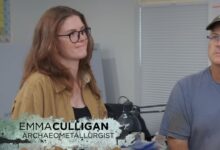
Deep beneath the surface of Oak Island, where pirate legends and buried treasure theories have swirled for generations, a modern scientific breakthrough has shifted the momentum. At the center of it is Emma Culligan—a metallurgical analyst whose work is rapidly becoming central to solving one of North America’s oldest unsolved mysteries.
Trained in both engineering and archaeology at a university in Newfoundland, Culligan was first drawn into the Oak Island project due to her rare ability to navigate chemistry, artifact preservation, and advanced testing technologies. Her unique skillset quickly made her indispensable to the team.
Detecting Gold in Oak Island’s Wood
Emma’s work involves using non-destructive analytical tools like portable XRF (X-ray fluorescence) scanners—machines capable of detecting the elemental makeup of objects without damaging them. These scans can pick up microscopic traces of metals like iron, copper, and, crucially, gold.
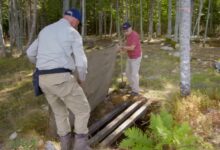
One of her scans—performed on what appeared to be an ordinary timber fragment from the Garden Shaft dig site—revealed something astonishing: gold embedded within the wood. Not visible flakes or nuggets, but measurable quantities, amounting to 0.11% of the wood’s surface material.


For the uninitiated, that number may sound small. But in archaeological metallurgy, it’s significant. Gold does not casually occur in wood, especially centuries-old timbers pulled from deep underground. The reading was consistent, repeatable, and impossible to ignore.

Science Trumps Speculation
The gold detection wasn’t a one-off. Follow-up scans on other artifacts, including nails and wood fragments from the same tunnel system, produced similar results. These findings have added a level of scientific validation to what was once considered fringe folklore: that someone buried something of value beneath Oak Island—and took great care to conceal it.
Importantly, Culligan’s method avoids damaging artifacts. Her surface-level readings, measured in weight percent rather than parts per million, are ideal for archaeological materials. This allows researchers to identify elemental presence without compromising historical integrity.
How Gold Could Appear in Wood
While the exact source of the gold remains unknown, there are several scientific explanations. One possibility is that trees and timbers absorbed trace elements from gold-rich soil or groundwater. Another, more provocative theory is that the wood was part of a container, shaft, or vault that housed refined gold for an extended period.
This wouldn’t be the first time gold was found in plant life. In Australia and Canada, researchers have documented gold particles in tree leaves growing over gold deposits. But finding it inside processed wood—especially at depth and within the structure of an ancient tunnel—is unusual.
Scaling Up the Research Operation
What began as a small research room is now a full-scale, year-round lab outfitted with high-grade equipment—scanners, readers, and metal analyzers—handling materials from across Nova Scotia and beyond. Emma’s lab is now seen as a regional hub for cutting-edge artifact analysis.
The tools she uses aren’t commonplace. Many cost tens of thousands of dollars and require precise calibration. Small shifts in scanning position can significantly affect results, making Emma’s role not just technical, but interpretive. She must understand not just what the data says, but what it means in a historical context.
From Junk to Clues
Not all artifacts that cross her desk turn out to be historic. Some turn out to be modern contaminants or false leads. But the pattern is changing. Increasingly, materials pulled from Oak Island’s Garden Shaft are proving to contain real, measurable evidence of historical metallurgy—namely, traces of gold and silver.
These findings, combined with consistent alignments in tunnel structures and artifact dating that goes back to the 1500s, are shifting the perception of the site. What was once dismissed as myth or coincidence is now being reevaluated through the lens of hard data and scientific rigor.
Conclusion: The Data Doesn’t Lie
With every scan, every fragment of wood, every old nail, the picture becomes clearer. Oak Island may not be just a legend site—it may be a real historical repository, carefully constructed, sealed, and forgotten… until now.
Emma Culligan’s work doesn’t offer spectacle. It offers proof. In a field long dominated by speculation, that might be the most valuable treasure of all.