Breakthrough Discoveries in the Garden Shaft and Beyond
New Tunnel Confirmed at E5N14
In a significant development, the drilling team has confirmed the existence of a tunnel approximately 100 feet below the surface at borehole E5N14. This tunnel, running east-west, aligns precisely with historical expectations of a tunnel that may lead toward the original Money Pit or the fabled treasure vault. The discovery is located just 4 feet away from the Garden Shaft, raising the possibility that both structures are part of a broader underground system.
This finding supports the longstanding theory that an engineered tunnel system was built to facilitate either the deposit or recovery of treasure. Core samples retrieved from the borehole show signs of wood structures and disturbed earth consistent with tunnel activity.

Aladdin’s Cave Tunnel Mapped and Analyzed
Further analysis in the Garden Shaft has provided a more detailed understanding of the mysterious “Aladdin’s Cave,” a void encountered at a depth of 95 to 99 feet. The team used a borehole camera to re-enter the chamber and confirmed the presence of an open cavity with a defined roof and floor structure. The void is estimated to be nearly 4 feet high with standing water at the bottom.



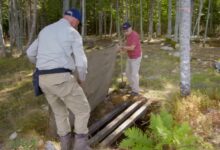
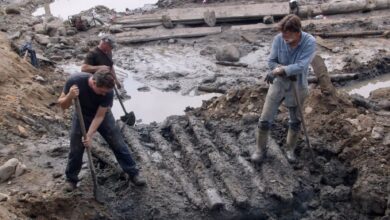
Adjacent to this, at a depth of 104 feet, drilling encountered wooden structural remains believed to be part of a tunnel extending toward the Money Pit. Additional core samples taken from 106 to 111 feet revealed stacked layers of wood, further indicating human construction. These tunnel remnants align closely with the known trajectory of the Garden Shaft tunnel and suggest a purposeful design.
Evidence of Metal and Gold in Water Samples
Recent water tests taken from boreholes near the Garden Shaft—including E5N14—have shown elevated concentrations of metals. Notably, silver and gold were detected in trace amounts, reinforcing the idea that valuable materials may be nearby. The team has previously speculated that a treasure cache, possibly associated with the Knights Templar or other early explorers, could still be intact within these lower tunnel systems.

Explosive Discovery on Lot 5
On Lot 5, archaeologists uncovered a large, corroded metallic object buried just beneath the surface. Initially appearing as a rusted fragment, closer inspection revealed that it resembled part of a cannon or culverin. The size, shape, and curvature of the iron piece suggest it could be from a 16th- or 17th-century shipwreck or coastal fortification.
This find aligns with other military-style artifacts recovered on Lot 5, including the previously discovered lead disc and a Roman coin. The presence of such an item supports theories that a group with maritime and military experience—possibly connected to European powers or secretive orders—may have used Oak Island for strategic or covert purposes.
Ongoing Excavations and Strategy Shift
With these discoveries, the Fellowship of the Dig has shifted their strategy. Drilling and probing efforts are now focused on tracing the newly identified tunnel at E5N14 toward the east in hopes of intercepting the vault. At the same time, Dumas Contracting has resumed excavation inside the Garden Shaft to reach the deeper levels connected to Aladdin’s Cave.
The team is also preparing to revisit and expand their search on Lot 5, treating it as a possible deposit site or staging area for earlier expeditions. The convergence of multiple lines of evidence—structural tunnels, voids, metallic traces, and historical artifacts—has brought renewed urgency and optimism to the treasure hunt.