An Ancient Textile and Deep Metal Signals Add Weight to the Oak Island Mystery

Season 13, Episode 13 Recap: Testing Their Metal
This is a full recap of The Curse of Oak Island Season 13, Episode 13, titled Testing Their Metal, which originally aired on January 27, 2026. The episode advances two major storylines: the growing significance of the boulder structure on Lot 8 and renewed metal evidence deep within the Money Pit solution channel.
Opening Context and Episode Setup
The episode opens on Lot 8, where the team continues investigating a massive boulder sitting atop a carefully arranged stone structure. Marty Lagina compares the scene to a cinematic booby trap, but the archaeology team quickly clarifies that what lies beneath is far more deliberate than theatrical.
Dr. Spooner and archaeologist Fiona explain that a trench running beneath the boulder has been fully cleared of rubble. Soil staining on the larger rocks suggests they have remained undisturbed for a very long time—possibly predating the original discovery of the Money Pit. Marty notes that this boulder does not appear in any historical searcher records, meaning it represents a modern discovery by the current team rather than a revisited feature.



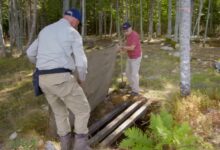
Although Marty is eager to lift the boulder immediately, archaeological protocol requires further hand excavation before heavy equipment can expose what lies beneath.
Money Pit Drilling and New Borehole Evidence
Attention then shifts to the Money Pit area, where a new borehole—J.7-7.5—has been drilled near the edge of the solution channel. This location was chosen due to previous findings of elevated silver and gold traces more than 200 feet underground.
Just two feet from the borehole, the team recovers a fragment of a drill auger dated by Emma to the mid-1800s. This artifact is potentially linked to an 1849 operation overseen by foreman James Piplatto, who famously claimed to have recovered a silver coin before abruptly leaving the site. That story gained new credibility earlier this season when a descendant presented the coin on camera.
Core samples taken between 210 and 218 feet repeatedly trigger metal detector hits. However, once disturbed, the signals briefly disappear—a phenomenon previously observed elsewhere on the island. One explanation offered is that tiny metal particles lose their clustered arrangement once the soil is moved, reducing detectability.
When Katya arrives with more advanced equipment, her detector produces constant signals, confirming the presence of metal particles in the soil. The samples are sent to the lab for further analysis.
Excavation Advances on Lot 8
Back on Lot 8, Marty authorises the use of an excavator to remove large surrounding stones so archaeologists can safely continue hand digging beneath the boulder. Fiona identifies additional stones that must be removed to explore voids between the rock layers and determine whether the structure was built around the boulder or whether the boulder was placed deliberately on a prepared base.
As excavation progresses, Craig Tester sifts spoil material and uncovers a fragment of red-dyed textile. Archaeologist Laird confirms the colouring is a dye and suggests it could be naturally derived if the fabric is historically old. The textile was recovered from approximately 18 inches below the natural surface, beneath the stone structure, indicating it predates the final placement of the rocks.
Laboratory Analysis: A Wool Textile from Medieval England
In the lab, Emma conducts a CT scan of the textile, revealing a weft-knitted structure composed of interlocking loops. While she cannot definitively determine whether the piece was hand-knitted or early machine-made, a burn test provides a clearer answer. The fabric burns and crushes in a way consistent with wool.
This result is particularly significant given the nearby discovery of a 14th-century lead bag seal bearing a sheepskin symbol linked to Leeds, England—a medieval hub of wool production. Emma also confirms the dye contains no modern components, reinforcing the textile’s age and potential historical importance.

Swamp Excavation and Artificial Pathways
Elsewhere on the island, the team continues exploring the northern section of the swamp, following a cobble pathway similar to one that previously led to an empty slate-and-brick vault. Brick fragments embedded beneath the cobbles confirm the pathway is man-made rather than natural.
Although no vault is immediately uncovered, the presence of brickwork at depth supports the theory that the swamp area was engineered for a specific purpose.
War Room Update: Silver Confirmed in the Solution Channel
Two days later, Dr. Spooner delivers updated lab results in the war room. Using X-ray fluorescence (XRF), his team detects significant silver concentrations in multiple boreholes, including K-9.5—located in the deepest section of the solution channel at approximately 217 feet.
These findings reinforce earlier conclusions that the metal is not naturally occurring. The possibility is raised that historical drilling and collapses may have caused metal objects to migrate downward into the solution channel over time.
Given the concentration and consistency of results, Marty concludes that conditions now justify contacting specialists to begin caisson sinking and recovery operations.
What’s Next: Episodes 14 and 15
The preview for Episode 14, The Shining, reveals that further excavation beneath the Lot 8 boulder may uncover evidence of a second Money Pit. Episode 15, Swamped, is expected to return focus to the swamp area, though its air date remains uncertain due to possible scheduling changes.
Closing Notes
This episode strengthens several long-running theories while introducing tangible new evidence—from medieval textiles to confirmed silver deep underground. With excavation expanding on multiple fronts, Season 13 continues to tighten its focus on deliberate construction rather than coincidence.