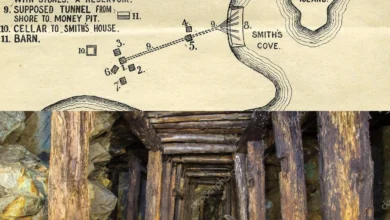
Aladdin’s Cave Revealed: Man-Made Tunnels and the Secret Beneath the Money Pit

Oak Island’s Alarming Turn: Water, Tunnels, and a Flight from the Money Pit
“We’re Not Quitting”
Rick Lagina and the team reaffirm their resolve: they’ll pause remote-sensing, not the investigation. Morale is aligned—no one is walking away from Oak Island’s mystery.
Water Trouble Freezes the Money Pit
A fresh day begins with bad news: persistent inflow is seeping through the Garden Shaft walls, stalling digging at ~87–100 ft. Recent storms don’t fully explain the volume. The crew suspects engineered flooding—possibly the long-rumored flood tunnels—just as they chase a 7-ton target zone near the “baby blob,” where prior testing showed gold and silver traces between 80–120 ft.

Sealing the Leak, Extending the Shaft
Dumas Contracting plans injections of multi-urethane through exploratory holes to seal voids and slow the ~700 gallons/hour inflow. If successful, they’ll push the shaft toward the suspected tunnel. Roger coordinates updates while the fix proceeds.
Lot 5: A Circular Enigma Near the Shore
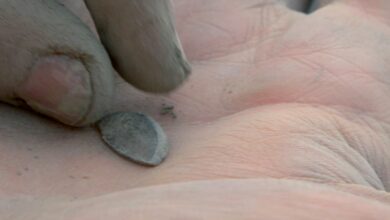
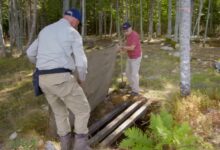
Away from the Money Pit, archaeologists reopen a circular stone feature on Lot 5. Storm checks pass, and excavation resumes. Finds around the structure—linked by some researchers to Sir William Phips and late-1600s Spanish wealth—include a lead trading token that may echo the medieval lead cross found at Smith’s Cove in 2017. Magnetometry hints at an even older footprint beneath.



Aladdin’s Cave: Sonar Maps a Hidden Void
About 60 ft southwest of the Garden Shaft, the team deploys an Echidna 710 sonar into “Aladdin’s Cave.” High-resolution scans reveal straight edges and planar faces unusual for natural cavities. Water samples previously showed wood fibers and precious-metal traces. A 3D model suggests sloping entries and a significant western chamber—potentially man-made.
Drilling L3.5: Eyes in the Dark
Borehole L3.5 intersects an open space at ~141 ft. A panoramic low-light camera drops into the void, returning images of flat walls, angles, and sediment ramps that look engineered. The working theory: Aladdin’s Cave is an access point or storage chamber tied to deeper workings.
Artifacts Speak: 17th-Century Hardware
At the Interpretive Center, Emma Culligan and blacksmith expert Carmen Legge examine Lot 5 finds: a metal band, robust fastener, and a rough hand-wrought nail—consistent with 17th-century chest hardware. Chemistry suggests pre-1800s manufacture, possibly early 1600s. Another Lot 5 recovery—a barrel band using copper and iron—aligns with earlier barrel fragments near the Stone Road/ship’s pier, supporting a historic cargo transfer operation.
Foundations in the Dirt: A Buried Building
Archaeologists Fiona Steele, Moya MacDonald, and Laird Niven track a collapsed stone wall and compact soils rich with iron fragments and nails. Magnetometer data implies four-sided foundations, perhaps a substantial structure intentionally backfilled long before modern searchers—tightening Lot 5’s link to Money Pit activity.

Lead Glass and a Rising Hypothesis
Analysis flags a high-lead “flint glass” gem-cut insert, likely French in origin. Soil profiles on Lot 5 match those from deeper Money Pit contexts—hinting at direct logistical ties. The working model: Lot 5 functioned as a staging ground for depositing valuables below—its artifacts pointing to elite ownership.
Deep Structures, Deeper Questions
GPR, sonar, and cores reveal timbered supports, shaped stone, and straight-cut passages—far beyond random geology. Etchings on a stone slab resemble Masonic/medieval motifs, fueling theories ranging from Spanish caches to Templar-era engineering and the 1746 Duc d’Anville nexus. Layered voids suggest a labyrinth designed to conceal and protect.
The Hidden Chamber
Beneath a sealed slab lies a silted cavity and indications of a larger chamber below. Carefully widened access releases ancient air; a probe glimpses structured space and retrieves a crafted artifact with purposeful detailing—material proof of deliberate subterranean construction.
Where the Evidence Points
- Money Pit: Hydraulic obstacles and purposeful engineering.
- Aladdin’s Cave: Man-made geometry, precious-metal signatures, and sloped entries.
- Lot 5: Chest hardware, barrel logistics, elite-grade lead glass, and a large backfilled foundation—possibly a base of operations.
Conclusion: Not a Pause—A Pivot
Remote sensing may pause, but the investigation accelerates. With sealing work underway, targeted drilling planned, and artifact science converging, Oak Island’s story looks less like legend and more like buried infrastructure—a designed system to hide, move, and guard something of high value.
Subscribe/Follow for updates as the team pursues the chamber, refines the 3D maps, and tests artifacts that could rewrite the island’s past.