The Goonies at 40: A Hollywood Legend With Roots in Real Treasure
A Childhood Obsession Comes Full Circle
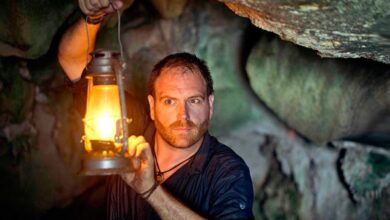
For many fans, The Goonies was more than a film — it was an invitation to adventure. For Josh Gates, it was the spark that ignited a lifelong fascination with legends, lost treasure, and historical mysteries. Now, as The Goonies marks its 40th anniversary, Gates finds himself on the Oregon coast investigating the remarkable truth behind the story that inspired the movie.
What begins as nostalgia quickly turns into something far more compelling: evidence that the legendary treasure of the Goonies may be rooted in a real, centuries-old mystery.





A Real Legend Behind the Fiction
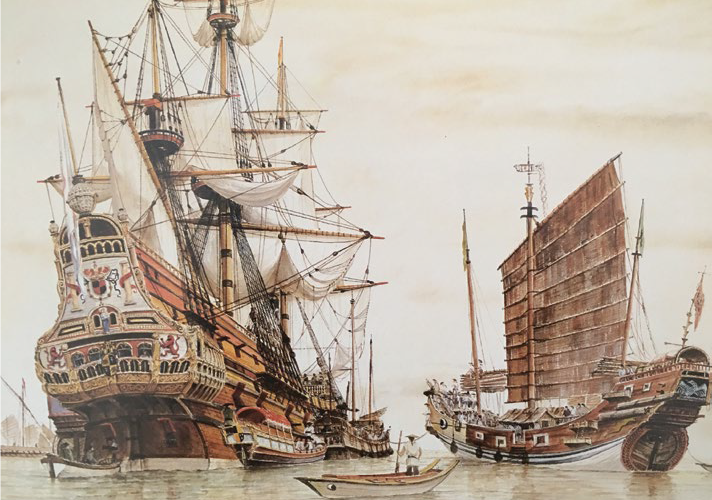
Local folklore along the Oregon coast has long told of a Spanish treasure ship wrecked during the late 17th century. According to historians, Spanish galleons once sailed from Manila across the Pacific, carrying valuable cargo destined for the Americas. These ships were loaded with silk, porcelain, spices — and enormous quantities of beeswax, a commodity once worth its weight in gold.
One such vessel is believed to have been blown far off course during a storm and wrecked somewhere near modern-day Astoria.
The Beeswax Wreck Mystery
Over generations, extraordinary discoveries have supported this legend. Nearly 90 tons of beeswax have been recovered from Oregon beaches, some pieces stamped with Spanish shipping marks. Indigenous communities used the wax to waterproof canoes, start fires, and trade with settlers. Later, homesteaders reportedly mined it directly from the sand.
Archaeological testing dated the wax and fragments of Chinese porcelain to a narrow window between 1680 and 1700. That timeline points to a single missing ship: the Santa Cristo de Burgos, a massive Spanish galleon that vanished in 1694 with a cargo estimated at more than 1,500 tons.
Physical Evidence Emerges
The case grew stronger when ship timbers were discovered embedded in a sea cave along the coast. Analysis revealed the wood was Asian hardwood from the Philippines — material used exclusively in Manila galleons. Only a handful of such wrecks have ever been identified in North America, making the find historically extraordinary.
For treasure hunters and historians alike, the implication is staggering: where a shipwreck exists, cargo may not be far behind.
Searching the Goonies Coastline
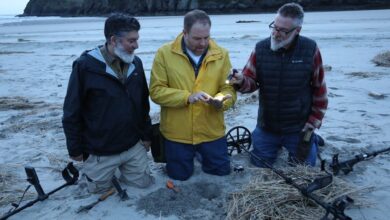
Gates and his team explore iconic locations tied to the film, including the famous Goonies house in Astoria, before shifting focus to the beaches below. Armed with metal detectors and local expertise, they begin combing the shoreline.
The first breakthrough comes unexpectedly: a fragment of blue-and-white Qing Dynasty porcelain, unmistakably Chinese and more than 300 years old. Such pieces have sold for millions at auction when intact. Finding one in the sand confirms that valuable cargo did, in fact, reach this shore.
Artifacts From a Lost Galleon
Soon after, a heavily encrusted iron spike emerges from the rocks — bent, aged, and unmistakably maritime. Experts confirm it is a ship’s spike, likely torn free during the violent wrecking of a large vessel. Its location near the previously discovered timbers suggests it belongs to the same ship.
These finds reinforce the idea that this coastline was once the site of a catastrophic wreck — and that more artifacts remain buried nearby.

The “X Marks the Spot” Theory
Using historical photographs and geographical landmarks, researchers identify a stretch of land matching early documentation of the wreck site. High tide would have submerged much of the area, making it plausible that survivors or pirates carried valuable cargo inland for safekeeping.
Attention turns to higher ground beyond the beach, where detectors soon uncover an old square-headed nail — the kind used in 17th-century ship chests.
Where nails exist, chests may follow.
A Stunning Discovery
As daylight fades, the search delivers its most remarkable find: a broken religious medallion bearing Spanish inscriptions and iconography associated with Our Lady of the Pillar, the patroness of Spain. Such talismans were commonly carried aboard Spanish ships.
Experts agree the medallion almost certainly arrived on a Spanish vessel, making it one of the clearest personal artifacts yet linked to the lost galleon.
The Goonies, Rewritten by History
Standing on the Oregon coast, holding centuries-old artifacts, the connection becomes undeniable. The Goonies may have been a fantasy — but the treasure, the ship, and the story behind it are real.
This is not just a movie anniversary. It is the rediscovery of a legend that never truly faded. And somewhere beneath the sand and trees of the Oregon coast, more secrets from the Santa Cristo de Burgos may still be waiting.
Just like the Goonies always believed.