Perched Above the Abyss: The Fortress of Predjama
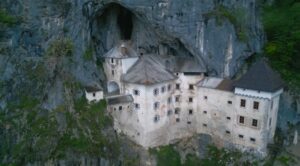
Rising dramatically from the mouth of a cave halfway up a 400-foot cliff, Predjama Castle is often described as the largest cave castle in the world. Built into the rock face in the 12th century, it was engineered to be nearly impregnable — a fortress fused with nature itself.
Strategically positioned along a vital South European trade corridor serving the Holy Roman Empire, the castle commanded movement through the region. Its location alone made it powerful. Its design made it formidable.

The Rise of the Luegg (Lug) Family
In 1274, control of the castle passed to the Luegg (Lug) family, and Predjama’s reputation darkened quickly. The stronghold became associated with banditry and ransom schemes. Local villagers were reportedly abducted and held within the castle’s shadowed chambers, their fate often determined by unpaid demands.
The castle’s most infamous master was Erasmus of Lueg (Erazem Predjamski). Inheriting the fortress in the late 15th century, Erasmus cultivated the image of a rebel noble — and, according to legend, a ruthless outlaw.




Siege by an Emperor
In 1483, Erasmus allegedly killed a marshal connected to Frederick III, cousin to the emperor. The response was swift. Imperial forces laid siege to Predjama.
But breaching a castle embedded within a cliff proved nearly impossible.
Rather than surrender, Erasmus endured the siege in defiance. Local legend claims he relied on hidden tunnels running through the cave system behind the fortress, allowing secret resupply routes to the outside world. While soldiers waited below, Erasmus supposedly dined comfortably within.
The stalemate lasted nearly a year.
It ended abruptly when a well-placed cannon shot — guided, according to folklore, by a servant’s betrayal — struck the very room where Erasmus was said to be.
His death brought the Luegg family’s violent chapter to a close.
Architecture of Defiance
Predjama’s defensive advantage was not myth alone. Its cave integration provided:
- Natural rock shielding
- Limited access points
- Elevated firing positions
- Concealed internal passages
The combination of medieval stone engineering and karst geology made it one of Europe’s most unusual fortifications.
Today, the castle stands restored and open to visitors, a blend of documented history and enduring legend.
A Haunted Legacy?
Over time, Predjama Castle has developed a reputation beyond warfare and rebellion. It is frequently cited as one of Europe’s most haunted sites.
Reports from guides and visitors include:
- Unexplained footsteps echoing in empty corridors
- Doors slamming without visible cause
- Sudden physical sensations, including being pushed
- Sightings of a shadowy knight-like figure
Folklore often links the apparition to Erasmus himself — a restless presence said to patrol the halls he once defended.
While no empirical evidence supports paranormal claims, the atmosphere of the cave fortress — damp stone, narrow passages, and centuries of conflict — naturally amplifies imagination.
Between Legend and History
Predjama Castle embodies the intersection of medieval politics, outlaw legend, and architectural ingenuity. Whether Erasmus was a freedom fighter, a brigand, or something in between depends on perspective.
What remains certain is this: few structures in Europe so dramatically merge landscape and fortress. Few hold such a layered narrative of rebellion, siege, and myth.
If its walls could speak, they would tell a story not only of violence and defiance — but of survival carved directly into stone.