Oak Island Team Discovers Possible 1600s Artifact in Ongoing Lot 5 Investigation

New Artifacts on Oak Island’s Mysterious Lot 5 Deepen Centuries-Old Puzzle
Oak Island’s Lot 5 has once again emerged as one of the most compelling archaeological sites on the island, as new discoveries continue to suggest that its history may stretch back much further than historians once believed. With Roman coins, medieval lead objects, and now 17th-century metalwork uncovered within meters of each other, researchers say the area may hold vital clues to understanding who visited or occupied Oak Island long before the discovery of the Money Pit in 1795.

Renewed Activity on Lot 5
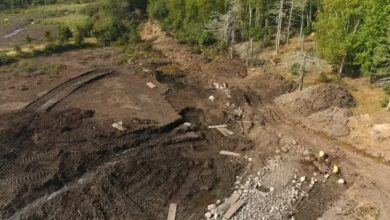
In the latest round of exploration, team members Rick Lagina and expert metal detectorist Gary Drayton focused their search on the center of Lot 5. This area has already produced six ancient Roman coins—objects that coin expert Sandy Campbell estimates to be between 1,500 and 2,000 years old. According to historians, Roman coins were still circulating as everyday currency until the 1400s, making their presence on a North Atlantic island highly unusual.
Building on these earlier finds, the team returned to search for additional evidence of early European presence. Their first discovery of the day was an elongated piece of lead, unusually heavy and similar in shape to other lead objects previously recovered in the area. Because the team has found medieval-style lead artifacts before—including the well-known lead cross—they immediately flagged the item for laboratory analysis.




Discovery of Metal Fragments Raises New Questions
Moments later, Drayton and Lagina uncovered two additional metal fragments. At first glance, they appeared to be broken handles from a pair of old scissors. However, field observation raised another possibility: the fragments might be part of a horse bridle. This prompted renewed speculation because, according to historical records, Lot 5 was not used as farmland or as a grazing area prior to 1795.
If the pieces were indeed related to horse equipment, they could indicate previously unknown human activity on the lot centuries before settlement. The team decided to send the fragments to the Oak Island research lab for further analysis.
Laboratory Findings Confirm a 17th-Century Origin
At the lab, archaeologist Laird Niven and scientific analyst Emma Culligan examined the fragments using cross-section analysis and compositional testing. Their first conclusion was that the pieces did not originate from a horse bridle. The cross-sections revealed different shapes, proving the fragments did not come from a single break and were instead two components from a pair of scissors or shears.
Culligan’s metallurgical assessment offered additional insight. The fragments contained minimal impurities—characteristic of metal produced before the widespread use of blast furnaces. Slight chlorine and sodium values also indicated prolonged exposure to saltwater. Based on stylistic comparisons with historical examples and the material’s purity, the lab concluded the artifact likely dates to the 1600s, and possibly the late 1500s.
A reference book on historical shears confirmed the match: the pieces were nearly identical to documented examples from the 17th century.

Implications for Oak Island’s Early History
The discovery adds another layer of complexity to Lot 5, which has already produced artifacts spanning multiple centuries and cultures. Although the scissors do not prove a direct connection to the Money Pit or any single group—such as Templars, early explorers, or settlers—they reinforce the idea that the area saw human activity long before official records suggest.
Rick Lagina noted that Lot 5 remains one of the most enigmatic areas on the island, rivaled only by the Money Pit in its complexity. Each new artifact, he said, brings researchers “one step closer” to understanding the site’s early history, even if individual finds remain puzzling.
Next Steps in the Investigation
With fresh evidence pointing to early European activity, the team intends to continue metal-detecting and excavation on Lot 5. Their goal is to determine whether the artifacts represent isolated losses or the remnants of a larger, undocumented operation on the island.
As exploration advances, Lot 5 may yet prove to be a key location in unraveling Oak Island’s oldest and most enduring mysteries.