New Discoveries on Oak Island’s Lot 5 Deepen Historical Mystery
Significant activity continues on Oak Island’s Lot 5, where team members Rick Lagina and Gary Drayton are conducting targeted metal-detection work in an area that has already produced some of the site’s most intriguing evidence. Previous discoveries here—most notably six Roman coins that expert Sandy Campbell dated to between 1,500 and 2,000 years old—have fueled theories that Europeans may have reached the island as early as the 13th century.

During a recent search, Drayton uncovered another piece of lead, elongated and unusually heavy. The team noted its resemblance to earlier finds, including the well-known medieval-style lead cross. The artifact was flagged for analysis, with the expectation that laboratory testing by Emma Culligan may reveal whether it is related to the earlier lead discoveries.
Shortly after, Drayton and Lagina made a second discovery: two metal fragments initially believed to be parts of old scissors. A closer field inspection, however, led to speculation that the items might instead be components of a horse bridle—an unexpected possibility, given that Lot 5 was not historically used as farmland or for grazing.




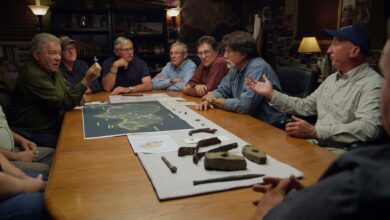
The fragments were sent to the island’s research lab for detailed examination. There, Emma Culligan and metal analysis expert Laird Niven determined that the pieces did not originate from a horse bridle. Cross-sectional comparisons showed they were not from the same break, confirming they were two separate handles from a pair of shears or scissors.
Metallurgical testing revealed additional insights. The metal showed signs of prolonged contact with saltwater and contained minimal impurities, indicating it predated the blast-furnace era. The results suggest the artifact dates to the 1600s, potentially even the late 1500s. Stylistic comparisons with historical examples supported this conclusion, matching known shear designs from the 17th century.

While the find does not establish a direct connection to the Money Pit, it adds to a growing body of evidence that Lot 5 was occupied or visited long before the island’s 1795 discovery. With numerous artifacts from various eras emerging from the same area, Lot 5 remains one of the island’s most difficult—and potentially revealing—locations to interpret.
The team plans to continue metal-detecting and excavation in the area as they work to determine who may have been on Lot 5 centuries before modern exploration began.