Oak Island Team Confirms Discovery of Rare Roman Coin Dating Back to 250–270 AD
A new episode of The Curse of Oak Island delivered one of the most compelling archaeological revelations in recent seasons: another ancient Roman coin found on Lot 5 — and this one dates firmly to the reign of Emperor Claudius II in the 3rd century AD.
The discovery has reignited debates about early European contact in Nova Scotia and deepened the mystery surrounding the island’s multigenerational activity.

CT Scan Confirms Coin Origin: “Roman, Without a Doubt”
The episode opens with Rick and Marty Lagina gathered in the Oak Island lab, where Emma Culligan unveils high-resolution CT scan images of the newly recovered coin.




Key findings include:
- A left-facing standing figure
- Clear “officina N” markings identifying the ninth workshop
- A right-facing bust with the distinctive sharp nose and chin associated with Claudius II
- Metal composition consistent with Roman alloy mixtures
“Roman, baby,” Marty remarks as the team reacts to the confirmation.
According to the analysis, the coin dates to 250–270 AD, making it nearly 1,800 years old.
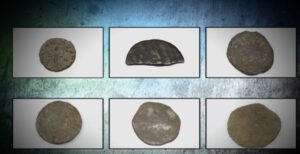
This marks the sixth Roman coin uncovered in the same area of Lot 5 — a highly unusual concentration for Nova Scotia.
Archaeologists Expand Work on Lot 5
Nearby on Lot 5, archaeologist Fiona Steele continues excavations around a rounded feature near the shoreline. The team uncovers several significant artifacts:
- A large, glossy earthenware bowl dated between 1600–1800
- Additional pottery fragments
- Evidence of multi-layered human activity spanning centuries
“There are no records of anyone living here,” Fiona notes, “so every piece adds to the puzzle.”
The discoveries strengthen the theory that multiple groups used Oak Island at different times — possibly including European visitors long before recorded settlement.
Roman Expert: “This Is Clearly Empire-Period — But How Did It Get Here?”
Rick and Doug later meet with numismatist Sandy Campbell, who confirms the coin’s authenticity without hesitation.
Campbell offers two key insights:
- Roman coins circulated widely as currency into the 1500s.
- Their presence on Oak Island raises a critical question: Who brought them?
He notes that Roman coins have been found at several Templar-linked sites in Europe and Iceland, adding another layer of intrigue.
Doug Crowell suggests the coins may have belonged to the people who engineered the original Money Pit:
“They could’ve been carrying this as currency in their pockets.”
Campbell agrees it is a “distinct possibility.”
A Growing Pattern: Roman, Templar, and Early European Links
The team reflects on the mounting evidence:
- Six Roman coins found on Lot 5
- Venetian trade beads possibly linked to the Knights of Malta
- Artifacts dating from 1600, 1700, 1800
- Geological anomalies beneath the Money Pit suggesting engineered structures
Rick summarizes the team’s position:
“It’s incredibly interesting — and bizarre — that Roman coins are showing up on Oak Island. The mystery only deepens.”