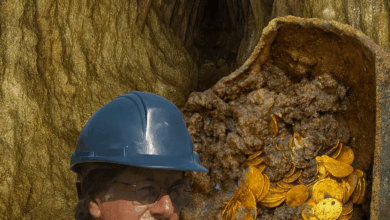
The Curse of Oak Island Season 13 Episode 3: They Finally Touched The Treasure!

Oak Island Season 13: Roman Coin Discovery Raises Stunning New Historical Questions
Episode 3 of The Curse of Oak Island Season 13 — titled Medieval Intentions — marks a major turning point in the long-running investigation. New discoveries made this week are not only significant archaeologically, but they also raise a deeper question: could Oak Island’s mysterious activity date back not just centuries, but millennia?

Roman Coin Discovery Shocks the Team
At the center of the episode is a remarkable find: a Roman coin recovered from Lot 5.
XRF analysis and CT scanning confirmed that the artifact is a coin minted during the reign of Claudius II, who ruled Rome from 268–270 AD.
Analyst Emma Culligan identified copper, iron, calcium, silicon, and silver — a chemical fingerprint consistent with ancient Roman alloy. Numismatics expert Sandy Campbell later reinforced this conclusion, noting that Nova Scotia has no record of Roman coins being found anywhere outside Oak Island.



Even more surprising: Lot 5 has now produced six Roman coins from the same era.
This raises a profound question:
Were these merely souvenirs — or the pocket change of people who worked on Oak Island more than 1,700 years ago?
Adding to the mystery, the metal composition of the Roman coin matches elements detected deep within the “solution channel” beneath the Money Pit — suggesting a possible link between surface artifacts and the engineering below.
Swamp Excavation Reveals Hand-Carved Stakes
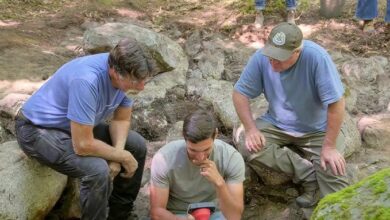
While Lot 5 delivers historical surprises, the swamp continues to produce evidence of ancient activity.
A new unexplored area on the western side of the swamp — just 180 feet from the medieval stone feature found earlier — was opened for excavation.
Immediately, the team uncovered hand-sharpened wooden stakes, carved with an axe rather than a saw. These match earlier stakes dated between 1630–1700, previously found near the cobbled path in the center of the swamp.
These objects suggest intentional construction, not random debris. They may represent a route or support structure designed to move heavy materials — a critical detail if the swamp served as a staging or concealment area.
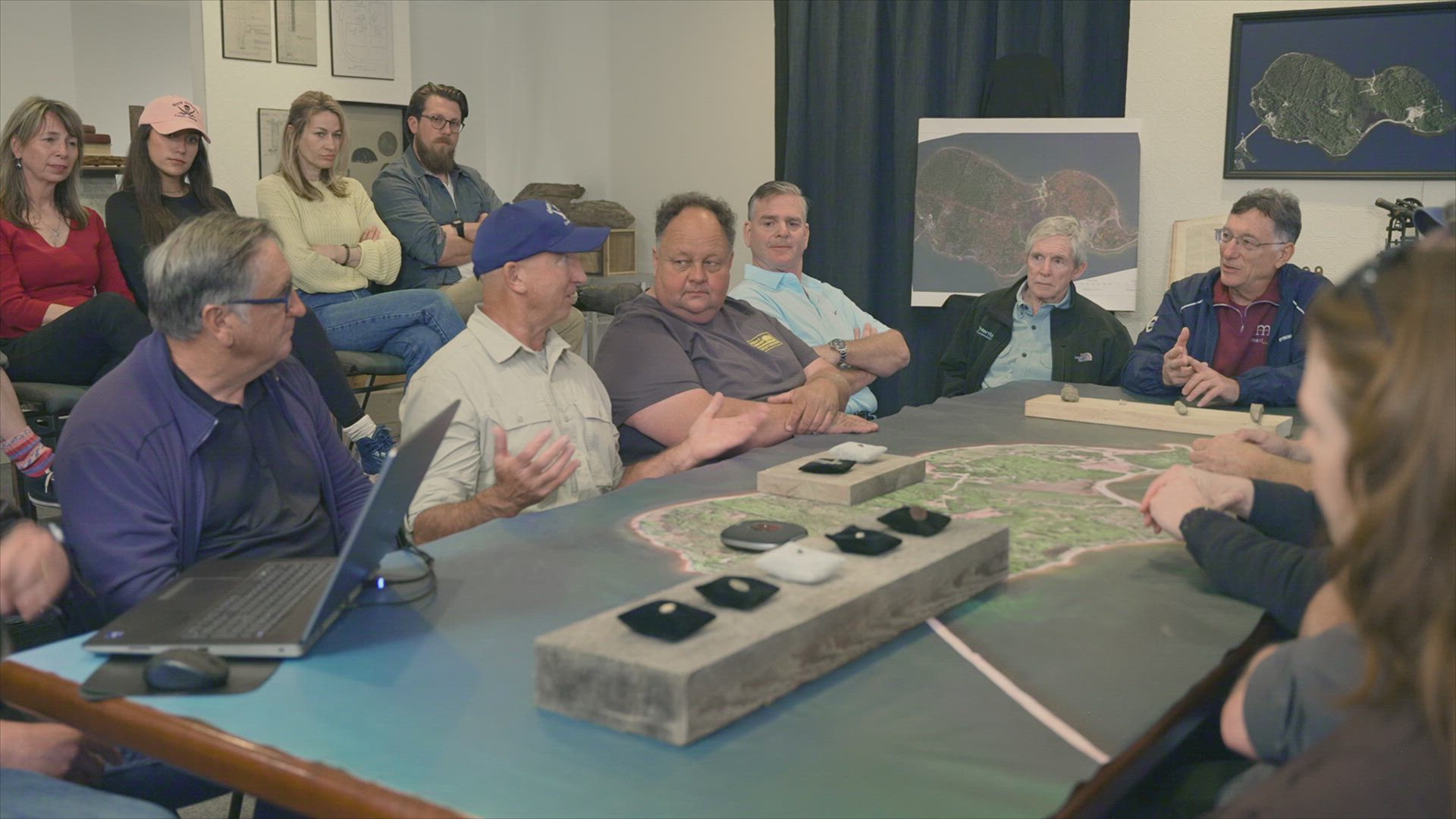
Lot 5: Evidence of Early Human Activity
Elsewhere on Lot 5, archaeologist Fiona Steele uncovered:
- a pipe stem dated between 1753–1800
- large glazed pottery fragments from the 17th–18th century
These finds imply that people were active on Lot 5 far earlier than official records suggest — long before the Money Pit discovery in 1795.
Venetian Bead Strengthens Knights of Malta Theory
A glass bead recovered from the same feature was analyzed and matched with Venetian-style beads previously found on the island.
More importantly, beads with identical composition have been discovered at Fort Point, headquarters of the Knights of Malta during the early 1600s under Isaac de Razilly.
If confirmed, this could form a direct historical link between Oak Island and known European military-religious groups — including those connected to Templar traditions.
Money Pit: A Massive, Unexpected Void
While surface discoveries dominate the headlines, drilling at the Money Pit produced one of the episode’s biggest shocks:
a 30-foot-high underground void at nearly 230 feet deep — far beyond previous expectations.
Such a collapse zone could be where dense objects — possibly treasure — migrated over centuries. The team believes much of the island’s prior digging may never have reached this depth.
Templar Echoes Reappear on Lot 4
In the closing moments, Gary Drayton unearthed a lead strip resembling part of the famous Templar cross found in 2017 at Smith’s Cove. If isotope tests match, it would be a breakthrough connection between medieval artifacts across the island.
Conclusion
Episode 3 delivers one of the strongest evidence chains ever presented on The Curse of Oak Island.
From a 1,750-year-old Roman coin to 17th-century pottery, Venetian beads, hand-carved stakes, and deep underground voids, the island is revealing a complex timeline spanning more than 1,500 years.
The discoveries suggest Oak Island was not a random site — but a deliberately chosen and engineered location used by multiple cultures over multiple centuries.
And for the first time in years, the island feels closer than ever to telling its true story.