The Curse of Oak Island Season 13: A Shocking New Discovery on Lot 5
A New Day and a New Lead
A fresh dawn breaks over Oak Island, and the hunt for history’s greatest buried secret continues. While the drilling team presses deeper into the Money Pit, another promising lead begins to unfold nearly half a mile away on Lot 5, the island’s newest archaeological hotspot.
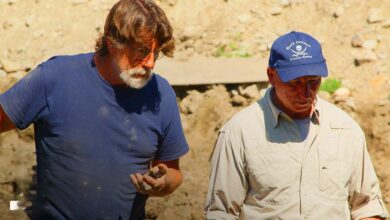
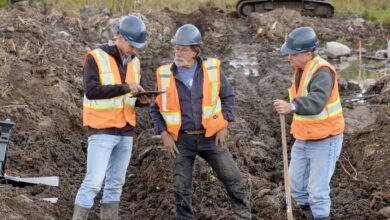
Metal-detection expert Gary Drayton and Peter Fornetti join the archaeology crew to reexamine a mysterious round stone feature discovered last year near the shoreline — a formation that has puzzled the team and intrigued historians. Beneath the soil of this quiet corner of the island, new secrets are stirring.

Searching the Spoil Piles
Gary and Peter begin their morning by combing through last season’s spoil piles, hoping to uncover any artifacts that may have slipped through the screens during excavation. “Sometimes stuff can go right through the quarter-inch mesh,” Gary says, his detector sweeping slowly over the ground.



Moments later, the familiar high-pitched signal of his metal detector breaks the silence. It’s a nonferrous target — potentially silver or lead. But before they can dig, the pair must call in Fiona, one of the island’s licensed archaeologists.
Since 2024, the area around the round feature has been designated a “Special Place” by the government of Nova Scotia, meaning all metal-detecting and excavation work must be supervised by a certified archaeologist.
When Fiona arrives, she quickly determines that the signal doesn’t come from the spoil pile — but from the undisturbed soil beside it. That makes it an in situ target — a potential clue preserved exactly where it was left centuries ago.
The First Find: A Lead Shot
Carefully digging under Fiona’s direction, Gary unearths a small, flattened piece of lead — a musket ball or lead shot, likely fired or dropped by someone centuries ago.
It’s not gold, but it’s a powerful clue. “That probably created somebody’s supper one day,” Fiona jokes, noting that the artifact could date back to the 17th or early 18th century, when muskets were common among explorers, soldiers, and settlers.
For the team, it’s yet another sign that Lot 5 was occupied long before the Money Pit was discovered in 1795. Could this area have been a base camp or staging site for whoever buried treasure beneath the island’s surface?
A Strange Iron Find Near the Round Feature
Encouraged, the team continues scanning the western side of the feature, where most artifacts have been found. Before long, Gary gets another strong hit — this time a heavy iron target.
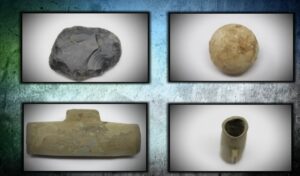
Digging carefully, they pull out a corroded, oddly shaped object covered in rust and encrustation. “Look at that,” Gary says. “It’s got shape to it — maybe part of a hinge or a lock mechanism.”
The find immediately raises questions. Could this have belonged to a chest or a door, possibly linked to the stone foundation only a few feet away? Fiona notes that the people who once used this site would have needed “locks of some kind — for doors, for crates, maybe even for treasure.”
It’s a small find with potentially big implications — evidence of construction and security near a feature already thought to be centuries old.
An Unexpected Discovery: Glass, Pottery, and Iron
Moments later, another deep signal stops Gary and Peter in their tracks. Fiona steps in to assist. As she trowels down through the earth, fragments begin to appear — green-tinted glass, coarse earthenware pottery, and a large iron object buried several inches deeper.
The team immediately halts. Fiona recognizes that they may have stumbled upon something significant — not just a discarded object, but possibly a new section of the round foundation itself.
She decides to preserve the site for formal excavation. “This may just be a pile of debris,” she cautions, “but what if it’s something else? What if this is another part of a structure?”
Their excitement grows when they realize how close they are to two of last year’s most important finds: the starburst button and the spiral button, ornate artifacts linked to the Knights of Malta — a medieval order that descended directly from the Knights Templar.
A Link to the Knights Templar?
The proximity of these finds to the round feature renews one of Oak Island’s oldest and most tantalizing theories — that the Knights Templar, or their successors, may have hidden treasure or sacred relics beneath the island centuries ago.
If this new section of foundation and its surrounding artifacts are indeed connected to the same group, it could mark one of the most significant archaeological breakthroughs in Oak Island history.
Fiona and the team agree to expand the excavation carefully under government supervision. “This is really encouraging,” she says. “If this connects to the round feature, we might finally understand who was here — and why.”
A Mystery Deepens
As the sun sets over Lot 5, the team marks the site and secures the area for further work. The excitement is palpable. Each new find — the lead shot, the iron hinge, the ancient glass — feels like a step closer to unraveling the riddle that has haunted Oak Island for more than two centuries.
And while the drilling continues in the Money Pit, the evidence on Lot 5 is telling another story — one of settlement, secrecy, and purpose. The question now is no longer if someone was here before the searchers of 1795 — but who they were, and what they left behind.
“Lot 5 just keeps on giving,” says Peter Fornetti.
“Every find takes us deeper into Oak Island’s hidden past.”