Swamp Secrets: Rick Lagina and Team Uncover Vault and 18th-Century Artifacts on Oak Island

The Curse of Oak Island: Discovery of a Hidden Vault in the Swamp Raises New Questions About Anthony Graves and the Treasure Legend
A New Mystery Emerges in the Swamp
It’s been a week of great excitement on Oak Island. For brothers Rick and Marty Lagina, their longtime partner Craig Tester, and the entire Fellowship of the Dig, a stunning new discovery in the triangle-shaped swamp could change everything they thought they knew about the island’s treasure mystery.
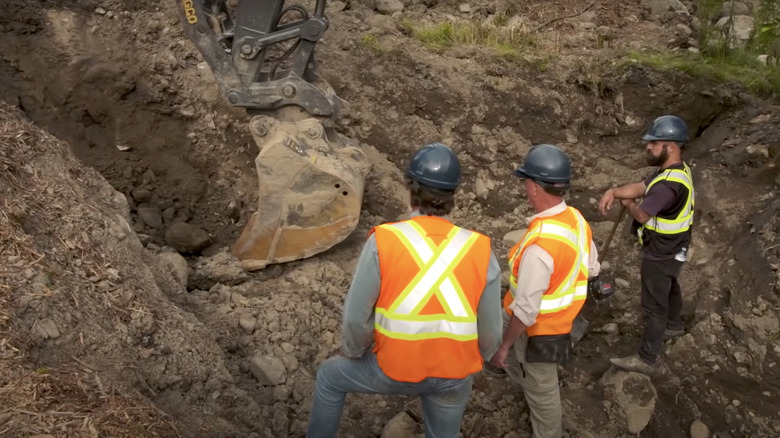
While excavating the swamp’s northern edge, the team uncovered two man-made features — a stone pathway and a vault-like structure buried beneath centuries of muck. “Now that looks like a stone road,” Rick observed as the crew began carefully digging deeper.
Archaeologist Laird Niven noted the uniform size of the stones and lack of gravel. “If this was natural, you wouldn’t have such a tight distribution,” he said, confirming what the team suspected — this was no natural formation.
The Ghost of Anthony Graves
As they examined the area, the conversation turned to Anthony Graves, a farmer who owned much of Oak Island in the mid-1800s. Though not a treasure hunter himself, Graves was rumored to have found Spanish silver coins somewhere on his land — coins that may have come from the very vault now emerging before the team’s eyes.


“This could easily be something connected to Anthony Graves,” said Alex Lagina. “We need to figure that out.”
Soon, metal-detecting expert Gary Drayton’s equipment began to buzz. “Got a great signal here,” he said, as Alex joined him in the dig. Moments later, Gary pulled a large, rusted object from the earth. “That’s it,” he said, revealing what looked like an old pipe or mechanical fitting, heavily corroded but clearly man-made.
Laird leaned in for a closer look. “It’s been down there a long time,” he said. “It’s some kind of pipe… but we’ll need to clean it up.”
The discovery was just the beginning.
“Built to Contain Something”
The following morning, Rick returned to the site with Tom Nolan, son of the late Oak Island landowner and treasure hunter Fred Nolan. As the two examined the mysterious vault-like structure, Tom was visibly astonished.
“I’ve never seen anything like this,” he said. “That slate is perfectly cut. There’s no reason for something like this to exist unless it was built to contain something — or to hide it.”
Rick agreed, noticing pieces of brick and a solid stone base. “It’s definitely not natural,” he said. “The question is — who built it, and why?”
Moments later, Rick spotted something glinting in the mud. He reached down and pulled out a small iron handle, possibly from a chest or container. “That’s odd,” he murmured. “A handle off a chest, maybe.”
Could this be a remnant of Anthony Graves’ rumored treasure hoard? Or was it evidence of something — or someone — far older?

Back in the Lab: The Artifacts Tell Their Story
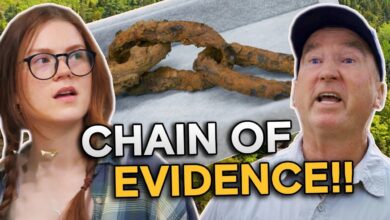
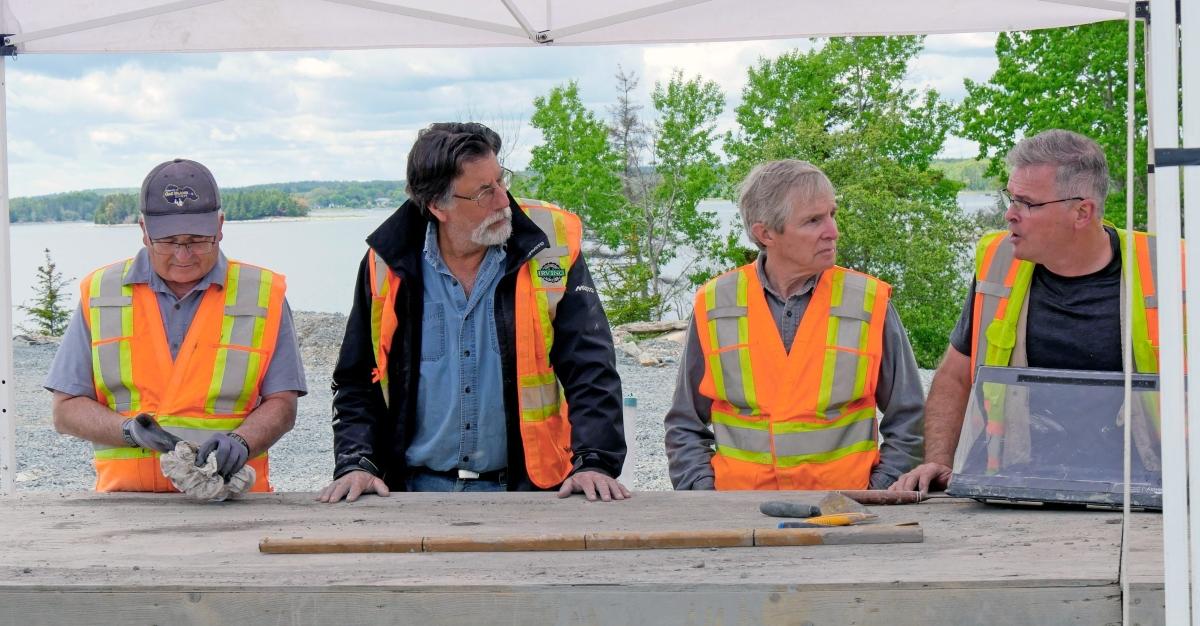
The next day, Rick and Craig joined Laird Niven and Emma Culligan, the team’s archaeometallurgist, in the Oak Island Research Center to analyze the three artifacts recovered from the swamp: the pipe, the hook, and the iron handle.
Emma’s scans revealed striking details. “The handle shows wood-grain structures typical of wrought iron,” she explained, pointing to CT images. “That suggests it was hand-forged.”
Laird, examining the shape, noted a square hole at the end. “That’s not decorative,” he said. “It’s functional — like a crank handle used to move something mechanical.”
Emma’s metallurgical tests narrowed down the ages of the artifacts:
-
The hook dates to the early to mid-1800s — the period when Anthony Graves lived on the island.
-
The pipe and crank handle, however, are much older, likely late 1700s or earlier.
That revelation shocked the room. “These predate Graves’ time here,” Emma said. “So someone was building and using equipment on that lot before he ever arrived.”
Could It Be a Hidden Vault?
The team began connecting the dots. The stone structure, the mechanical crank, and the iron hook might all point to a concealed chamber or vault, built to store — or retrieve — something valuable.
“There’s a purpose to this feature,” Rick said. “It has to do with Graves. I think it was his safety deposit box.”
Craig nodded. “We know Spanish coins were found on Lot 5. Graves was rumored to use them for trade. It fits.”
But the deeper question remains: if the artifacts predate Graves, who created the vault in the first place? And what else might still lie buried beneath it?
Back to the Bog
Despite his well-known distaste for swamp work, Rick couldn’t hide his enthusiasm. “We need to do more in the swamp,” he said. “It’s messy, but it’s where the answers are.”
Laird agreed, outlining plans for controlled excavation and artifact mapping. The team would return with new tools, more precise surveying, and a fresh determination to uncover what lies beneath the slate and brick.
As Rick prepared to leave the lab, he smiled. “Hopefully, next time we’ll have more than curiosities,” he said. “Maybe we’ll have answers.”
Theories and Implications
If confirmed, the vault-like structure in the swamp could represent one of the most significant finds in Oak Island history. Its age, construction quality, and location suggest it was intentionally hidden — perhaps by early explorers, settlers, or even by whoever engineered the Money Pit centuries earlier.
Could this be where the Spanish silver was stored — or something far more valuable?
For Rick Lagina and the Fellowship, one thing is certain:
Every discovery on Oak Island opens two new mysteries.