Oak Island Team Discovers Possible Flood Tunnel Beneath Smith’s Cove
For over two centuries, treasure hunters on Oak Island have searched for the elusive flood tunnels believed to guard the Money Pit. In a dramatic new turn, the team led by Rick and Marty Lagina may have finally uncovered one of the island’s most important clues yet.
A Rush of Water and a Dangerous Discovery
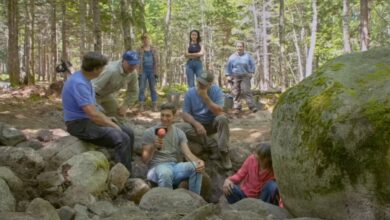
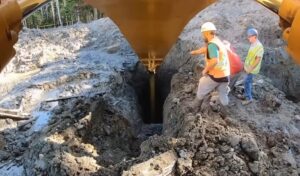
While investigating the uplands near Smith’s Cove, Craig Tester, Jack Begley, Gary Drayton, and heavy-equipment operator Billy Gerhardt noticed something strange — water suddenly gushing upward from the ground like a geyser.
“Do you see that? It’s squirting up from below,” one team member exclaimed as the earth began to shift beneath them. Within moments, cracks appeared, the soil started collapsing, and the team realized they were in danger.
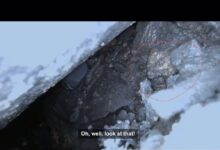


“This is all getting kind of dangerous,” Marty warned. “It’s not worth it.”
The team quickly withdrew, recognizing that the mysterious surge of water was no accident — the island’s centuries-old booby-trap flood system might have been triggered again, just as it was designed to do.
Stabilizing the Site
After retreating, the crew decided to backfill the unstable area to prevent further collapse. Unfortunately, that meant pausing excavation at one of the most promising sites on the island.
“We take risks out here,” Marty explained. “But it’d be foolhardy to keep digging when the ground’s giving way.”
A Closer Look: Is It a Tunnel?
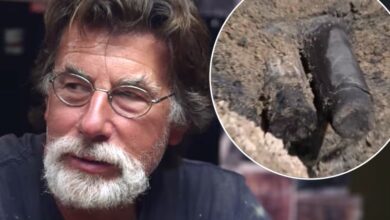
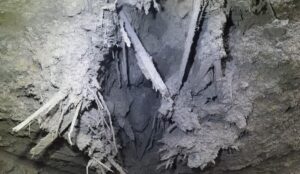
Before leaving the site, the team mounted a camera to an excavator arm to peer safely into the unstable pit. The footage revealed what appeared to be wooden supports, rock layers, and a possible tunnel-shaped cavity.
“There’s structure on the left wall — beams, boards… It looks like a tunnel to me,” Craig observed.
If confirmed, this could be the long-sought main flood tunnel, part of the ingenious system designed to flood the Money Pit and protect whatever treasure lies beneath.
The War Room: Reviewing the Evidence
Back in the War Room, the team analyzed the camera footage frame by frame.
“It’s wood on both sides, filled with rocks,” Marty noted. “That could be a collapsed tunnel or shaft.”
Craig Tester pointed out the double-layered wall structure and the beam-like supports — features unlikely to be from modern searcher activity. The team agreed that if the dendrochronology tests (tree-ring dating) confirmed the wood predates the original 1795 Money Pit discovery, it would strongly suggest they had located part of the original flood tunnel.
A Race Against Time
Despite the excitement, there was bad news. In less than 24 hours, Irving Equipment Limited was scheduled to arrive to dismantle the massive steel cofferdam surrounding Smith’s Cove. The removal process would take weeks and make further exploration in the area impossible.
“Our permits won’t allow more digging this year,” Rick admitted. “We’re done — for now.”
Searching the “Golden Egg”
With Smith’s Cove work halted, attention shifted to the Money Pit area, where Dr. Ian Spooner’s geochemical analysis pinpointed a small oval-shaped target zone — dubbed “The Golden Egg.”
“It’s the area where the metals are most concentrated,” Spooner explained. “We need to drill several wells here to evaluate it.”
At borehole EN13, the team hit soft ground followed by resistance at around 100 feet deep, suggesting a possible void or wooden structure nearby. Later, Dr. Spooner reported hearing rumbling underground, as if part of the ground had collapsed — a sign that they might be near an open chamber.
The Viking Connection
Meanwhile, new discoveries have revived one of Oak Island’s oldest theories — a Viking or Templar connection.
After uncovering another Roman coin on Lot 5, Doug Crowell and Emiliano Morra discussed evidence linking Oak Island to L’Anse aux Meadows, the only confirmed Viking settlement in North America, located in Newfoundland.
“If something happened here in the 1200s, it almost has to involve descendants of Vikings,” Emiliano suggested.
The team decided to mount an expedition to L’Anse aux Meadows to investigate possible ties between Norse explorers, medieval relics, and Oak Island’s mysterious structures.
Looking Ahead
Although flooding and safety concerns halted excavation, the Oak Island team remains determined. The combination of new tunnel footage, geochemical data, and archaeological leads in Newfoundland has reignited hope that the island’s greatest mystery may finally be within reach.
As Rick Lagina summed up:
“If we’ve got undisturbed soil, then wood, then undisturbed soil again — that sure sounds like a tunnel to me. And we’re not giving up on that.”