The Engineer-Detective of Oak Island: How Emma Culligan Is Rewriting a 200-Year Mystery
Lede: Brains, Data, and a New Direction
On a TV show famed for legends and hunches, Emma Culligan brings something rarer: hard data. With training that spans civil engineering, archaeology, and metallurgy, the Curse of Oak Island specialist has become the series’ quiet force—turning curios into evidence, speculation into testable hypotheses, and “maybe” into measurable. From X-ray fluorescence (XRF) to X-ray diffraction (XRD) and material forensics, Culligan’s work has reframed key discoveries and, in places, the island’s entire timeline.
A Global Path to a Very Local Puzzle
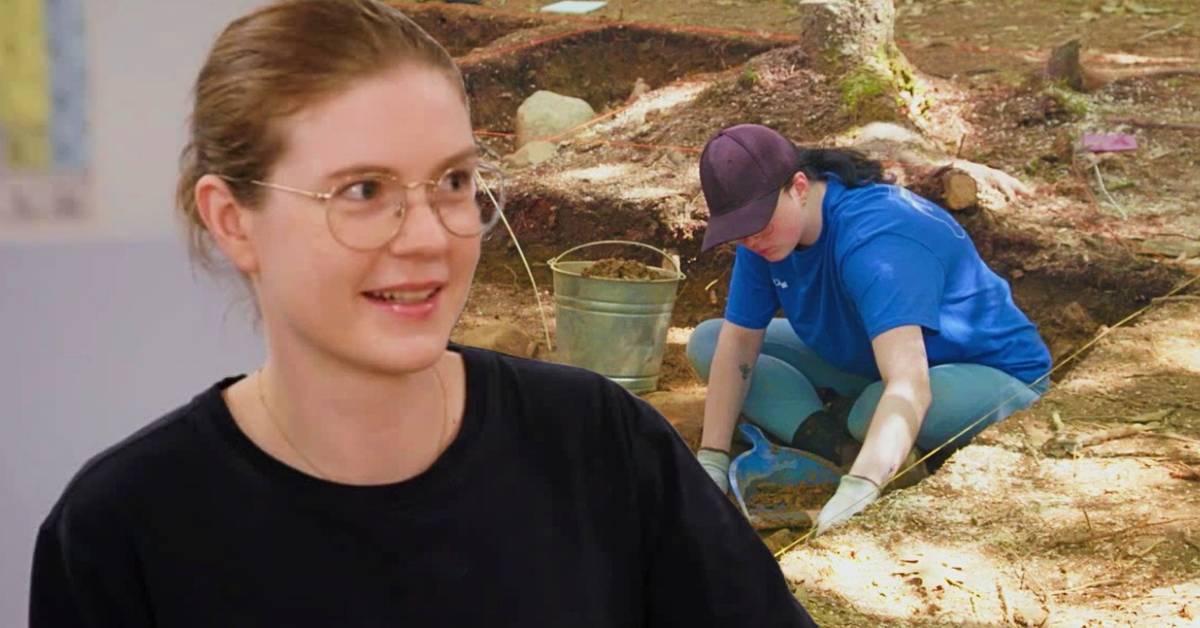
Raised in Japan and a native Japanese speaker until age 15, Culligan’s journey is anything but linear. She studied engineering at Dalhousie University before transferring to Memorial University in Newfoundland, where she blended civil engineering with archaeology—an unusual pairing that now looks prescient. Invited into academic materials research thanks to a knack for chemistry, she dove into metallurgy, learning to read the hidden story inside metals and minerals.
When Oak Island came calling, the role seemed almost invented for her: an engineer-archaeologist-metallurgist tasked with making sense of centuries-old artifacts in real time. On camera, she now operates advanced instruments and translates outputs—fast—into field decisions.
The Toolkit: How Science Meets Spoil Pile
XRF (X-ray fluorescence): Non-destructive elemental analysis of metals, ceramics, glass, and soils—ideal for identifying alloys, impurities, coatings, and probable origin zones.
XRD (X-ray diffraction): Crystallography for minerals and cements—critical for separating ancient construction from modern searcher activity.
Comparative materials mapping: Cross-matching metal signatures, mortars, and timbers across sites (Lot 5, Smith’s Cove, Money Pit zone) to build a chemical and temporal map of past activity.


“The real magic,” says one teammate, “isn’t the gadget—it’s Emma reading the signal and telling us what to do next.”
Case File: The Lot 5 Coin That Bent the Timeline
A modest, weathered coin from Lot 5 turned into a flashpoint when Culligan’s XRF showed an unusual alloy—approximately 70% copper and 16% lead—not standard for many familiar coinages. Combined with stylistic assessment, the data suggested a much earlier horizon—with team discussion landing in the 200–300 AD window for a Roman origin. Whether the coin arrived by trade, collection, or chance centuries later, Culligan’s analysis propelled Lot 5 from intriguing to pivotal, widening Oak Island’s cultural and temporal scope.
Case File: Gold in the Wood—Garden Shaft Anomaly
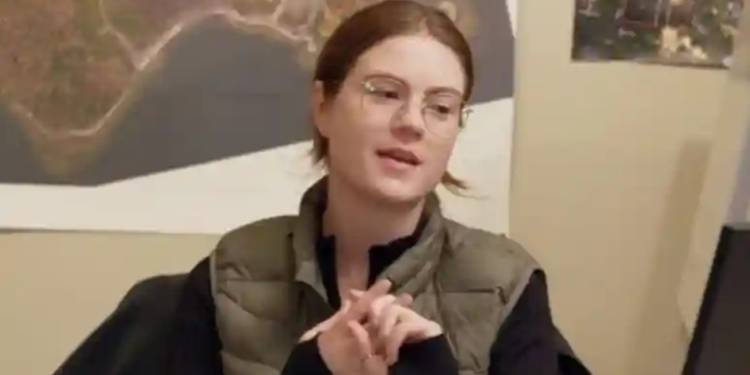
In one of the season’s most debated moments, Culligan’s XRF detected trace gold (~0.11%) within a wood sample associated with the Garden Shaft. The finding doesn’t prove treasure—but it does imply gold movement through that context, whether via fluid transport, mechanical contact, or post-depositional processes. It sharpened the crew’s focus on subsurface pathways and tunnel alignments in the 90–100 ft range and strengthened arguments for purpose-built access toward the Money Pit area.
Case File: Cement at Smith’s Cove—Searcher Work, Not Original Vault
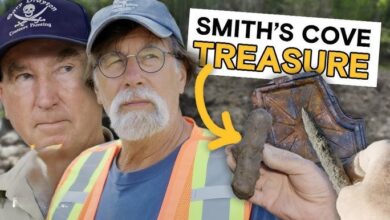
Culligan’s XRD analysis of a Smith’s Cove cement sample identified portlandite, consistent with Portland cement—and pointed toward a 20th-century production window (circa 1920s–1970s). The implication is decisive: this specific material relates to searcher activity, not an original depositional system. It dovetails with records of the Restall family and others attempting to seal the legendary flood tunnels with concrete—evidence that modern interventions are layered atop any older engineering below.
The Flood-Tunnel Question: Engineered Trap or Geology in Disguise?
For generations, Smith’s Cove has yielded clues to an intentional flood system:
- Box drains of stone reportedly arranged to funnel seawater,
- Coconut husk—a non-local filtration medium,
- Historic accounts (e.g., Truro Company, 1849) of finger drains feeding the Money Pit.
Skeptics, including some geologists, counter with karst explanations—natural voids and conduits that can mimic engineered tunnels. Culligan’s contribution is not to claim either camp outright but to separate searcher material from potential original structures using compositional proof. If a structure’s mortar or metal fingerprints as modern, it narrows the field. If it fingerprints as pre-industrial, the case for human design grows.
Case File: The Cast-Iron Stove Door—Life on the Island
A heavy cast-iron stove door recovered at Smith’s Cove initially teased shipwreck speculation. Culligan’s XRF shot that down, dating the piece broadly to the mid-1800s, aligning with intense searcher occupation. It’s not treasure, but it is history—evidence that crews lived and worked on the shoreline, wintered over, and left industrial signatures behind. For researchers, these “everyday” artifacts are vital context that helps interpret which layers belong to searchers versus earlier actors.
Lot 5: Foundation, Metals, and a Mosaic of Cultures
Work on Lot 5 has produced a small archive of outsized implications:
- Rectangular stone foundation likely backfilled by the 1780s,
- Hand-forged iron with high sulfur / no manganese (pre-1840 metallurgy),
- Gilded copper-alloy button (~3% gold), consistent with 18th-century English naval kit,
- Near-pure silver piece (possible hilt or finial),
- Prior context: Roman coins, a lead trade token, Venetian glass beads.
Culligan’s instrument-driven identifications give these pieces chronological anchors—turning a mixed scatter into a layered story that plausibly spans medieval to early modern.

Technology as Strategy: Drilling, Scanning, and Correlation
Beyond artifacts, the team’s tactics increasingly lean on geophysics:
- Seismic programs to model voids and tunnels to ~300 ft,
- Ground-penetrating radar to follow linear anomalies,
- Targeted coring to “ground-truth” the scans.
Culligan’s lab outputs feed these campaigns: if mortar from Lot 5 chem-matches mortar signatures near the Money Pit, that’s a structural link. If wood at 95 ft radiocarbon-dates to the 1600s (as some samples on the show have), that’s pre-searcher tunneling—and a map pin for where to probe next.
What Changes With Emma
- Evidence-led sequencing: Lab results now prioritize digs and de-prioritize dead ends.
- Cleaner timelines: Metallurgy and mineralogy separate centuries, preventing “time slip” interpretations.
- Stronger claims: When the show presents a theory, it increasingly brings numbers with it.
“Science doesn’t kill the mystery,” a producer quipped. “It makes the right mysteries bigger.”
The Open Questions
- Roman horizon or modern intrusion? Are early coins and beads original deposit or later curios carried to the island?
- Flood tunnels: engineered or natural? Can consistent non-local materials and coherent geometry overcome karst explanations?
- Garden Shaft vectors: Do compositional hotspots and 17th-century dates point to a purpose-built access into a vault?
Culligan won’t speculate on-air; she tests. And that discipline—rare in a story soaked in lore—may be Oak Island’s best chance at a definitive breakthrough.
The Bottom Line: A New Standard on an Old Island
Whether she’s confirming searcher cement, flagging pre-industrial iron, or pulling trace gold from unexpected places, Emma Culligan has changed how Oak Island is explored and explained. Her cross-trained lens—engineer’s structure, archaeologist’s context, metallurgist’s certainty—is turning a two-century treasure hunt into a forensic investigation.
Is she the key? No single person can unlock a puzzle this layered. But if the island’s deepest secrets yield in our lifetime, don’t be surprised if the final chapter starts with a spectrum, a diffraction pattern—
—and Emma Culligan saying, “Let’s test that.”