Oak Island’s Deepening Mystery: New Clues, Older Timelines, and a Race Against Time
A Legendary Island That Refuses to Yield
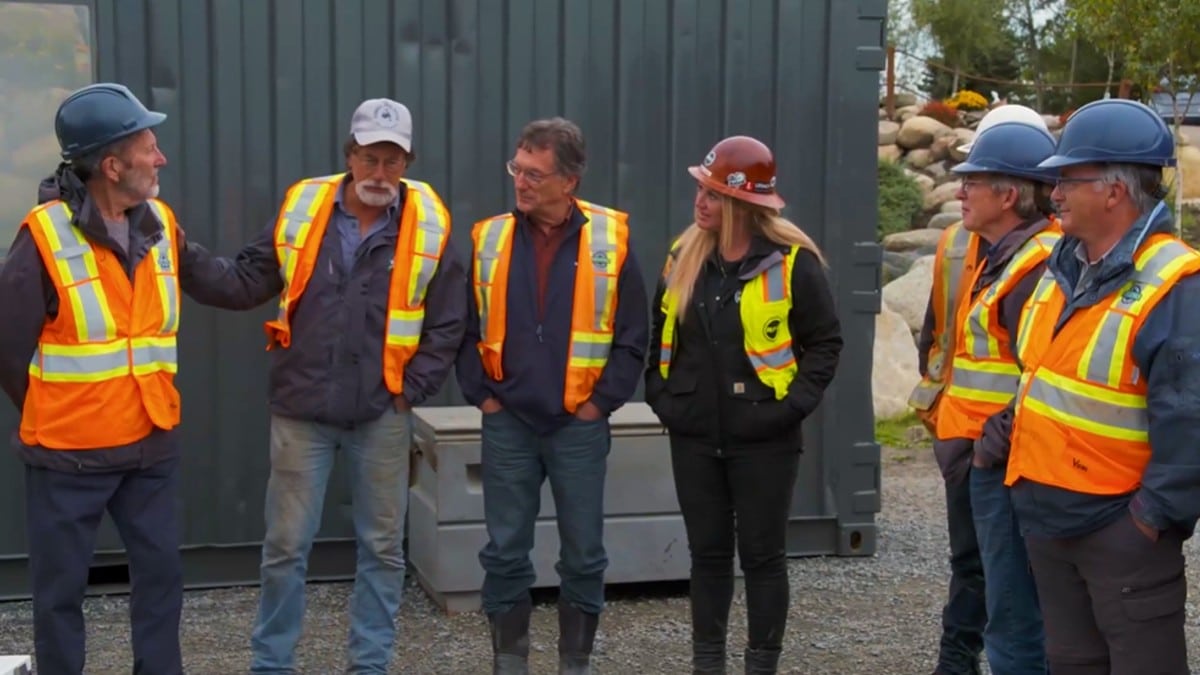
Oak Island, perched off Nova Scotia’s rugged coast, has magnetized treasure hunters, historians, and adventurers for generations. From the infamous Money Pit to artifacts dredged from its marshy lowlands, the island’s lore only grows as each discovery spawns more questions than answers. With that magnetism in mind, Rick Lagina, metal-detecting ace Gary Drayton, and seasoned operator Billy Gerhardt continue to push into the southern edge of the triangle-shaped swamp—one of Oak Island’s most confounding hotspots.
Ship Clues in the Swamp
In recent years, the swamp has produced a trove of ship-related finds dated broadly from the 15th to 18th centuries—timbers, hardware, and maritime fragments that imply sustained nautical activity. But in 2020, the narrative lurched in a startling direction: a ship railing found near the swamp’s southern border carbon-dated—at the outer bounds—to as early as the 8th century. That single result cracked open a broader horizon of possibilities and invited fresh scrutiny of the island’s timeline, including the potential for contact with medieval Viking cultures.
A Theory Expands the Timeline
Enter Dr. Doug Symons (as referenced by the team): his perspective further complicated the picture, suggesting interactions and activities on Oak Island that predate traditionally accepted narratives. With this lens, every find—coin, plank, or plank-like railing—took on new significance. If the swamp’s assemblage includes materials spanning centuries, then the site may encapsulate multiple layers of occupation, staging, or concealment.
A Wall in the Muck—and Nolan’s Shadow
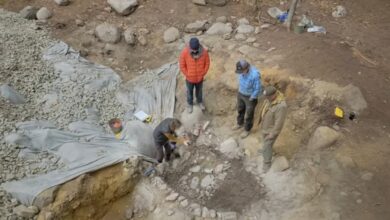
While following up on curved, boat-like timbers, the crew encountered something that re-ignited a decades-old idea: a possible wall or dam-like feature beneath the swamp’s southern margin. This echoed veteran surveyor Fred Nolan’s claims from over 30 years ago—he believed the swamp was engineered, possibly as a deliberate cover for something of great value. The team now wonders whether the newly exposed structure intersects with Nolan’s observations and whether it ties to the 2020 ship-railing find just upslope.


Stone Road, Red Sediment, and a Hidden System
To triage the find, Rick invited geoscientist Dr. Ian Spooner to examine the feature. Spooner noted a distinctive red sediment similar to that underlying the island’s stone road—an engineered pathway already suspected to be older than early searcher activity. If the wall-like structure is stratigraphically tied to the road, both could predate the Money Pit era and hint at a larger, pre-existing infrastructure—perhaps a transport or concealment corridor built with long-term endurance in mind.

Rounded Timbers and Shipwright Signatures
As the team expanded the exposure, they recovered rounded-edge, flat-topped wood fragments—elements consistent with purposeful shaping and potentially with historical ship carpentry. Preservation within the swamp’s anoxic conditions could explain their condition. The question becomes: were these components part of a cradle, a cofferdam, a slip, or even a containment system around a vessel deliberately sunk and buried?
Safety, Strategy, and Scientific Discipline
Even amid excitement, practical constraints loomed large. The swamp demands caution—unstable footing, hidden voids, and water management all complicate excavation. Back at base, the team set a phased plan: targeted exposures, incremental sampling, and lab work guided by Spooner’s sediment analysis. The goal is to knit context to material and avoid destructive over-digging that could erase critical evidence.
The Garden Shaft: A Parallel Breakthrough
While swamp work advanced, the Money Pit area delivered its own shock. Dumas Contracting deepened the historic Garden Shaft to ~95 feet, pursuing a west-trending tunnel that earlier water tests had flagged with elevated silver, gold, and other metals between 80 and 120 feet. During coring and follow-up, the team exposed substantial timbers—massive beams that might represent a long-sought passage linked to the “Baby Blob” anomaly.
Dating the Depths: Seventeenth-Century Wood
Wood taken from the tunnel during coring returned dates in the 1600s—decisively pre-searcher. If that holds across multiple samples, it implies engineered tunneling predating the first recorded Money Pit dig. That single datapoint challenges long-held assumptions about who built what—and when—and rekindles questions about whether the Money Pit was one node in a larger, coordinated system.
Hard Choices: Sample or Stand Down?
With heavy beams now visible, the team faced a consequential choice: preserve in place or remove select elements for analysis. They opted to extract a limited number for tool-mark, species, and micro-wear studies—evidence that could distinguish searcher work from original builders and potentially identify shipwright techniques or regional timber sources. The team balanced urgency against stewardship; the objective is clarity, not collateral damage.
A Button in the Stones—and Military Shadows
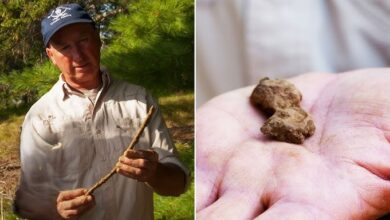
Amid hurricane preparations (as Hurricane Lee barreled toward Nova Scotia), Drayton swept a circular stone foundation that had previously yielded Money Pit soils at depth. His detector spiked on a finely made button, likely 1700s or earlier, featuring iconography reminiscent of artillery buttons worn by French, British, or Spanish forces. Military presence—direct or indirect—would dovetail with Imperial interests in timber, navigation, and coastal staging sites, and it reframes the island not merely as legend-lure but as a strategic waystation.
Storm Delay, Not Surrender
With the storm’s arrival, operations paused for safety. Crews secured sites, pumps, and shafts; documentation and sample chains were tightened. The pause was tactical, not a retreat. When winds eased, the plan called for immediate resumption: lower the Garden Shaft to the tunnel elevation, expand the swamp’s test windows, and keep the lab queue full—sediments, timbers, metals, and organics all under the microscope.
The Chapel Vault Question Revisited
In parallel, Borehole H8 produced dense metal fragments some interpret as part of the historic “plug” associated with the legendary Chapel Vault. If correct, it could explain why earlier efforts drove the vault deeper, and it would place the team closer to the core mystery than at any point in years. H8’s significance rises further if compositional analysis matches metals observed in water-testing signatures.

Convergence: Swamp, Road, Tunnel
Three strands now threaten to braid into one story:
- A man-made swamp feature (wall/dam) near ship-like timbers;
- A stone road underlain by distinctive red sediment;
- A seventeenth-century tunnel trending toward an anomaly rich in metallic traces.
If these are parts of a single engineered scheme—concealment, transport, or redirection—then Oak Island’s “treasure” might be as much about construction genius as gold.
Gold at Smith’s Cove—and a Deeper Source
Recent traces of gold within Smith’s Cove waters remind the team of a practical truth: gold moves. If concentrations appear in the cove, there must be an upstream source—either seepage from worked gravels, leakage from a containerized cache, or residuals flushed through tunnels over time. The discovery of a submerged wooden ladder descending into a flooded passage compounds the intrigue: who placed it, and what task did it serve?
What Comes Next
The path forward is clear and methodical:
- Cross-dating: Obtain multiple timber samples from the tunnel and swamp structure to lock timeframes.
- Tool-mark analysis: Differentiate original builders from later searchers.
- Sediment mapping: Extend the red-sediment signature and correlate with the stone road and swamp feature.
- Metals assay: Tie waterborne gold and silver signatures to specific stratigraphic zones.
- Foundation study: Examine the circular stone structure’s fabric and the Money Pit soils embedded within it.
The Long Chase Continues
Oak Island has always been more than rumors of chests and coins. It’s a layered archive of engineering, navigation, empire, and perhaps sanctuary. Whether the ultimate prize is bullion, documents, or proof of an audacious maritime operation, the latest finds—older timbers, engineered walls, metallic signals, and military artifacts—suggest a bigger, older, and more deliberate story than once imagined. The island’s greatest treasure may be the truth itself—and for Rick, Marty, and their team, that truth feels closer than ever.