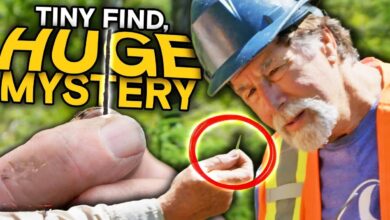
Oak Island’s “Roman Sword” and the 10X Ordeal: Clue to Ancient Visitors or Another False Lead?
A Crisis Underwater—and a Glimmer of Hope
What began as a routine dive at Oak Island’s notorious Borehole 10X spiraled into a tense, life-threatening episode. Communications failed, visibility vanished, and for 32 agonizing minutes the surface crew had no idea whether their diver would return. When a light finally broke the black water, the relief was palpable. The mission hadn’t revealed hidden chambers or glittering treasure—only hazards: a constricting, 27-inch-wide tunnel, choking silt, and a 20-foot drill bar wedged like a steel spear in the shaft. If nothing else, the dive proved 10X would not give up its secrets easily.

And yet, as so often happens on Oak Island, one door closed and another creaked open. With the 10X effort paused, the team shifted focus—and soon found themselves holding an artifact that would ignite one of the island’s biggest debates.
“A Roman Sword”: Discovery or Distraction?
Enter the headline-maker: a bronze/brass sword alleged to be Roman, said to have surfaced decades earlier in Mahone Bay and kept quietly in a local family’s possession. Ornate, heavy, and crowned with a Hercules motif, the weapon ticked all the boxes of an ancient showpiece. If genuine—and if it truly originated near Oak Island—it would challenge the orthodox timeline of transatlantic contact.


The team did what they should: they sought science. Archaeologists and metallurgists examined form and decoration; chemists analyzed alloy composition. Early visual impressions likened it to ceremonial Roman styles. But material tests complicated the picture: while elements consistent with ancient bronze appeared, the casting method looked more like a later bivalve mold than typical Roman lost-wax work. Subsequent scans reported elevated zinc—more suggestive of modern brass than ancient bronze. Meanwhile, near-identical swords in European collections have been cataloged as 19th-century replicas.
Does that end the story? Not entirely. Dissenters argue natural zinc contamination sometimes occurs, designs can be copied from authentic originals, and provenance murmurs are notoriously slippery in maritime contexts. But if we’re weighing evidence, the scale tilts toward “replica,” not Roman relic.
Why the Sword Still Matters
So if the sword is likely modern, why does it still loom so large? Because it exposes a deeper truth about Oak Island: the island’s mystery endures not only in gold rumors, but in how we build narratives. The sword sits at the intersection of wishful thinking, genuine curiosity, and the seductive pull of legend. It forces the team—and viewers—to ask harder questions about standards of proof, chain of custody, and what counts as historical significance.
The 10X Reality Check
While the sword stirred headlines, Borehole 10X delivered a different lesson: geology and engineering don’t bend to romance. The shaft plunges about 235 feet—181 feet of reinforced descent, followed by that tight, water-filled 44-foot choke point. With decades of debris collapses and lost tooling, the diver’s report was stark: zero visibility, claustrophobic constriction, and an immovable drill bar blocking progress. No “money pit” panorama. No vaulted chamber. Just a reminder that in the battle between expectation and environment, bedrock usually wins.
![Roman Sword Found Near Oak Island, Nova Scotia May 'Rewrite' North American History [Updated] - Inquisitr News](https://i.pinimg.com/736x/36/79/c7/3679c7fd6e2d87b1ceaee8cb6f1ce57f.jpg)
Another Thread: The Pulley, the Bolt, the “Boring” Stuff
Away from 10X and the sword, the team’s finds skewed practical: a heavy pulley, clustered fasteners, and uniform nails and bolts—many likely 19th–20th century. On paper, that inventory sounds mundane; onscreen, it’s less cinematic than a gleaming doubloon. But patterns matter. When plotted, nails and bolts formed suggestive rows and clusters, hinting at platforms or casings—construction, not chaos. That dovetails with other evidence around the island: stone foundations, brick fragments, charcoal lenses, and industrial residues pointing to tanning, brickmaking, or other workaday operations.
Is that deflating? Only if treasure is the sole prize. For historians, these strata of “ordinary” activity are exactly how real pasts are reconstructed.
Lot 5, Smith’s Cove, and the Starburst Thread
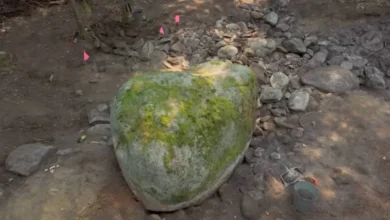
Lot 5 turned up a substantial stone foundation with charcoal, partial bricks, and bones—ambiguous, but consistent with prolonged human use. At Smith’s Cove, finds continued: boards, newer nails, a bolt, a spike—items that likely trace back to 20th-century search efforts (think Restall era). Still, there’s a reason Smith’s Cove keeps drawing researchers back: beneath the tidal clutter are stonework, cribbing, and road-like features that don’t look like random drift.
Back in the lab, conservator Emma Culligan cracked open a concreted metal mass retrieved by Gary Drayton and revealed a cast-iron stove door—mid-1800s by material and manufacture. On its face, that’s a far cry from medieval treasure. But Emma noticed a familiar motif: a starburst similar to a button recovered elsewhere on the island. Coincidence? Possibly. A maker’s mark distributed through trade networks? Also possible. Still, the repetition invites a cautious question: are we glimpsing a thread—commercial, symbolic, or organizational—tied to the island’s 19th-century industrial and search history?
Science vs. Story
If there’s a hero in this chapter, it’s process. Emma’s careful deconcretion, compositional tests identifying manganese and casting signatures, and the team’s willingness to cross-reference patterns—this is how speculation hardens (or collapses) into evidence. Just as water tests at the Garden Shaft came back unexpectedly clean, redirecting attention to the Chappell and Hedden shafts, the lab work nudged the narrative from “romance” toward “record.”
What About Other “Roman” Signals?
Roman-style crossbow bolts, the lead cross at Smith’s Cove with isotopes traced to Southern France, the (lost) 90-foot stone with undeciphered symbols, even rumors of very old wrecks offshore—each item adds intrigue, but none, by itself, proves a Roman landing. Coins travel; religious symbols migrate; later searchers import tools and iconography. Without secure archaeological context—stratigraphy, dating, and clear provenance—ancient-contact claims remain tantalizing but unproven.
The Case for a Working Island
Stack the “boring” evidence and a persuasive picture emerges: Oak Island as a working site across multiple centuries—industrial tasks, organized construction, and successive waves of treasure hunters building, bracing, draining, and documenting. Platforms, casings, water management, and cribbing look less like pirate booby traps and more like iterative engineering to probe, preserve, or exploit subsurface anomalies. That story is smaller than myth—but truer, richer, and far more useful.
Where the Evidence Points—For Now
- Borehole 10X: extremely hazardous; no confirmed chamber; obstructions and zero visibility rule the day.
- “Roman Sword”: aesthetics match antiquity; metallurgy and parallels suggest a 19th-century replica; provenance is murky.
- Smith’s Cove & Lot 5: consistent with prolonged, purposeful activity; clustered fasteners and structural timber imply deliberate builds.
- Stove Door & Starburst: mid-1800s artifact with a recurring motif; likely tied to later work/search periods rather than antiquity.
Conclusion: The Treasure of Hard Truths
Oak Island still captivates because it refuses a single, tidy answer. The near-disaster at 10X underscores the physical reality of the hunt; the sword controversy highlights the necessity of skeptical rigor; the “ordinary” artifacts, when mapped and dated, tell a compelling tale of human labor and layered history. Maybe there is gold yet to be found. Maybe the grand prize is a complete, evidence-based account of what actually happened here.
Either way, the path forward is clear: less mythmaking, more measurement. Follow the patterns. Date the layers. Let the small finds speak. Because on Oak Island, the surest way to a big discovery is learning to read the little ones.