A Breakthrough Discovery on Oak Island: Unearthing Secrets from the Past
A Major Turn in the Treasure Hunt
Rick and Marty Lagina have spent years unraveling the riddles of Oak Island. While past seasons of their exploration have often brought more questions than answers, recent discoveries may signal a turning point. A series of unusual artifacts and underground clues now offer the most promising evidence yet that Oak Island could indeed be hiding something extraordinary.
Intriguing Finds in the Swamp
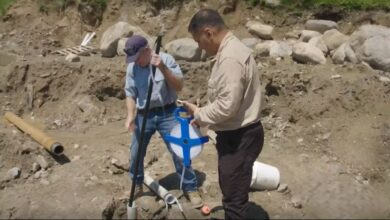
The triangular-shaped swamp on Oak Island has long captured the imagination of researchers. Now, that curiosity has been validated. The team recently uncovered what appears to be a man-made structure beneath the swamp, alongside a carefully constructed stone pathway and a large rock placed with apparent intent.
These findings strongly suggest human activity in the area between the late 1600s and early 1700s—precisely the period that aligns with many treasure legends associated with Oak Island. The structure could indicate a former building site, while the adjacent pathway implies that it once served a defined logistical or ceremonial purpose. The size and placement of the large rock suggest it was deliberately moved, possibly as a marker or part of a larger operation.



A Gentleman’s Boot from the 1600s
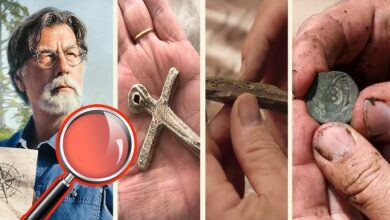
Among the key artifacts uncovered is an old leather boot, believed to belong to a gentleman from the late 17th or early 18th century. This discovery is important for two reasons: it helps date the presence of people on the island to a historically significant period, and it suggests that individuals of higher social standing were involved in the island’s activities—possibly in the concealment or transportation of treasure.
The boot was discovered in the southeastern corner of the swamp, further supporting theories that the swamp itself may have been artificially altered to conceal something important.
The Garden Shaft Yields a 7-Foot Tunnel
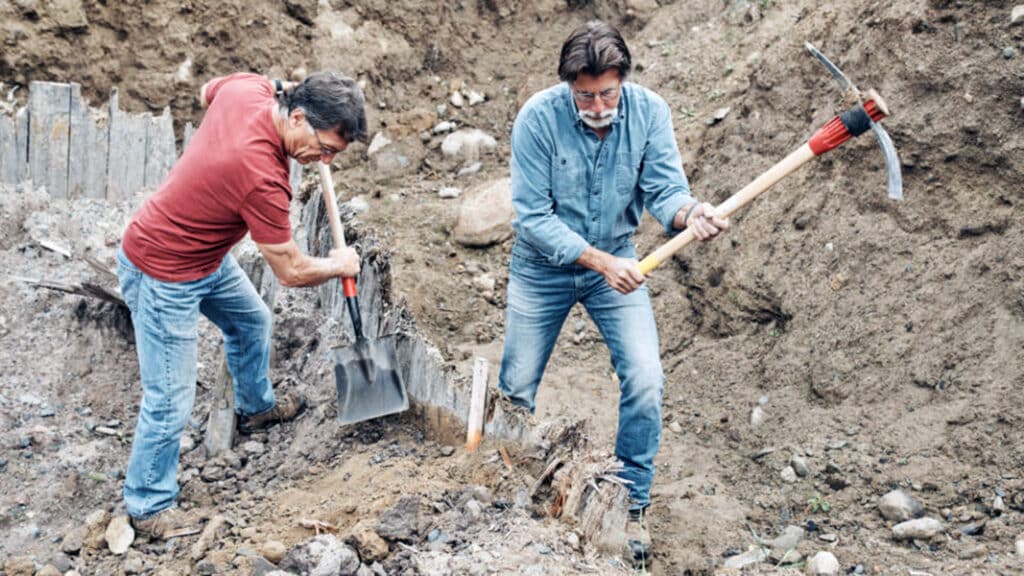
Equally compelling are the new developments at the Garden Shaft. The team has discovered the top of a 7-foot-high tunnel that may contain valuable metals, according to recent water sampling and geochemical analysis. The size of the tunnel implies that it was not simply a natural feature or drainage channel—it was built with intention, possibly to transport large items or serve as a storage facility.
This discovery has reinvigorated the theory that the Knights Templar—or their successors, the Freemasons—may have used Oak Island to safeguard valuable items, including religious relics.
Reinforcing the Templar Connection
The idea that medieval groups, such as the Knights Templar, may have used Oak Island to hide important objects is gaining more credibility. Chris Morford’s theory posits that the Templars, followed by the Freemasons, may have designated the island as a secret vault. The tunnel’s dimensions, its strategic location, and the presence of heavy metals support this hypothesis.
The connection is strengthened by the alignment of drilled stones, Nolan’s Cross, and the Money Pit—all seemingly arranged with precision. Nolan’s Cross itself—a symmetrical cross formation made of large boulders—is consistent with Templar symbolism and may serve as a coded map to the island’s hidden secrets.
A Canadian Boot Company and Historical Clues
Further adding to the historical context is the discovery that a Canadian rubber boot company operated in the region around 1908–1909. Though this is long after the theorized Templar presence, it underscores the long-standing interest in the island and may explain some modern artifacts. Nevertheless, it’s the older finds—like the boot, tunnel, and stone pathways—that continue to excite historians and archaeologists.

Possible Templar Land Grants and a Portuguese Link
There are also tantalizing questions about whether Oak Island could have been one of the first land grants given to the Knights Templar after their alleged escape to Portugal. If so, this would make Oak Island not just a site of hidden wealth, but a key piece in a much broader historical puzzle involving European power struggles, sacred artifacts, and secret societies.
Beyond Treasure: Reconstructing History
The search on Oak Island is no longer just about gold or riches. It is about recovering a hidden chapter of history. Every tunnel, artifact, and structure is a clue not only to a potential treasure but to the people and motives behind its concealment.
If the team can prove a direct link to the Knights Templar or Freemasons, it would fundamentally change how historians view the island—and possibly rewrite our understanding of North American history during the post-Crusade era.
The Road Ahead
The Garden Shaft has emerged as the most critical area in the entire Oak Island investigation. The team’s efforts to fully excavate the 7-foot tunnel and analyze the metal-rich water samples may finally yield the proof needed to validate centuries-old theories. Each layer of earth brings new discoveries—and each artifact could be the missing piece of a centuries-old puzzle.
As the quest continues, Oak Island transforms from a local mystery into a site of global historical significance. What lies beneath may not only fulfill the dreams of treasure hunters but could alter our understanding of medieval history itself.