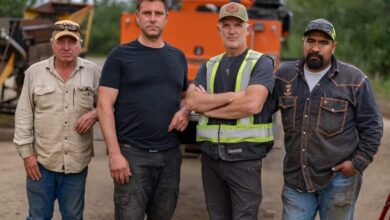
In the heart of Alaska’s icy wilderness, gold miner and reality TV star Parker Schnabel was on a familiar quest — digging through frozen ground in search of gold. But what he uncovered instead was something far older and, in many ways, even more remarkable than the precious metal he’s built his reputation mining.
While working through layers of ancient permafrost, Schnabel stumbled upon several astonishingly well-preserved woolly mammoth tusks — rare, valuable relics from a time long before humans walked North America. The tusks, still intact after thousands of years underground, were discovered in terrain often overlooked for anything beyond its mineral wealth. But in Alaska, the line between gold mining and time travel can be surprisingly thin.
Thanks to the naturally frozen soil that blankets much of the region, some areas have become natural vaults preserving remnants of Earth’s prehistoric past. These frozen conditions act as a protective casing, allowing organic materials like ivory to remain in exceptional condition.

Parker Schnabel, known for his relentless work ethic and sharp instincts on Discovery Channel’s Gold Rush, didn’t expect to find mammoth ivory while dredging through dirt and rock. But when his team pulled the long, curved tusks from the ground — smooth, gleaming, and unmistakably ancient — Schnabel instantly recognized the significance.




“We found some mammoth tusks, which were really cool,” Schnabel said, clearly energized by the discovery. “They’re preserved because they’re ivory and were buried in the permafrost, so the weather doesn’t really get to them. Some of those came out in beautiful shape.”
Although finding tusks in Alaska isn’t unheard of, it remains rare enough to stir excitement among scientists and treasure hunters alike. Woolly mammoth tusks, particularly those recovered in pristine condition, can fetch sky-high prices on the market. In recent years, some specimens have sold for over a million dollars, depending on their size, preservation, and provenance.
However, Parker Schnabel’s interest in the tusks runs deeper than dollar signs. The woolly mammoth — a towering beast from the Pleistocene epoch — once roamed the sweeping plains and tundras of North America, Europe, and Asia. Standing up to 13 feet tall and weighing more than 10 tons, these massive mammals were iconic parts of the Ice Age landscape until their extinction roughly 5,000 years ago.
Their tusks, sometimes measuring over 15 feet long, were not only formidable weapons and tools during the mammoths’ lifetimes but now serve as one of the last tangible links to that lost world. Discovering mammoth remains in such pristine condition doesn’t just excite gold miners; it thrills paleontologists and archaeologists too.
Each tusk holds clues about the environment, diet, and migration patterns of these prehistoric giants. The fine growth rings inside the tusks, much like those of trees, can help scientists estimate the age of the mammoth, detect health patterns, and reconstruct ancient climate conditions.
In that light, Parker’s discovery isn’t just about luck — it’s about legacy.
In an era when elephant ivory remains a contentious issue due to illegal poaching and the global ivory trade, mammoth tusks present a legal but still ethically sensitive alternative. Because woolly mammoths are extinct, their ivory isn’t protected under the same laws as elephant ivory. However, the trade is closely monitored to avoid loopholes that could endanger modern species.
Schnabel understands these complexities. While the idea of selling the tusks for a hefty profit might tempt many, he has chosen a different path.
“You can sell them, but it requires obtaining a few permits to export them out of the territory,” he explained. “However, I found them so fascinating that I decided to keep them.”
That choice reflects a growing awareness in the mining community of the need to balance economic pursuits with cultural and environmental responsibility. Schnabel’s respect for the artifacts and their historical value shows that he sees himself not just as a miner, but as a steward of the land he works.
The discovery of mammoth tusks amid the daily grind of gold mining shines a spotlight on the often overlooked intersection of industry and history. In regions like Alaska and the Yukon, mining operations routinely disturb soil layers that haven’t seen sunlight in tens of thousands of years. It’s within these frozen depths that treasures of a different kind of weight — fossilized bones, ancient flora, and even whole carcasses of Ice Age animals — are preserved so well they retain fur, muscle, and DNA.
Schnabel’s dig site, like many across the north, isn’t just a gold claim — it’s a time capsule. His reaction to the discovery sets an example of how modern miners can embrace the responsibility that comes with working in such historically significant areas.
This also raises broader questions: Should mining companies be required to report and preserve such finds? What role should government and science play in protecting prehistoric artifacts found on active mine sites? And perhaps most importantly, how do we as a society define the value of our past?
Over the years, Parker Schnabel has built a reputation as one of the most successful and driven young miners in the world. His journey from teenage rookie to seasoned crew leader has played out on television screens across the globe. Yet it’s moments like these — when his path intersects with ancient history — that truly expand the scope of his story.
More than just a master of mining and machinery, Schnabel’s discovery of mammoth tusks adds a new layer to his public persona: that of a man keenly aware of the bigger picture. A miner who, while digging for gold, also unearths the forgotten stories of a time before time — a figure who balances rugged ambition with reverence for the earth’s secrets.
As he continues to work Alaska’s gold-rich ground, viewers of Gold Rush now have something else to watch for: those serendipitous moments when the past quite literally breaks the surface. Because when Parker Schnabel digs, he doesn’t just find gold — he finds history.
For Parker Schnabel, gold mining has never just been a job — it’s a way of life. As one of the standout stars of Discovery Channel’s Gold Rush, he’s built his career chasing rich paydirt across some of the most unforgiving terrain on Earth.
But as the seasons pass and the ground keeps giving, Parker’s ambitions continue to evolve. Today, he’s digging with more than just ounces of gold in mind — he’s hoping to uncover all the hidden wealth Alaska’s frozen wilderness has to offer.
After years of leading massive operations and pulling in thousands of ounces of gold, Schnabel has developed a deeper appreciation for the land he works. With recent finds like ancient mammoth tusks buried deep in permafrost, he now knows that Alaska’s riches aren’t limited to shiny metal.
“When you’re mining in places like this, you learn to expect the unexpected,” Parker said in a recent interview. “Of course, we’re here for the gold — but it’s not the only valuable thing beneath our feet.”
Gold Still Front and Center
Despite a broader outlook, Parker’s primary goal remains the same: finding gold, and lots of it. Every season, he pours time, resources, and relentless energy into pushing the limits of his operation. From hiring bigger crews to running multiple wash plants, he’s always looking for ways to increase his yield and outdo previous years.
“We’re always looking for that one cut that changes everything,” Parker explains. “That layer of ground that nobody else believed in, or that new patch of land that surprises you — that’s what keeps me going.”
For Schnabel, it’s not just about chasing wealth — it’s about proving to himself and others that hard work, experience, and risk-taking still pay off in the gold fields.