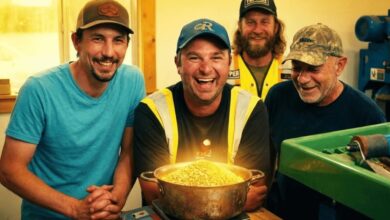
Gold Rush Season 16 Finale: A Season Decided by the Smallest Margin in Klondike History
A High-Stakes Season Driven by Record Gold Prices
Gold Rush Season 16 unfolded under one of the most intense economic backdrops in the show’s history, with gold prices reaching nearly $4,000 per ounce. This unprecedented value transformed every decision in the Klondike into a high-risk calculation, where even small production gains or losses translated into millions of dollars.
Across the Yukon, the biggest mining operations pushed harder than ever, knowing that every ounce extracted carried historic financial weight.

Rick Ness Under Extreme Pressure to Save His Season
Rick Ness entered the final stretch of the season facing one of the most critical challenges of his mining career. With a target of 1,800 ounces, he found himself roughly 400 ounces short as winter approached.




Multiple setbacks defined his season:
- Underperforming ground at key cuts
- Costly equipment failures
- A failed double plant strategy at Lightning Creek
- Constant pressure from expiring ground conditions
Despite these obstacles, Rick refused early buyout offers from both Tony Beets and Parker Schnabel, choosing instead to push toward a final cleanup that would determine the future of his operation.
The Double Plant Gamble That Collapsed at Lightning Creek
In a last-ditch effort to close the gap, Rick implemented an aggressive strategy: running two wash plants simultaneously.
However, the plan quickly unraveled when the Lightning Creek operation suffered a catastrophic mechanical failure. A feed pump overheated and destroyed itself after a belt tension system failure triggered a chain reaction of overheating.
The shutdown eliminated one of Rick’s key production sources, forcing him to rely entirely on a single remaining cut with no backup capacity.

A Season on the Edge of Financial Collapse
With only weeks remaining, Rick’s operation became a single-point system:
- One active cut
- One working plant
- No operational redundancy
- Extreme dependence on weather and ground conditions
At this stage, missing the target would not only mean lost profit but also jeopardize crew bonuses and leave the operation vulnerable to buyout pressure from larger competitors.
The Rivalry at the Top: Parker Schnabel vs Tony Beets
While Rick fought to survive, the top of the Klondike was locked in a historic rivalry.
Parker Schnabel’s Record Push
Parker ran multiple wash plants across different cuts, producing some of his strongest weeks ever, including a 827-ounce single-week haul worth nearly $2.9 million.
Tony Beets’ Historic Season
Tony Beets maintained consistent production across four plants and ultimately overtook Parker in the final stretch, building a season total exceeding 11,000 ounces.
The competition between the two set the benchmark for the entire mining season, both surpassing Rick’s target multiple times over.
The Final Cut: Rick Ness’s Last Chance
With everything on the line, Rick’s final hope rested on the Last Chance Cut — a single remaining source of pay dirt capable of saving his entire season.
The preparation was difficult:
- Drainage and excavation of frozen ground
- Equipment failures under pressure
- Hydraulic system breakdowns mid-operation
- Constant race against early snowfall
Despite these issues, the crew managed to bring the plant online just in time for a final cleanup.
The Weigh-In That Changed Everything
The final cleanup began under extreme tension. The gold tally steadily climbed:
- 50 ounces
- 100 ounces
- 200 ounces
- Over 300 ounces
When the final numbers were calculated, the result stood at:
431.91 ounces from the Last Chance Cut
This pushed Rick’s season total to:
1,811.56 ounces
A result that exceeded his target by just 11.56 ounces.
A Season Saved by the Narrowest Margin
That razor-thin margin defined the entire season. After months of breakdowns, failed strategies, and financial pressure, Rick Ness managed to:
- Hit his production goal
- Secure crew bonuses
- Avoid losing operational control
It was one of the closest season finishes in Gold Rush history.
Final Klondike Results: A Divided Outcome
The final season standings highlight the scale of competition:
- Tony Beets: 11,231 oz (~$45M) – Season winner
- Parker Schnabel: 10,596 oz (~$42M) – Record season, runner-up
- Rick Ness: 1,811 oz (~$7.2M) – Goal achieved by 11 oz
- Kevin Beets: 1,591 oz (~$6.3M) – Below target
Each operation faced the same gold prices and seasonal constraints, yet the outcomes were defined by execution under pressure.
Conclusion: A Season Defined by Risk, Timing, and Survival
Gold Rush Season 16 ultimately became a study in extremes. While Parker Schnabel and Tony Beets fought for dominance at the top of the leaderboard, Rick Ness battled simply to survive.
In the end, the season was not decided by massive differences — but by the smallest margins possible in the Klondike, where 11 ounces determined success, and every decision carried millions of dollars in consequence.