Oak Island Mystery May Finally Be Solved After Stunning Medieval Map Discovery

The Curse of Oak Island May Have Finally Solved Its Biggest Mystery
A Chain of Clues Begins Connecting Across Nova Scotia
For more than 225 years, Oak Island has remained one of the world’s greatest unsolved mysteries. Treasure hunters, historians, engineers, and archaeologists have all attempted to explain the strange structures, underground tunnels, and unexplained artifacts buried beneath the island. But according to Rick and Marty Lagina, a series of recent discoveries may finally be revealing the larger picture behind the mystery.
What once appeared to be disconnected clues now seems tied together through a carefully organized operation stretching far beyond Oak Island itself.
From carved coastal markers and hidden slipways to medieval maps and underground transport systems, the evidence uncovered during the latest investigation is beginning to point toward something much larger than a buried treasure chest.

A Strange Stone Face Points Toward Oak Island
The investigation began near Overton, Nova Scotia, where researcher Terry Deveau guided Rick Lagina, Marty Lagina, Craig Tester, and Dave Blankenship to a mysterious granite boulder hidden along the coastline. At first glance, the rock appeared natural. But from a specific angle facing the sea, the stone revealed what looked unmistakably like a carved human face.
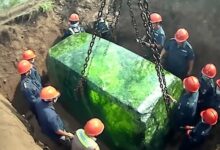


Even more surprising were the carefully cut stone shims positioned beneath the boulder. Terry explained the shims appeared intentionally placed to hold the face at the perfect angle for visibility from approaching boats offshore. Rick and Marty quickly noticed that portions of the stone showed signs of deliberate tool work rather than natural weathering.
The discovery immediately reminded the team of earlier carved symbols previously uncovered near Peggy’s Cove and other locations connected to Oak Island theories involving the Knights Templar.
According to Terry, these markers may have formed part of a hidden navigational system used centuries ago by individuals who understood how to read the coastline.
A Wooden Slipway Emerges From the Swamp
Back on Oak Island, Gary Drayton and Peter Fornetti made another remarkable discovery while investigating the southeastern corner of the swamp. After detecting metal signals beneath the mud, the pair uncovered parallel wooden timbers connected by hand-forged iron braces.
Initially, the structure appeared to resemble the top of a buried shaft. But archaeologist Laird Niven quickly reached a different conclusion.
“This is not a shaft,” Laird explained. “This is a slipway.”
The wooden ramp would have allowed boats to unload heavy cargo directly from the water onto carts, transporting materials inland toward higher ground near the Money Pit.
The location proved especially important because geological studies suggest the swamp area was once open shoreline before becoming flooded centuries later.

The Team Discovers Evidence of Underground Transport
Days later, Gary Drayton made another important find while working alongside David Fornetti, Dr. Aaron Taylor, and Miriam Amirault near the eastern swamp trenches. Buried deep within the trench wall, the team uncovered a heavy iron caster wheel.
Gary immediately recognized the object as part of a small transport cart designed for tunnels or confined underground spaces.
The wheel added another layer to growing evidence suggesting extensive tunneling operations once existed beneath Oak Island. Previous discoveries — including ancient tunneling tools and cribbing timbers — already pointed toward large-scale underground engineering efforts.
Now the caster wheel appeared to confirm that heavy cargo may have been moved underground using specialized transport systems.
The Massive Stone Road Changes Everything
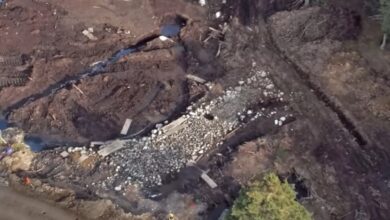
Perhaps the most significant discovery came when Rick Lagina, Tom Nolan, and Dr. Aaron Taylor fully exposed what initially looked like random stones scattered through the swamp. After weeks of excavation, the feature revealed itself as a massive engineered stone roadway stretching from the swamp inland toward the uplands near the Money Pit.
The road was carefully constructed using interlocking stones laid over timber cribbing designed to prevent sinking into the swampy ground. Aaron Taylor explained the engineering closely resembled medieval European harbor construction methods.
The lower section of the road appeared rougher and more temporary, while the upper section showed signs of advanced planning and permanent construction.
For the team, the implications were enormous.
The road suggested ships may have once unloaded cargo directly into the swamp before transporting it inland through a carefully engineered route.
Coal Fragments Revive an Old Theory
While studying the stone road, the team uncovered another disturbing detail: large amounts of coal and charcoal buried between the stones.
According to Rick Lagina, there should have been no reason for coal to exist on Oak Island before industrial search operations began in the 1860s.
The discovery immediately revived a theory first proposed years earlier by the late Fred Nolan. Nolan believed Oak Island was originally two separate islands connected by a narrow water channel. He theorized a treasure ship may have been intentionally burned and sunk within the channel before the swamp was artificially created to hide the operation.
The coal fragments and burn evidence along the stone road may now support that theory for the first time.
A 1347 Map May Have Been Mistranslated for Years
Meanwhile, mechanical engineer Matt Santi introduced what could become one of the investigation’s most important breakthroughs.
Using the original medieval French version of Zena Halpern’s famous 1347 map, Matt argued that earlier English translations contained a major error involving the map’s leader lines.
According to Matt, the phrase previously interpreted as separate features should actually be read as one location: “the hole under the hatch.”
When the corrected translation was overlaid onto a satellite image of Oak Island, the location pointed directly toward Lot 4 — an area of the island that has received relatively little exploration.
The revelation stunned Rick and Marty.
If the corrected translation proves accurate, it could completely redirect the entire search effort.
The Discoveries Begin Forming One Unified Story
What makes these discoveries so important is not simply the individual artifacts themselves, but how closely they now connect together.
The carved coastal markers suggest navigational guidance systems.
The slipway points to cargo unloading operations.
The caster wheel supports underground transportation theories.
The stone road connects the harbor area directly to inland excavation zones.
The coal fragments may indicate the deliberate destruction of a ship.
And the corrected medieval map appears to identify a specific hidden target location.
Taken together, the clues no longer describe random treasure hunting legends.
They describe a coordinated engineering operation.
Oak Island’s Mystery May Be Entering a New Phase
Despite the growing evidence, Rick Lagina admitted the discoveries continue raising even bigger questions.
“We get excited at all these things we find,” Rick said, “and we are just left with more questions.”
Still, the team now believes they may finally be approaching the moment where Oak Island’s separate mysteries begin converging into one larger explanation.
The next major focus will be Lot 4, where Billy Gerhardt is already preparing equipment for a new excavation based on Matt Santi’s corrected map translation.
Whether the area contains the legendary hatch, a hidden chamber, or another unexpected clue remains unknown.
But for the first time in generations, Rick and Marty Lagina appear closer than ever to understanding what Oak Island was truly built to hide.