The Curse of Oak Island Season 13 Episode Island Hopping Was a Detour That Went Nowhere
Another Field Trip, Another Episode That Promises a Lot and Delivers Very Little
If there is one pattern The Curse of Oak Island fans know too well by now, it is this: the moment the team leaves Oak Island for an overseas field trip, expectations usually sink fast.
Season 13’s Island Hopping does exactly that.
Instead of building momentum around real excavation progress, the episode spends much of its time in the Azores, trying to convince viewers that a collection of vague visual similarities and speculative reactions somehow adds up to major historical proof. The result is an hour that feels less like a breakthrough and more like the show stalling for time while pretending it is expanding the mystery.
And that is the real frustration. The episode wants to feel important. It wants to sound like a global investigation. But what it mostly delivers is a long chain of weak connections presented as if they are far more meaningful than they actually are.



The Azores Trip Is Treated Like a Major Discovery, but Barely Moves the Story Forward
The overseas portion of the episode is supposed to feel exciting.
The team heads to the Azores, and the show strongly suggests that this trip could help prove the Templars moved treasure across the Atlantic and eventually to Oak Island. That is already a huge claim, and naturally viewers might expect something substantial to support it.
Instead, what they get is a sequence of familiar Oak Island logic leaps.
At one point, the reasoning seems to boil down to the idea that the Templars once had boats, therefore they could have brought treasure to Oak Island. That is not investigation. That is imagination dressed up as evidence. The episode keeps treating possibility as progress, even when no real bridge is built between the two.
This is where the Azores segment starts to lose viewers. The show acts as though just being in a historically old place automatically makes every symbol, wall, or church carving part of the Oak Island puzzle. But atmosphere is not proof.
Visual Similarity Is Once Again Used as Evidence
One of the oldest tricks in Oak Island is the “look at this, it looks like that” approach.
And Island Hopping leans on it heavily.
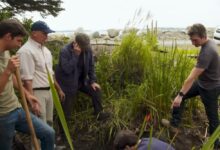
The team visits a church and spots a symbol that they say resembles one they found not even on Oak Island itself. Then they stare at a rock wall and suggest it is essentially identical to one back in Nova Scotia. Then, in one of the episode’s more absurd reaches, viewers are asked to accept that a giant stone carving is somehow “exactly the same” as a tiny copper artifact found in a completely different context.
This kind of comparison has become a staple of the show, but here it feels especially thin.
Similarity in appearance is not enough. Scale matters. purpose matters. context matters. age matters. provenance matters. Without those things, saying two objects “look alike” is little more than a conversation starter. It is not a breakthrough. But the episode keeps asking the audience to react as though visual resemblance alone is enough to rewrite history.
The Expert Segment Feels More Like Pressure Than Analysis
Perhaps the most unintentionally funny part of the episode is when the team brings a collection of Oak Island objects to a local guide or expert and asks him to weigh in.
This should be one of the stronger moments. If the episode wants to prove a historical connection, this is the place where solid interpretation should happen.
Instead, the whole scene plays like an awkward exercise in forcing relevance onto ordinary material.
The expert is shown looking at a range of objects that the show clearly wants him to connect to the Azores in some meaningful way. But the conclusions feel vague, overstated, or oddly circular. A stone shot that had previously been linked elsewhere is suddenly framed differently. A hand cannon that the expert does not recognize somehow becomes even more significant simply because it is unknown. A nail is treated as a notable clue because, apparently, it once helped hold wood together, which is not exactly a revolutionary insight. Even the coin segment ends up sounding uncertain, as though the episode is trying to draw weight from an object whose original context still feels unsettled.

At no point does this come across as definitive. It comes across as the show hoping that proximity to an old European setting will somehow make every old object from Oak Island feel more impressive.
Back on Oak Island, the Episode Barely Improves
If the Azores storyline is frustrating, the return to Oak Island is not much better.
After all the dramatic framing, the island-side discoveries are almost comically small. The team digs near a stone feature and finds dirt and rocks near the stone feature. Then they dig near the swamp and find dirt, rocks, and a nail near the swamp.
That is, unfortunately, not much of an exaggeration.
The problem is not that archaeology is slow. Real archaeology often is slow. The problem is that the show continues to present minimal findings as though they are major confirmations of larger theories. Every ordinary piece of earth disturbance is treated like validation. Every fragment becomes “potentially significant.” Every shallow hint gets packaged with dramatic music and intense narration.
By the end, the viewer is left with the impression that almost nothing actually happened, yet the episode still expects applause for how “important” it all was.
The Episode Confuses Activity With Progress
That may be the biggest issue with Island Hopping.
A lot happens, in the sense that people travel, point at things, dig in a few places, hold up objects, and talk in serious voices.
But almost none of it feels like real progress.
The story does not become clearer. The evidence does not become stronger. The theories do not become more disciplined. If anything, the episode makes the mystery feel looser and more inflated, because it keeps piling broad speculation on top of weak connections without giving the audience much to stand on.
That is a dangerous habit for a show this deep into its run. After so many seasons, viewers are not just looking for motion. They are looking for payoff. They want to know that the time being spent on side trips and dramatic interpretations is leading somewhere real.
Here, it does not feel that way.
Why These Field Trip Episodes So Often Fail
The reason these episodes tend to disappoint is simple.
They almost always replace excavation with suggestion.
Instead of uncovering new physical evidence on the island, they send the team somewhere visually interesting, let them react to old structures and symbols, and then build an episode around the idea that “this could be connected.” But “could be connected” is the weakest fuel this show runs on, and by this point, viewers know it.
That is why Island Hopping feels especially flat. It is not just boring because it moves slowly. It is boring because it repeats a formula that no longer feels persuasive. The show wants the field trip to feel like expansion. What it actually feels like is avoidance.
A Better Episode Would Have Asked Harder Questions
What makes the episode even more frustrating is that the raw material could have been interesting.
A trip to the Azores could have worked if the show had been more disciplined. It could have explored real maritime history, stronger documentary evidence, clearer artifact chains, or more serious comparison methods. It could have asked whether the similarities were meaningful or superficial. It could have brought skepticism into the frame instead of treating every resemblance as exciting by default.
But that is not what happens.
Instead, the episode mostly asks viewers to accept that because something is old, foreign, and vaguely similar to something else, it must matter. That is not history. That is mood.
In the End, It Feels Like Filler With Better Scenery
By the time the episode wraps up, the central impression is hard to escape.
This was filler.
Expensive-looking filler, international filler, mysterious-sounding filler, but filler all the same.
The Azores trip produces atmosphere but not substance. The island digging produces motion but not meaningful discovery. The expert segment produces reactions but not clarity. And the whole episode ends up feeling like a long pause in the real search, stretched into something grander than it deserves to be.
Final Verdict
Island Hopping is the kind of Oak Island episode that reminds viewers how thin the line can be between mystery and repetition.
Yes, it offers travel. Yes, it offers old symbols, dramatic narration and serious-looking conversations. But underneath all that, it has very little to show. The episode asks the audience to be impressed by resemblance, possibility and vague association, while giving them almost no hard reason to believe the story has genuinely advanced.
For viewers already tired of the show’s field trip formula, this episode will probably confirm the worst.
It is not just slow.
It is a detour that feels like it goes nowhere.