Oak Island Season 13 Episode 22 Pushes the Mystery Toward Portugal
A Late-Season Decision Refocuses the Search
As The Curse of Oak Island moves into the final stretch of Season 13, Episode 22, Road Trip, marks a major shift in strategy.
With only a few episodes left in the season, the team gathers in the war room to decide where the next caisson should go in the Money Pit area. Up to this point, they have already explored several deep targets, but time is running short and the group needs to focus on the location with the strongest scientific promise. That decision leads them to a new target called MS1, a point selected after reviewing water-testing data collected by Dr Ian Spooner and Dr Fred Michael. According to their analysis, this zone contains some of the highest trace readings of gold, silver and other precious metals found anywhere on site.
For the team, this is not just another random hole. The belief is that repeated collapses over more than two centuries may have caused precious material once located higher in the Money Pit to sink deeper into the solution channel. If that theory is correct, then MS1 could represent one of the best remaining chances to intercept evidence of the original deposit.

The Science Behind MS1 Raises Expectations
The selection of MS1 is significant because it is driven directly by the scientific data the team has been collecting throughout the season.
Dr Spooner again argues that the precious metals detected in the water are not naturally occurring in this context. In his view, those readings suggest that valuable material remains below the surface and that it was not entirely removed in the past. That is why the team decides to sink the new caisson in a spot northwest of the Hedden shaft outline and north of the Chapel shaft, an area that earlier searchers likely did not adequately explore beyond the bedrock shelf.
As excavation begins, the team hopes the new target will finally bring them closer to the source of the long-discussed metal signatures. At this point in the season, the strategy is clear: trust the data, move quickly, and see whether the deepest untested zone can finally deliver something decisive.
The Swamp Road Continues to Change the Picture
While the Money Pit remains central, the swamp once again proves it may hold some of Oak Island’s most important clues.
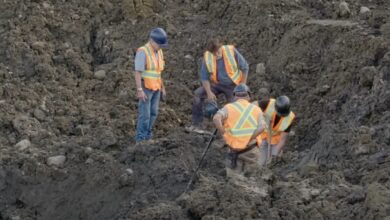
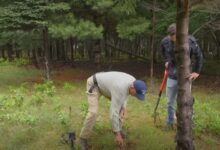
The team continues tracing the sand-and-cobble road they have been following through the swamp. As more sections are exposed, it appears increasingly likely that the feature aligns with the stone road in the southeastern corner of the swamp. Organic material taken from inside the road has reportedly dated to the 1500s, and the construction style is said to resemble Portuguese methods.
Peter Fornetti finds yet another survey stake along the road, while Gary Drayton recovers what he identifies as a very old ox shoe. These repeated finds strengthen the idea that this was once a functioning route rather than a random or natural formation. The road is beginning to look like part of a larger system of movement across the island, possibly linking key areas such as Lot 5 and the Money Pit.
Center Road May Be Hiding Something Much Older
One of the most interesting developments in the swamp is the growing belief that the so-called sand road may continue beneath the modern Center Road.
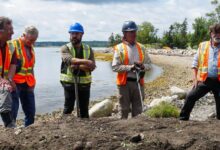
Craig Tester joins Peter, Gary and Billy and suggests that the newly exposed feature appears to run along the same line as Center Road, the route associated with the island’s 1762 survey divisions. This raises a remarkable possibility: instead of the road being built after the survey, the survey itself may have followed an already existing path.
That idea has major implications. If Center Road was built on top of a much older route, then Oak Island’s transport network may predate official lot divisions by centuries. Peter notes that the team already has strong reasons to believe Lot 5 is connected to the Money Pit, and a buried older road could help explain how people once moved between those locations.
A Stone Shot Points Toward the Azores
The episode’s biggest turning point comes not from the swamp, but from analysis of a stone shot found deep in the Money Pit area.
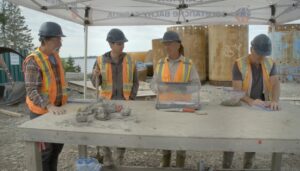
Back in the war room, the team speaks with geology professor Robert Rysdijk, who has studied the stone projectile recovered in the previous episode. After cutting it and examining its makeup, he concludes that it matches two other similar finds from the Money Pit area and points toward the Azores, a Portuguese archipelago in the Atlantic. He argues that all three shots suggest a significant human presence on Oak Island in the 1400s.
This is where the narrative takes its boldest step. The stone shot is no longer treated as just an unusual object from underground. It becomes a potential transatlantic clue linking Oak Island to Portuguese exploration, and specifically to a historical world connected with the Knights of Christ, the Portuguese order associated with the legacy of the Templars.
The Portugal Theory Gains New Momentum
The Azores connection immediately gives new life to one of the show’s longest-running theories.
The team discusses how the Portuguese coin previously presented to them dates from the late 1300s and how political unrest in Portugal may have encouraged the Knights of Christ to move religious treasures away from Europe. Research by Doug Crowell, Emiliano Sacchetti and others suggests that the Azores may have served as a staging point before such materials were moved to a more distant safe haven, possibly Oak Island.
What makes the theory especially compelling for the team is the claim that multiple maps from the 1300s already show the Azores accurately, despite the accepted discovery date being later. In the show’s logic, that strengthens the idea that the islands were known, used and possibly strategically important well before standard history usually acknowledges.
Lot 8 Continues to Raise Questions
Elsewhere on the island, Lot 8 remains a source of growing interest.
At the structure on Lot 8, Laird Niven and Fiona Steele believe they may have reached the natural bottom, though they still have not encountered bedrock or slate. Peter asks whether heavier equipment might be used nearby, within archaeological limits, to help define the boundaries of the feature. He points out that the team has already been misled before by Oak Island’s unusual soil conditions, where what looked like the bottom turned out not to be the end at all.
This matters because Lot 8 has increasingly emerged as one of the more intriguing peripheral areas on the island. While the Money Pit remains the main target, the surrounding lots continue to suggest that important activity was spread across a much wider area than earlier searchers may have realized.
MS1 Brings More Frustration in the Money Pit
Despite the hopes surrounding the new caisson, the dig at MS1 delivers more uncertainty than answers.
During the excavation, the team encounters cut wood deep underground, a sign that usually points to human-made structure. But between 140 and 150 feet, the caisson hits a difficult obstruction. The driller keeps trying, and eventually the team breaks through, only for the final bucket of spoils to come up empty of meaningful wood or artifacts.
That disappointment forces Rick and Marty to reconsider their next move. They decide that if MS1 does not bear fruit, they will return to TPF1, the first caisson target of the season, because of the strong silver signature detected there and the continuing belief that the area may contain more coins associated with the Portuguese find mentioned earlier in the season.
The Team Prepares for an International Search
The episode ultimately builds toward a very different kind of investigation.
After further discussion in the war room, the team begins planning a road trip to the Azores. Marty supports the idea, while noting that he will stay behind on Oak Island to keep operations moving. For Rick, however, the overseas trip represents a chance to gather previously unknown information that could later shape where and how the team digs back in Nova Scotia.
This is what gives Episode 22 its importance. It is not just about whether the latest caisson succeeded. It is about how the mystery is expanding. Oak Island is no longer being treated purely as an isolated treasure site. It is being investigated as part of a much larger Atlantic story involving Portugal, the Azores and the wider legacy of the Templars.
Road Trip Becomes a Bridge to the Final Episodes
In the end, Road Trip feels like a setup episode, but an unusually important one.
It adds scientific weight to the MS1 search, deepens the mystery of the swamp road, suggests that Center Road may conceal a far older route, and introduces a stone shot that sends the investigation across the Atlantic. It also sets up the next episode, Island Hopping, where Rick leads members of the team to the Azores while Marty continues work at home.
That split storyline may prove crucial. If the Azores trip produces architectural or historical parallels that match finds on Oak Island, and if the island itself continues yielding evidence from areas like Lot 8, the team may finally begin connecting some of the show’s biggest theories into one larger explanation.
For now, Episode 22 does not solve the mystery. But it clearly changes its direction. And after years of digging in the same ground, that shift may be one of the most significant developments of the season.