Oak Island’s Search Takes a Dramatic International Turn
A New Discovery May Push the Mystery Far Beyond Nova Scotia
For more than a decade, viewers have watched Rick and Marty Lagina pour time, money and determination into one of television’s most enduring treasure hunts. Year after year, the Oak Island team has battled mud, floodwater, freezing temperatures and countless setbacks in the Money Pit area, all while chasing answers to a mystery that has lasted more than 230 years.
But in this latest chapter, the story appears to be shifting in a remarkable new direction.
What if the final answer to the Oak Island mystery is not buried deep beneath the island at all? What if the most important clue lies more than 2,000 miles away, across the Atlantic Ocean? That possibility now sits at the centre of the team’s investigation, turning what was once a tightly focused dig in Nova Scotia into something much broader and potentially international in scope.


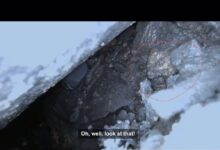


Episode 22 Signals a Major Change in the Investigation
Season 13, Episode 22, titled Road Trip, is presented as a turning point not just for the current season, but for the wider direction of the series.
For years, the Oak Island team has concentrated its effort on a relatively small area of land, searching for signs of a hidden vault, engineered flood system or underground deposit. Their work has involved drilling, sonar analysis, caisson excavation and the careful recovery of objects from the Money Pit, the swamp and various lots across the island. But now, according to the narrative presented in this episode, the evidence is encouraging them to look far beyond Oak Island itself.
Rather than narrowing the investigation, the latest discovery appears to expand it. The team is no longer only asking what lies underground in Nova Scotia. They are now asking whether Oak Island may have been connected to a much larger Atlantic story involving European exploration, military orders and possible pre-Columbian activity.
The Swamp Continues to Offer New Structural Clues
Before the investigation takes its dramatic overseas turn, the episode also revisits the swamp, an area that has long fueled some of Oak Island’s most ambitious theories.
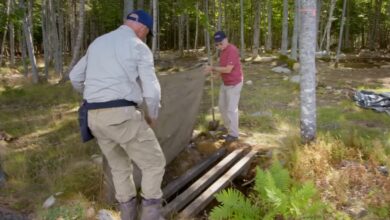
The triangular swamp on the island’s southern end has often been treated by the team as more than a natural feature. Instead, it has been interpreted as a man-made zone, possibly engineered to hide a vessel, protect a vault or conceal a secondary part of the broader Oak Island system. In this episode, attention returns to the sand-and-stone road beneath the swamp, where viewers reportedly spotted more intriguing material being pulled from the muck, including a wooden stake, a rusted iron nail and what looked like a newly branching path off the main cobblestone feature.
On an ordinary archaeological site, such finds might seem minor. On Oak Island, however, they are treated as potentially meaningful evidence of planned activity. A second path branching away from the main road suggests complexity, not randomness. It hints that the swamp may once have formed part of a larger engineered network rather than a single buried feature.
The Money Pit Discovery Changes the Direction of the Story
As interesting as the swamp developments may be, the episode’s real significance lies elsewhere.
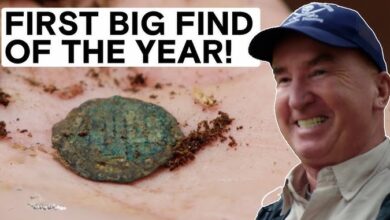
In the Money Pit area, the team has continued exploring a deep anomaly often described as the Baby Blob. This target has already drawn heavy excavation, steel casings and advanced scanning technology as the team chases signs of a hidden structure or deposit. But the new discovery highlighted in Episode 22 is said to be something entirely different: a round stone shot recovered from deep underground.
That object is presented as unusual enough to force a complete reassessment of the investigation. Rather than fitting the expected pattern of collapsed searcher debris or random buried material, the stone projectile is treated as a clue with wider historical implications. Its shape, composition and implied function push the team away from the idea of a purely local event and toward something transatlantic in scale.
A 2,000-Mile Connection Points Toward the Azores
According to the narrative built around the find, the round stone shot does more than add another artifact to the Oak Island collection. It allegedly points toward a specific destination: the Azores.
This is where the story takes its boldest step. By linking the object to European maritime history, the team is said to draw a line from Oak Island across the North Atlantic to the Portuguese archipelago. The implication is striking. If the artifact truly corresponds to materials or technology associated with historic European activity in the Azores, then Oak Island may not simply be a local treasure mystery. It may be part of a larger Atlantic network involving staging points, transport routes and organized exploration long before Columbus.
That theory transforms the investigation. Oak Island would no longer stand only as an isolated deposit site. It would become part of a historical chain stretching from Portugal to Canada.
Why the Azores Matter to the Templar Theory
The Azores are not introduced as a random destination. They are framed as central to one of the show’s most persistent and ambitious theories: the connection between Oak Island and the Knights Templar.
According to that line of thinking, when the Templars were disbanded in the early 14th century, many surviving members fled to Portugal, where they were protected and reorganized under the Order of Christ. This successor order played a major role in Portuguese maritime expansion, and the Azores later became an important Atlantic base during the Age of Discovery.
The theory presented in the episode suggests that these Portuguese successor knights may have used the Azores as a strategic launch point for transatlantic travel long before such voyages entered accepted mainstream history. If so, a match between the Money Pit stone shot and material linked to the Azores could be seen as evidence supporting the idea of pre-Columbian European activity on Oak Island.
Rick Lagina Takes the Search Overseas
The significance of the new clue is presented as so great that Rick Lagina decides not to wait.
Rather than leaving the question unresolved in Nova Scotia, he is said to travel with a small group of team members to the Azores in the following episode, Island Hopping. Their mission is to study ancient Portuguese structures and investigate whether architectural parallels exist between those sites and the engineered features found on Oak Island.
This split in the storyline adds a new layer of tension to the series. While Rick travels overseas in search of historical corroboration, Marty Lagina remains in Canada to continue managing a separate excavation on Lot 8. The structure of the investigation becomes more complex, with findings from Europe potentially influencing the next major dig decisions back on Oak Island.
The Fan Reaction Has Been a Mix of Excitement and Doubt
As with many major developments on The Curse of Oak Island, viewer reaction appears deeply divided between fascination and skepticism.
Some fans reportedly embraced the international turn as fresh energy for a long-running series, especially after years of mud, drilling and repeated disappointment in the Money Pit. Moving from a cold Nova Scotia excavation to the volcanic islands of Portugal gives the show a new scale and, for some, restores a sense of possibility to the final stretch of the season.
Others reacted with humor and suspicion. Online commentary reportedly joked about the convenience of discovering a single stone shot just when the production had reason to stage an overseas trip. Some viewers mocked the show’s long-running habit of drawing bold lines across maps and building large theories from limited evidence. Yet even that criticism reflects the same truth: people remain deeply engaged with the series and eager to debate every new clue.
The New Theory Builds on Years of Earlier Clues
What makes this new Atlantic theory more powerful, at least within the show’s internal logic, is that it does not stand alone.
The episode places the stone shot into a much larger body of evidence developed over previous seasons. That includes Zena Halpern’s maps, the star-alignments associated with Nolan’s Cross, the lead cross from Smith’s Cove, the reported Roman and Byzantine coins, and earlier European-style artifacts linked to the island. Taken together, these clues are used to support the idea that Oak Island may have hosted activity from well before the standard timeline usually accepted in Canadian history.
In that sense, the Azores theory is presented not as a sudden leap, but as an extension of a narrative already years in the making. Whether viewers find that persuasive is another question, but the show clearly frames this development as part of a growing transatlantic puzzle.
Weather, Production and the Shape of the Series
Of course, there is also a more practical way to view the episode’s timing.
Some fans argue that international excursions often arrive when conditions on Oak Island become especially difficult. Harsh weather, heavy mud and excavation limits can make it hard to sustain visually dramatic digging in Nova Scotia, and an overseas research trip offers the show a way to keep momentum while broadening the narrative.
That interpretation may sound cynical, but it also reveals something important about why The Curse of Oak Island remains so watchable. The show has always balanced real excavation, speculative history, visual storytelling and global mystery. Even when viewers question the conclusions, they continue to follow the journey because each new theory reopens the possibility that the next clue might finally connect everything.
Oak Island Is No Longer Just a Local Mystery
What Road Trip ultimately suggests is that Oak Island may no longer be framed as a mystery confined to one island in Nova Scotia.
Instead, the story is becoming wider, more international and more ambitious. The team is still digging in the same mud, still chasing the same unanswered questions, and still searching for whatever lies at the heart of the Money Pit. But now those questions are tied to places across the Atlantic, to the Azores, to Portugal, and to the possibility that Oak Island was part of a much larger historical movement.
Whether that theory holds up or not, it marks a major narrative shift. The mystery is no longer only about what is beneath the surface. It is also about where the clues may lead next. And in that sense, Oak Island may have just opened one of its largest chapters yet.