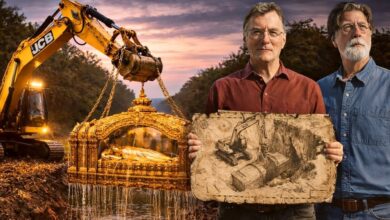
Oak Island Finds May Rewrite the Mystery With New Clues Linked to Samuel Ball

Oak Island Uncovers New Clues Linking Samuel Ball, Ancient Roads and Possible Military Activity
Fresh Discoveries Deepen the Island’s Historical Puzzle
The mystery of Oak Island has taken another significant turn as Rick and Marty Lagina, Gary Drayton, and the wider team uncovered a series of artifacts across multiple lots that may help clarify who once operated on the island and why.

What makes these latest finds especially compelling is not just their age, but their variety. From a small 18th-century spoon bowl and decorative chest hinges to possible musket-related artifacts and hand-painted pottery, the discoveries suggest that Oak Island was not shaped by one isolated event. Instead, the island may have seen repeated episodes of activity involving transport, storage, settlement, and perhaps even organized military presence.
Taken together, the finds from Lot 24, Lot 12, Lot 25, the uplands near the swamp, and especially Lot 5 are beginning to form a wider pattern. For the Oak Island team, that pattern may be pointing toward a much more connected and deliberate story than previously understood.



Lot 24 Reveals More Evidence Around Samuel Ball’s Activity
The search began on Lot 24, where Rick and Marty Lagina joined Gary Drayton and archaeologist Laird Niven to continue investigating an area that had already produced potentially important Samuel Ball-related artifacts the previous year.
The team focused on ground that had become newly accessible after tree stumps were removed, opening sections that had never been properly detected before. It did not take long before Gary received a promising signal and recovered what appeared to be a small spoon bowl. Laird identified it as an 18th-century object, likely copper, making it another meaningful clue from a site that continues to raise questions about Samuel Ball’s life and activity.
The importance of the find was not simply in the object itself. For Rick, each artifact helps piece together a larger historical narrative. Samuel Ball remains one of Oak Island’s most intriguing figures, a man who rose from slavery to become one of the wealthiest landowners in the area. Finds like this do not solve his mystery outright, but they add to the sense that something significant took place on land connected to his story.
Chest Hinges on Lot 12 Raise New Questions About Buried Storage
Elsewhere on the island, Gary Drayton, Jack Begley and Charles Barkhouse made what could prove to be one of the more visually suggestive finds of the day.
On Lot 12, near the middle of the island, Gary recovered two old decorative hinges that he believed resembled hardware once found on chests or boxes at Spanish shipwreck sites. The design immediately prompted speculation. Could these hinges have belonged to one of the missing chests long rumored to be connected to pirate Captain James Anderson? And if so, what might that say about the role of this area?
The discovery becomes even more interesting in light of the team’s belief that the area may have served as an old dump site. If that interpretation is correct, then the site may have been used not just during construction work associated with the Money Pit, but also as a place where discarded material from earlier activity accumulated over time. Pottery fragments found nearby only strengthened the idea that the site once saw sustained use.
For Marty Lagina, the find represented more than a random piece of old metal. It was a sign that the dump might hold a much wider range of buried evidence, including clues linked to storage, transport, or even hidden valuables.
Lot 25 Continues to Add Layers to the Samuel Ball Mystery
One of the most anticipated areas of investigation was Lot 25, land once owned by Samuel Ball.
With archaeologist Laird Niven’s cooperation, Rick Lagina and Gary Drayton were finally permitted to conduct supervised metal-detecting around the Samuel Ball foundation. The site is especially significant because Ball, though remembered publicly as a cabbage farmer, accumulated unusual wealth over the course of his life and eventually owned nine lots on Oak Island. That rise in fortune has long fueled speculation that he may have discovered at least part of whatever was hidden there.
Gary had already marked several promising non-ferrous signals with his pink flags before the day’s work began. The first notable recovery was a piece of lead that may have been either a musket ball or the remains of lead used in musket-ball casting. Either possibility is meaningful, as old lead finds often point to a working historic site rather than a modern intrusion.
Soon after, another signal produced a curved metal object that Gary compared, at least in shape, to the back of a pocket watch. The object was fragile and difficult to identify immediately, but it was clearly considered significant enough to bag and tag for further study. For Rick, the finds on Lot 25 are valuable precisely because they may help pull back the curtain on Samuel Ball’s life. Every object from the site brings the team slightly closer to understanding not only what Ball owned, but perhaps what he knew.
Pottery in the Uplands Suggests the Stone Path Continues Inland
Another important development came in the uplands near the northeastern border of the swamp, where archaeologists Miriam Amirault and Dr Aaron Taylor continued tracing the course of the mysterious stone pathway.
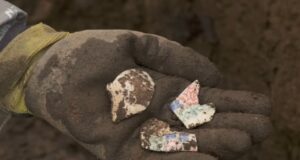
Their work produced a striking piece of hand-painted pottery featuring multiple colours, including blue, pink and green. The artifact immediately stood out as visually distinct and potentially useful in dating the surrounding context. Rick Lagina, upon seeing it, stressed the importance of archaeology in turning seemingly small finds into larger historical meaning.
More importantly, the pottery and surrounding excavation reinforced Aaron Taylor’s belief that the pathway does not simply stop at the swamp. Instead, he argued that it likely turns and continues upland. Rick agreed to have Billy Gerhardt strip back more ground so the team could test that theory.
That intuition soon paid off. As the soil was pulled back, more cobblestones were revealed, strongly suggesting that the path really does extend inland. The implication is major. If the road turns upland and heads in the direction of the Money Pit, then the team may be following another structured route across the island, one that could help explain how materials, equipment or valuables once moved between key sites.
Lot 5 Produces Some of the Most Important Clues Yet
The most potentially important discoveries of all came from Lot 5, where Rick Lagina and Gary Drayton continued searching spoil material removed from a circular depression.
This area has already yielded artifacts dated from the 17th to the mid-18th centuries, and the team believes it may hold evidence tied to a deeper enterprise on the island. The first notable item found in the spoils was a small lead shot, likely dating to the 1700s and possibly linked to military activity. That alone was enough to draw attention, especially given the ongoing theory that a 1746 French naval mission, recorded in the Duc d’Anville ship’s log, may have had some connection to treasure activity on an island in this region.
But the more remarkable find came next: a copper, barrel-shaped artifact that immediately looked unusual. Archaeologist Helen Sheldon was called over for an opinion and suggested it might be gun-related, possibly even part of a sight. That early impression made the object especially intriguing, and the team quickly decided it needed laboratory analysis.
Laboratory Analysis Points to a Musket Component With Unusual Markings
Later, at the Interpretive Center, Rick Lagina, Craig Tester, Laird Niven and Emma Culligan reviewed the Lot 5 artifact in detail.
Their conclusion was striking. The object appeared to be a ramrod guide for a musket, a component used to help guide the ramrod when loading projectiles into the barrel of the weapon. Laird noted that muskets of this kind could date broadly from the 1600s to the 1800s, already placing the find well within the historical window that matters most on Oak Island.
Yet the most unexpected detail only emerged after Emma processed the object through a CT scan. The scans appeared to reveal Roman numerals engraved on the artifact, something that immediately caught the attention of Rick and Craig because of where they had seen similar markings before. The team recalled Roman numerals associated with the famous U-shaped wooden structure discovered at Smith’s Cove decades earlier, a structure long believed to be linked to the island’s legendary flood tunnel system.
That connection gave the artifact enormous significance. According to Rick, they had not encountered Roman numerals on any other artifact before this. To now find them on a musket ramrod guide from Lot 5 raised the possibility that the feature at Smith’s Cove and the material from Lot 5 may be tied to the same historical enterprise.
The Finds Strengthen Theories of Military or Organised Activity
The musket component, the lead shot, the old hinges, and the repeated structural clues all point in one direction: Oak Island may have been used not simply by treasure seekers, but by organized groups with tools, planning, and possibly military connections.
Rick openly suggested that several of the Lot 5 finds may fit a broader context involving the Duc d’Anville expedition. While that theory remains unproven, the presence of weapon-related artifacts, Roman numerals, and early material culture gives the idea new weight. At the very least, the discoveries suggest that whoever worked on Oak Island was operating with more sophistication than a casual or purely local effort would imply.
This is why the team’s interest in Lot 5 continues to grow. If the artifacts from this area really do connect to other engineered features elsewhere on the island, then Lot 5 may represent far more than an isolated activity zone. It may be part of a much larger network of movement, storage, construction and concealment.
Oak Island’s Story Is Becoming More Connected
What makes these latest discoveries so powerful is that they do not stand alone.
The spoon bowl on Lot 24 adds to the Samuel Ball mystery. The hinges on Lot 12 raise questions about old chests and buried storage. The finds on Lot 25 deepen the enigma of Ball’s wealth and occupation. The stone pathway in the uplands suggests deliberate movement inland. And the Lot 5 musket component with Roman numerals may tie the area to one of Oak Island’s most important engineered structures.
Individually, each find is intriguing. Together, they suggest the island’s past may be far more coordinated and interconnected than many once thought. The story emerging now is not just about a single pit, a single road, or a single treasure theory. It is about a broader system, one that may have involved settlement, military equipment, transport routes, hidden storage, and long-term activity across multiple lots.
For Rick Lagina and the team, that is exactly why they keep digging. The mystery may still be unresolved, but the evidence is no longer scattered in quite the same way. It is beginning to point inward, toward a story that is slowly starting to connect.