Across Ruins, Caves and Forgotten Cities, the Search for Lost History Takes a Dangerous Turn
A journey driven by mystery
From the jungles of Cambodia to the highlands of Peru, from the underground chambers of Hungary to the caves of Honduras and the pyramids of Guatemala, the search for lost history is rarely straightforward. It is a path shaped by danger, uncertainty and the constant tension between discovery and destruction. In the text, each location presents a different mystery, yet they are all connected by the same question: what remains hidden beneath the surface, and who will reach it first?

What emerges is not simply a sequence of expeditions, but a wider portrait of how fragile the past can be. Ancient relics, tombs, ritual objects and lost settlements are shown not as static museum pieces, but as vulnerable traces of civilisations still at risk from looting, conflict, time and the environment itself.
Cambodia reveals the price of protecting the past
One of the most immediate themes in the text is the threat posed by tomb raiders and the illicit trade in antiquities. In Cambodia, a hidden expert agrees to speak only under conditions of anonymity, warning that ruins tied to a lost city may already be known to looters. Sandstone statues and sacred objects are described as targets for criminal networks willing to strip away not only valuable artifacts, but also part of the country’s identity.
The danger in Cambodia is not limited to theft. The journey toward the ruins also passes through territory still scarred by millions of landmines. The text describes a visit to the Cambodian Landmine Museum and a meeting with Akira, the former child soldier who now devotes his life to removing mines by hand. That part of the journey shifts the tone of the expedition entirely. The search for history becomes inseparable from the still-living consequences of war.




Lost worlds remain hidden in the mountains and jungle
In Peru, the text turns toward the search for remote Incan ruins and the lingering legend of a lost city of gold. What the expedition actually finds is not a golden temple, but something perhaps more important: a large and largely undocumented site, with walls, ceramics and signs of a settlement still hidden beneath the jungle. The text presents this as a reminder that the world is far from fully mapped, and that forgotten cities may still survive in places where terrain and isolation have kept them out of view.
A similar tension appears again in Honduras, where the search for ancient crystal legends leads into a cave containing untouched pottery and evidence of a much older culture. The discovery is described not as proof of every legend attached to the site, but as confirmation that the region still holds major archaeological value. The cave has preserved objects left in place for centuries, and the text makes clear that even now, there is much more work to be done before the full story can be understood.
Underground discoveries change the scale of the search
Some of the strongest moments in the text happen below ground. In Hungary, a wine cellar investigation leads to carved sandstone blocks and metal fixtures that appear to belong to a lost Ottoman structure, possibly linked to the long-sought site connected with Sultan Suleiman. The thrill of that discovery lies in its immediacy: not a rumour, not a theory, but physical stonework touched and lifted from the earth.
Elsewhere, in Mexico, underground obsidian mines reveal how Teotihuacan built its power. Green obsidian, described as rare and symbolically potent, appears as both material wealth and strategic advantage. The text argues that this resource was central to the city’s wider influence, not only economically but politically and spiritually. It suggests that understanding ancient empires often means understanding the raw materials that made them dominant.
The search for tombs continues beneath the pyramids
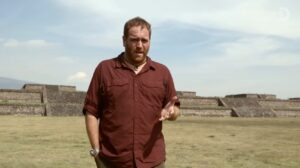
In Guatemala, the narrative moves to El Mirador, where new scanning technology points toward possible chambers hidden inside one of the great pyramids. After years of searching for the tombs of the Snake Kings, the team identifies what appears to be a void within the structure, then drills carefully and lowers a camera into the space below. The images suggest a chamber with features that may match known royal tomb architecture.
What matters here is not only the possibility of a burial, but the method itself. The text highlights the slow, careful nature of the work. Even with a potential breakthrough, excavation cannot simply be rushed. The chamber may hold answers that have remained untouched for more than two thousand years, and those answers can only be reached through patient archaeological effort.
Caves hold both wonder and danger
The underground theme reaches an even more dramatic scale in the exploration of the Cueva de los Tayos. There, the expedition extends an earlier map into a newly discovered region of the cave system, revealing vast chambers, giant formations and a geological world that feels almost beyond belief. Rather than confirming every myth attached to the site, the text suggests that the cave offers something more grounded but equally powerful: a record of time, environment and survival written into stone itself.
But the cost of exploration is never far away. Conditions underground are harsh, the environment is full of insects and bats, and the expedition ends with several crew members hospitalised by illness. The message is clear throughout the text: discovery is often romantic from a distance, but at close range it is exhausting, dangerous and unpredictable.
Treasure stories blur the line between evidence and legend
The text also returns repeatedly to treasure legends, from pirate caves in the Seychelles to tales of sacred relics and hidden archives. In some cases, hard evidence begins to emerge, such as unexplained mortar in a sea cave or architectural remains beneath later structures. In others, the narrative becomes more ambiguous, with documents, cryptograms and long-circulated stories subjected to closer scrutiny.
That balance between evidence and legend is one of the strongest threads running through the piece. Treasure may attract attention, but the deeper value often lies elsewhere: in understanding the people who created these places, the networks that connected them and the beliefs that shaped what they left behind. The text repeatedly suggests that the most important discoveries are not always made of gold.
Ancient objects still carry cultural weight
Whether the artifact is a Khmer statue, an Incan ceramic, a carved Ottoman stone or a Maya vessel, the text consistently returns to one idea: these are not simply objects. They are extensions of cultural memory. To remove them without context is to lose part of the story they were meant to tell.
That is why the expeditions often stop short of reckless excavation. In Peru, the choice is made to leave a site undisturbed until it can be properly managed. In Honduras, local authorities are alerted after the cave discovery. In Guatemala, the potential tomb chamber is approached with caution rather than haste. The text presents responsible archaeology as the opposite of treasure hunting, even when both begin with the same excitement.