Oak Island Season 13 Episode 16 Recap: Massive Boulder Lift, Silver Detected Underground, and a George Washington Medal Deepen the Mystery

The Curse of Oak Island Season 13 Episode 16 Recap: New Discoveries Push the Mystery Forward
Episode 16 of The Curse of Oak Island Season 13 continues the long-running effort to uncover what lies beneath Oak Island. The episode brings together engineering challenges, intriguing discoveries, and new historical theories that stretch the possible timeline of activity on the island.
From drilling setbacks in the Money Pit area to the discovery of an artifact connected to George Washington, the investigation advances across several key locations. The most dramatic moment comes when the team lifts a massive boulder on Lot 8, revealing disturbed soil beneath it and detecting traces of silver underground.
Together, these developments add fresh momentum to one of the world’s longest-running treasure hunts.



Drilling Problems at the Money Pit
The episode begins with a disappointing development in the Money Pit region. Rick Lagina, Marty Lagina, Craig Tester, and Scott Barlow meet to discuss a major issue with the drilling operation known as Top Pocket Find One (TPF1).
The team had been installing a large steel shaft using a seven-foot-diameter auger, hoping to reach the solution channel where earlier drilling detected elevated traces of silver.
However, the operation quickly runs into trouble.
The drill becomes stuck about 25 feet below the surface. While the auger can still spin, the casing cannot move because the drill has encountered dense backfill gravel left behind by earlier excavations.
The situation brings drilling to a halt and forces the team to reconsider their strategy.
The Creation of the Karma 1 Shaft
Rather than wait idly for new equipment to arrive, the team decides to shift their efforts to a nearby location.
This new site had previously produced an intriguing clue: a piece of old drill pipe believed to date back to the 1849 excavation conducted by the Truro Company. That historical operation reportedly recovered a medieval Portuguese silver coin from deep within the Money Pit area.
Because groundwater tests in the surrounding area also showed elevated metal levels, the team decides to begin drilling there.
They name the new shaft Karma 1, hoping that the unexpected setback may have led them to a more promising location.
Investigations Continue in the Swamp
While drilling equipment is repositioned, another group continues work in the swamp.
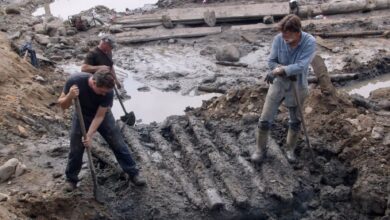
Over the past few seasons, the swamp has become one of the most fascinating areas on Oak Island. Researchers have discovered what appears to be a stone roadway, paved surfaces, and a line of unusual wooden stakes.
Surveyor Steve Guptil has been carefully mapping these stakes. Each one is shaped into an eight-sided form and placed with consistent spacing along the edge of a cobblestone pathway.
The regular positioning suggests intentional surveying rather than random placement.
During the excavation, metal detection expert Gary Drayton makes another discovery — a small round object with visible markings.
At first, the team suspects it might be an old coin or button. However, the heavily corroded object requires laboratory analysis before its true identity can be confirmed.
A Medal Linked to George Washington
Later in the episode, the mysterious artifact is examined in the Oak Island laboratory.
Materials specialist Emma Culligan and archaeologist Laird Niven determine that the object is not a coin at all.
Instead, it is a Washington Funeral Medal, created in 1800 to commemorate the death of George Washington in 1799. These medals were designed by inventor Jacob Perkins and distributed during memorial services held on February 22, 1800.
The discovery raises an intriguing question.
How did a commemorative medal connected to one of the most famous figures in American history end up buried on Oak Island?
Because George Washington was a prominent Freemason, the find also strengthens ongoing theories suggesting that Masonic networks may have played a role in the island’s mysterious past.
The Dramatic Boulder Lift on Lot 8
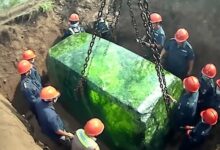
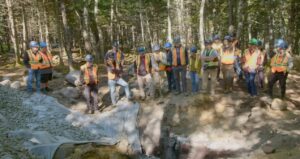
One of the most dramatic scenes of the episode takes place on Lot 8, where the team prepares to lift a massive 40,000-pound boulder.
Previous excavations around the rock revealed several unusual features. Smaller stones appeared to have been deliberately positioned to stabilize the boulder, and a void beneath it suggested the ground had been disturbed.
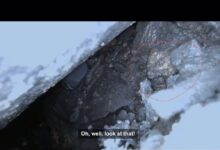
Earlier camera footage even captured what looked like a metallic object beneath the rock, along with a gold-colored substance.
Soil samples from beneath the boulder also showed unusually high concentrations of lead.
Because of these anomalies, archaeologists suspect the rock may have been deliberately placed to conceal something underneath it.
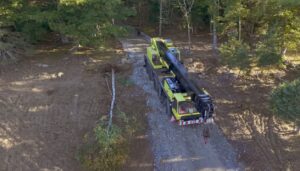
Using a 130-ton crane, the team carefully lifts the enormous stone.
What they find beneath it is surprising.
Instead of natural glacial subsoil, the ground contains dark organic material that appears to have been deliberately deposited.
This strongly suggests that the boulder was placed by human hands rather than left there naturally.
Silver Detected Beneath the Boulder
After the rock is removed, geoscientist Dr. Ian Spooner performs a chemical analysis using a handheld XRF spectrometer.
The results reveal something unexpected.
The soil beneath the boulder contains detectable traces of silver.
This discovery is significant because silver has also been detected in groundwater samples from the Money Pit area. The presence of the metal beneath Lot 8 suggests that a larger source of silver could exist deeper underground.
Dr. Spooner explains that if a shaft or tunnel once existed beneath the rock, mineral particles may have migrated upward through groundwater movement or airflow.
Another possibility is that buried objects such as silver coins could be located below the site.
Astronomical Alignments and the Templar Theory
The episode concludes with a presentation from Italian archaeoastronomy expert Adriano Gaspani.
Gaspani studies the arrangement of the eight-sided stakes discovered in the swamp and compares them to astronomical alignments.
His analysis suggests that the stake positions correspond with the Cygnus constellation and align with the famous stone formation known as Nolan’s Cross.
According to his research, the alignment may date back to around 1200 AD.
If correct, this could indicate that people with advanced astronomical knowledge were present on Oak Island centuries before its recorded discovery.
Some researchers believe such knowledge may have been associated with the Knights Templar, a medieval order often connected to Oak Island theories.
A Mystery That Keeps Expanding
Episode 16 delivers both challenges and promising discoveries.
The stalled drilling operation in the Money Pit initially slows progress, but the creation of the Karma 1 shaft opens a new direction for exploration.
At the same time, the discovery of the Washington Funeral Medal, the disturbed soil beneath the Lot 8 boulder, and traces of silver underground all add new layers to the mystery.
Meanwhile, the astronomical analysis of the swamp stakes hints that the island’s history may stretch back nearly 800 years.
Each new clue raises fresh questions.
But together, they bring the team one step closer to answering the question that has puzzled explorers for more than two centuries:
What really happened on Oak Island — and is the legendary treasure still waiting to be found?