Oak Island: TOT-1 Descends Toward the Solution Channel
As drilling continues in the TOT-1 shaft, the team edges closer to the mysterious solution channel — and possibly the legendary vault believed to lie more than 200 feet underground.
Jack Begley and geologist Terry Matheson carefully monitor the depth as the caisson pushes downward. By late afternoon, the shaft has reached 142 feet and continues progressing steadily.
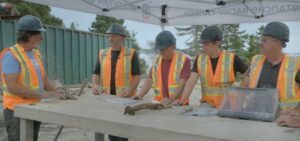
Wood fragments begin surfacing in large quantities — a promising sign.

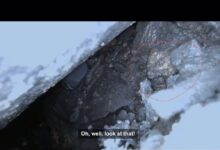


Terry suggests they are cutting through the side of the historic Chappell Shaft, constructed in 1931 by Melbourne Chappell, his father William, and treasure hunter Frederick Blair during their ambitious but unsuccessful attempt to reach a suspected vault.
If TOT-1 is indeed intersecting the Chappell Shaft, the team may finally be working below previous searcher efforts — placing them in territory untouched for nearly a century.
The critical question remains: once they pass 200 feet, will they encounter the legendary vault?
A Deep Discovery: Iron at 160 Feet
Later that afternoon, Marty Lagina and metal detection expert Gary Drayton make a striking discovery in the spoils.
At a depth exceeding 160 feet — deeper than any prior treasure hunter — they uncover a heavy, hand-wrought iron fragment.
The striations and curved profile suggest it may be part of a pickaxe, possibly used for tunneling.
This is not the first time such a tool has surfaced. In 2019, a similar broken pickaxe was found nearby in shaft RF-1. More intriguingly, during a recent research trip to Malta, historians noted that similar tools were used by the Knights of Malta in 16th-century underground tunneling systems.
If this tool predates modern search efforts, it could represent direct evidence of original construction activity deep within the Money Pit.

Carmen Legge’s Analysis: A 16th-Century Tool?
The following day, blacksmithing expert Carmen Legge examines the artifact in the Oak Island laboratory.
His assessment is significant.
The folded grain structure indicates repeated impact against stone. The metallurgy suggests a heavy mining tool, likely part of a pickaxe.
Most notably, Carmen dates it to the 1500s, possibly early 1600s — centuries before the Money Pit’s documented discovery in 1795.
Archaeometallurgist Emma Culligan supports this timeline. Elemental analysis shows impurities consistent with iron produced between the 1500s and 1700s.
If accurate, the tool predates known searchers by nearly three centuries.
This discovery strengthens the possibility that early European groups — potentially linked to the Knights of Malta — conducted organized tunneling operations on Oak Island long before the treasure legend began.
For Marty and Rick, the implication is profound: they may be drilling through original depositional work.
Smith’s Cove: A Shoreline Signal
Meanwhile, Gary Drayton and Alex Lagina scan the shoreline at Smith’s Cove during low tide.
A deep metal signal beneath several feet of rock and sediment prompts excavation. After careful digging and water removal, the team extracts a large encrusted iron object.
Initial excitement suggests it could be shipwreck material or part of a significant structure.
However, laboratory analysis reveals it to be a cast-iron stove door featuring a decorative starburst design.
Metallurgical testing dates it to the mid-1800s, likely tied to searcher activity rather than original treasure depositors.
Though not medieval, the artifact still contributes to the layered history of the island.
The Restall Shaft and the Flood Tunnel
Back at Smith’s Cove, Rick Lagina joins Craig Tester and the crew to investigate signs of the vertical shaft built by the Restall family in 1961.
Wood structures emerge at the expected depth. Metal detection reveals modern nails and hardware consistent with Restall construction forms used during their attempt to pour concrete into the shaft.
The presence of these materials confirms they are close to the Restall worksite.
The significance lies beyond the shaft itself.
If they can precisely locate this vertical shaft, they may finally identify the elusive flood tunnel system believed to channel seawater into the original Money Pit.
Finding that connection would provide critical confirmation of engineered hydraulic defenses — a feature long considered one of the island’s most compelling mysteries.
Momentum and Meaning
Between the ancient pickaxe fragment in TOT-1 and the structural clues at Smith’s Cove, the team gathers pieces of a much larger narrative.
The iron tool suggests organized tunneling centuries earlier than previously confirmed.
The shoreline excavation reinforces the existence of complex shaft systems.
For Rick, the convergence of blacksmithing analysis, metallurgical data, archaeology, and historical research represents something rare — interdisciplinary alignment.
The work continues.
As TOT-1 moves deeper toward the solution channel, the possibility grows stronger that they are following the path of original builders.
And if that path leads beneath 200 feet — into the void — the next discovery could redefine everything known about Oak Island.