Ancient Jewelry Find Adds New Layer to Oak Island’s Flood Tunnel Investigation

Ornate Ring Discovery in the Swamp Raises New Questions on Oak Island
Oak Island, Nova Scotia — A routine sweep with a metal detector in the island’s triangle-shaped swamp has led to a potentially significant discovery: an ornate silver ring that may date back to the early 18th century or earlier. The find adds another layer to the growing body of evidence suggesting deliberate activity in the swamp area long before modern treasure hunts began.
A Signal Worth Digging
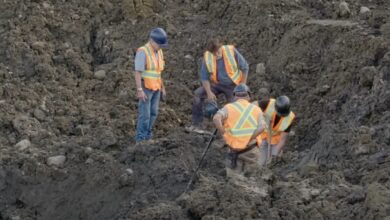
Rick Lagina and Gary Drayton returned to the swamp to continue investigating a massive stone-paved feature uncovered earlier in the year. For the first time, water levels allowed deeper access along the bank.
After several minor signals — including a tin can lid — Gary’s detector lit up again. What emerged from the mud was a thick, intricately patterned ring.
“It’s a ring, mate,” Gary said, visibly excited. Unlike modern jewelry, the piece featured hand-cut floral detailing and no gemstone setting. The craftsmanship immediately suggested age.



“This is a top pocket find,” Gary declared.
Expert Analysis: Pre-1730 and Possibly Spanish
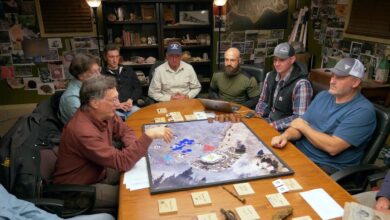
The team consulted Charles Lewton-Brain, a professional gemologist and master goldsmith with more than three decades of experience. After examining detailed photographs, Lewton-Brain delivered compelling insights.
- The ring shows evidence of at least two repairs — one to enlarge it, another to reduce it.
- The floral design appears hand-chiseled rather than saw-cut.
- Saw blades were not widely available to jewelers until approximately 1730–1750.
His conclusion: the ring likely dates to pre-1730, and the floral motif suggests a European origin, possibly Spanish.
The implications are notable. In 1652, the team discovered a Spanish Maravedí coin in the same swamp. If the ring is indeed Spanish and of similar age, it strengthens the case for early European activity in the area.
Offshore Clues: A Possible Second Flood Tunnel
While excavation at Smith’s Cove remains limited due to permit constraints, attention has shifted offshore. Sonar scans conducted by the Centre for Geographic Sciences (COGS) revealed several anomalies on the southern seafloor.
Among them:
- A triangular rock formation pointing toward the Money Pit.
- Objects resembling a possible anchor.
- Anomalies that could represent vent systems or structural remains.
Professional diver Tony Sampson, joined by Alex Lagina, descended to investigate. Despite heavy underwater vegetation, they confirmed that the triangular formation aligns directionally with the Money Pit.
If deliberate, the formation could function as a marker connected to a second flood tunnel system.
More Finds in the Swamp: Tools and Leather
Back on land, excavation just north of a previously discovered slate-and-brick vault uncovered additional clues:
- Axe-cut wooden survey stakes.
- An iron spike.
- A possible chisel.
- Fragments of thick leather footwear.
Leather expert Joe Landry examined the artifacts at the Oak Island Research Center. His assessment:
- The thicker sole likely belonged to a heavy boot.
- The tanning method suggests oak-tanned leather.
- Estimated date range: 1830–1900.
This timeframe overlaps with the residency of Anthony Graves, a 19th-century landowner who lived near the swamp. Though Graves never formally participated in Money Pit excavations, historical records indicate he later spent Spanish silver coins in nearby Mahone Bay.
The proximity of these leather artifacts to the empty vault structure raises questions: Did Graves discover something in the swamp? And if so, could there be another vault still hidden?
Connecting the Threads
The ring predates 1730.
The coin dates to 1652.
The leather aligns with mid-19th century occupation.
The offshore formation points toward the Money Pit.
Individually, each discovery raises questions. Together, they suggest a layered history of activity in and around the swamp — possibly spanning from early European visitors to later island inhabitants.
Rick Lagina summarized the situation clearly: each clue leads to another.
The swamp continues to yield artifacts. The seafloor presents new targets. And while definitive answers remain elusive, the accumulation of dated evidence is gradually narrowing the timeline of who may have worked on Oak Island — and when.
For the team, the search is no longer only about treasure. It is about reconstructing the story hidden beneath centuries of mud, stone, and speculation.