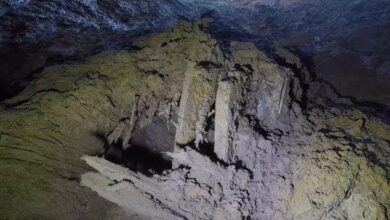
Sudden Cave-In at Smith’s Cove Reveals Wooden Structure That Could Rewrite the Oak Island Mystery

Possible Flood Tunnel Discovery Forces Oak Island Team to Halt Excavation
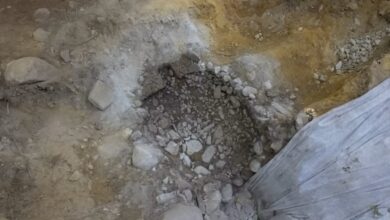
Oak Island, Nova Scotia — A dramatic discovery near Smith’s Cove may have brought the Oak Island team closer than ever to locating the legendary flood tunnel system believed to protect the Money Pit. But just as excitement peaked, safety concerns and permit restrictions forced the team to suspend operations in the area.
Water Surge Sparks Urgent Investigation
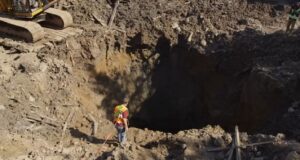
The moment began with what appeared to be a sudden surge of water erupting from the bottom of an excavation site in the uplands near Smith’s Cove. Team members observed water “squirting up like a geyser,” raising immediate questions about whether they had intersected part of the long-theorized flood tunnel system.
Responding to the call, Marty Lagina joined Craig Tester, Jack Begley, Gary Drayton, and Billy Gerhardt to assess the situation. What they encountered was both promising and dangerous. Water was clearly rushing in from the landward side — consistent with historical accounts of engineered flood tunnels designed to protect the Money Pit from excavation attempts.
Within moments, however, the unstable ground began collapsing. Large sections of earth sloughed off into the hole, forcing the team to retreat. Safety quickly became the priority.



Camera Reveals Possible Tunnel Structure
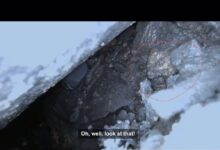
Unable to safely enter the collapsing shaft, the team mounted a camera to an excavator arm and lowered it into the void.
The footage revealed wooden structures embedded within the soil, including what appeared to be braced timbers forming a double-walled feature. The wood extended downward in a linear pattern, suggesting the presence of either a collapsed shaft or a constructed tunnel.
Several team members noted the structure appeared more tunnel-like than shaft-like. The positioning also aligned with previous seismic imaging that identified an anomaly consistent with a potential flood tunnel route.
If confirmed, the discovery could represent part of the engineered booby-trap system believed to have been constructed in the 18th century to guard whatever lies beneath the Money Pit.
Coconut Fiber Discovery Revives Historic Clues
The breakthrough deepened when the team uncovered what appeared to be coconut fiber embedded within the structure.
Coconut fiber is not native to Nova Scotia, with the nearest indigenous coconut trees located thousands of miles away. Yet historical records state that coconut fiber was discovered in 1804 within the original Money Pit and again in 1850 at Smith’s Cove, where it was reportedly used as filtration material above the famous box drains.
Samples were carefully bagged and sent for scientific analysis.
Within days, geoscientist Dr. Ian Spooner confirmed via conference call: the material was indeed coconut fiber.
The confirmation electrified the team. Coconut fiber has long been considered one of the strongest indicators of original construction associated with the flood tunnel system. Its presence suggests that the structure may predate modern searcher activity and could be tied to the original works described in historical accounts.
Timeline Pressure Forces Suspension of Work
Despite the promising evidence, reality intervened.
In less than 24 hours, heavy equipment contractors were scheduled to begin dismantling the massive steel cofferdam at Smith’s Cove. The removal process would make further excavation in the area impossible for the remainder of the year.
Additionally, the team’s excavation permits restricted further digging in the unstable zone.
Reluctantly, Rick and Marty Lagina announced that work in the uplands and Smith’s Cove area would be suspended until conditions allow a return.
What the Evidence Suggests
The key remaining question centers on dendrochronology — the scientific dating of the recovered timbers. If the wood dates to the 18th century or earlier, it would strongly support the theory that the structure is part of the original flood tunnel system.
The alignment of the wooden feature with mapped structures, the presence of coconut fiber, and the direction of water flow all point toward the possibility that the team has intersected a significant component of the legendary trap system.
However, without further excavation, the hypothesis remains unproven.
A Pause, Not an Ending
Although work at Smith’s Cove is halted for now, the team remains optimistic.
The confirmed presence of coconut fiber revives historical accounts that many skeptics had questioned. Combined with structural evidence and geophysical data, it strengthens the case that the flood tunnel system was not simply myth.
As Rick Lagina summarized, the discovery represents “original work.” Marty added that the findings confirm the old stories that searchers encountered large quantities of coconut fiber while attempting to locate the box drains.
For now, the excavation must wait. But with scientific confirmation in hand and structural anomalies documented on camera, the team believes they are closer than ever to solving one of Oak Island’s oldest mysteries.
The search will resume — and when it does, the uplands near Smith’s Cove will remain a focal point in the effort to uncover what lies beneath the Money Pit.