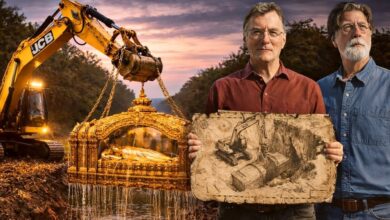
Oak Island Season 13, Episode 8: The Solution Channel and the Secrets Beneath the Money Pit

A Mystery Two Centuries in the Making
For more than two hundred years, a small wooded island off the coast of Nova Scotia has resisted every attempt to uncover its secrets. Oak Island exists in the uneasy space between history and legend, where each discovery raises as many questions as it answers. In Season 13, Episode 8, Rick and Marty Lagina and their team reach what may be one of the most critical turning points in the modern search for the island’s legendary treasure.
From deep beneath the Money Pit to the dark peat of the swamp and the enigmatic stone features of Lot 5, the evidence uncovered in this episode suggests a vast, multigenerational operation—one possibly driven by wealth, power, and deep spiritual fear.
![The Curse Of Oak Island | Season 13 Episode 2 Preview [HD] [2025]](https://i.ytimg.com/vi/bJDo25TVNws/hq720.jpg?sqp=-oaymwEhCK4FEIIDSFryq4qpAxMIARUAAAAAGAElAADIQj0AgKJD&rs=AOn4CLB_nVakM6cE9yBj1-Wv9VMiq6JV1w)
The Money Pit and the Solution Channel Hypothesis
The episode opens with renewed urgency at the Money Pit, where drilling efforts are focused on a new borehole known as H9.25. This is no routine excavation. Instead, it is a calculated attempt to intercept the so-called solution channel, a natural limestone void beneath the island that may have swallowed the legendary Chapel Vault.



The theory is grounded in past discoveries. In 2017, drilling at borehole H8 encountered a solid obstruction at approximately 170 feet—believed by many to be the vault itself—before it disappeared deeper into unstable ground. The current hypothesis suggests that the vault collapsed into the solution channel, a subterranean void capable of redistributing heavy objects laterally.
When drilling at H9.25 produces loose, viscous material instead of compact earth, the team believes they have finally reached that void. Metal detection readings on the core samples indicate strong metallic signals, yet no visible artifacts appear. The conclusion is both tantalizing and frustrating: microscopic traces of precious metals may be suspended within the slurry itself. Rather than dismissing the find, the team bags the entire core for laboratory analysis, marking a shift from treasure hunting to forensic science.
The Swamp: Evidence of Ancient Maritime Engineering
While drilling continues, attention turns to the swamp—an area increasingly believed to be man-made. Near a stone feature in the southwest corner, the team uncovers a curved, beveled piece of worked wood. Metal detection expert Gary Drayton immediately recognizes it as a possible piece of ship’s railing, suggesting maritime activity rather than natural debris.
This discovery echoes an earlier swamp find: a ship railing fragment carbon-dated to the 7th century. If the newly recovered wood matches that timeframe, it strengthens the theory that the swamp was engineered to conceal an ancient vessel.
The intrigue deepens with the discovery of wooden survey stakes driven deep into the peat. Geologist Dr. Ian Spooner explains that the stakes were placed before sand accumulated above them, indicating human activity centuries earlier than previously assumed. By dating both the peat and the stakes, the team hopes to establish a precise timeline for this hidden engineering project.
Lot 5 and the Presence of High-Status Individuals
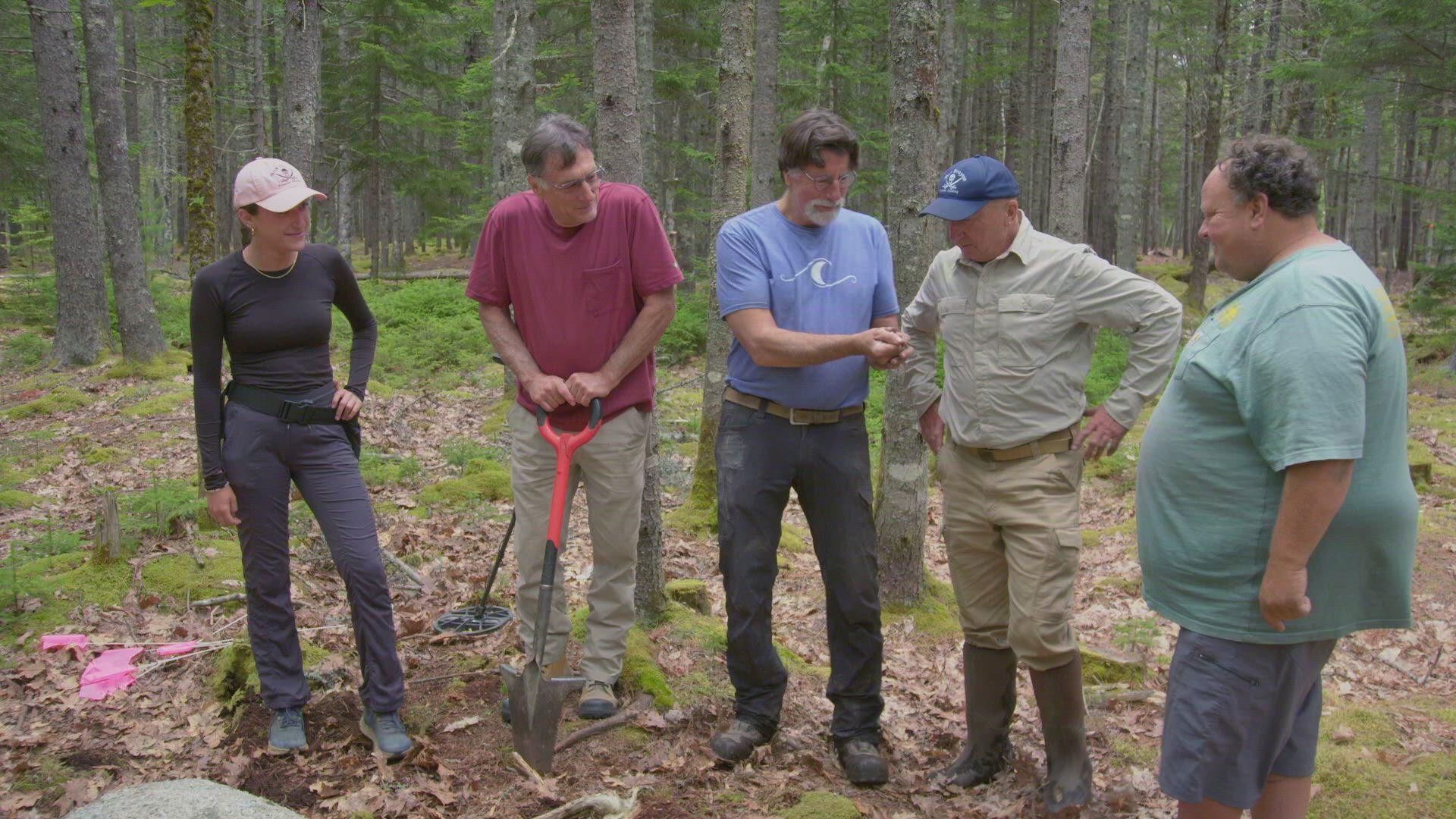
On Lot 5, archaeologists uncover artifacts that dramatically shift the narrative. Pottery shards date to the mid-to-late 18th century, including creamware from 1762 and pearlware from 1775. But the most startling discovery is a small black gemstone.
Laboratory analysis by Emma Culligan identifies the stone as a diamanté, a high-quality simulated black diamond made of glass and manganese. Its composition dates it to around 1734 in France, and its design confirms it was mounted jewelry—an item worn by aristocrats or high-ranking officers, not common laborers.
This find aligns with historical records of the Duc d’Anville expedition, a failed French armada sent to reclaim Nova Scotia in 1746. Logs suggest one of the treasure-laden ships may have diverted to a remote island to hide its cargo. Lot 5 now appears to be a potential staging ground for that desperate act.
The Folded Coin and the Spiritual Dimension
Perhaps the most haunting discovery comes from a simple piece of copper: a folded coin. Identified by Gary Drayton, this artifact represents a medieval ritual practice known as “bowing” a coin—a talismanic act meant to seek protection, ward off evil, or honor a saint.
This act suggests fear. People do not destroy currency without reason. Whether Templars, French sailors, or later privateers, those who worked on Oak Island may have believed they were guarding something dangerous as well as valuable—something requiring spiritual protection.
A Multigenerational Secret Nearing Exposure
By the episode’s end, a powerful pattern emerges. The Money Pit hints at a mobile vault swallowed by geology. The swamp reveals precise surveying and ship concealment. Lot 5 exposes the presence of European elites. And the folded coin reminds us of the fear carried by the men who buried the treasure.
Oak Island now appears less like a single event and more like a centuries-long operation, involving different groups united by a common goal: to hide and protect something extraordinary. As drilling at H9.25 continues, science is finally catching up to legend. The answers may not only reveal where the treasure is—but why so many believed it should never be found.