A Journey to Italy in Search of Templar Secrets
Rick Lagina and members of the Oak Island team travel more than 65 miles northwest of Rome to Viterbo, Italy, a city that once stood at the very heart of medieval Christianity. During the 13th century, Viterbo served as the temporary headquarters of the Catholic Church and a known stronghold of the Knights Templar during a period of unrest in Rome.

Their guide is Gianluca Prospero, a Templar investigator and author who has spent more than two decades researching medieval Templar activity in the region. His goal is to show the team symbols and locations that may connect Europe’s secretive past to the mystery of Oak Island.
Santa Maria Nova: A Church Filled With Hidden Meaning
The investigation begins at Santa Maria Nova, a church built in 1080. While its beauty is immediately apparent, Prospero explains that medieval churches often concealed hidden messages and symbols meant only for those who knew how to read them.



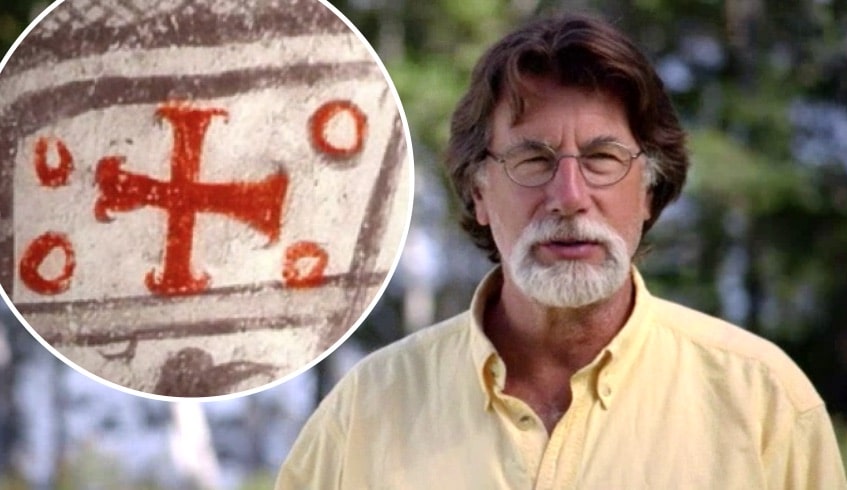
As the team carefully examines the walls, carvings, and artwork, a familiar symbol suddenly appears — a cross surrounded by four dots.
The Four-Dot Cross and Its Templar Significance
Peter Fornetti is the first to spot it. The symbol is unmistakable.
Prospero explains that the four-dot cross is believed to mark special Templar locations, often associated with sacred relics such as the Holy Grail or the Holy Shroud. The symbol’s presence inside Santa Maria Nova strongly suggests Templar influence.
For Rick and the team, the discovery is chilling. The same symbol appears on the mysterious HO Stone, found on Oak Island in the 1920s.
The HO Stone: A Message From the Past?
The HO Stone was once part of a much larger boulder discovered on Oak Island’s northern shore. Treasure hunters destroyed it with dynamite, hoping to uncover treasure beneath. Nothing was found — but the carved symbol remained.
Could the HO Stone be a marker indicating Templar relics hidden on Oak Island? If so, might it explain the trace amounts of gold and other precious metals detected deep within the Money Pit?
Every European site the team visits seems to reinforce the idea that Oak Island is part of a much larger, ongoing story.
Masonic Symbols Hidden in Plain Sight
As the investigation continues inside the church, Alex Lagina discovers additional carvings — letters and shapes resembling a compass and square, symbols commonly associated with Freemasonry.
Given the widely held belief that Freemasonry evolved from the Knights Templar after their suppression in the 14th century, the find raises even more questions. Since the Money Pit’s discovery in 1795, Freemasons have been involved in nearly every major Oak Island treasure hunt.
Could this be more evidence of a direct connection?
“Here Lies Templar Gold?”
By combining the symbols seen in the church with those on the HO Stone, Alex proposes a compelling interpretation:
The markings could translate to “Here — Templar — Gold.”
In an era obsessed with ciphers and hidden meanings, the possibility is hard to ignore. The circle and dot symbol has also been interpreted as a medieval sign for gold.
Malta and the Knights of St. John
The investigation continues more than 4,000 miles east in Malta, home of the Knights of St. John, also known as the Knights of Malta. Underground tunnels built in the 16th century reveal striking similarities to the flood tunnel descriptions of the Oak Island Money Pit.
Inside an ancient prison, the team discovers yet another four-dot cross carved into stone — reinforcing the idea that the symbol marked locations tied to sacred relics.
A Bloodline Linking Jerusalem to Nova Scotia
Researcher Corjan Mol presents a groundbreaking theory connecting generations of powerful families. He traces a direct lineage from high-ranking Templars fleeing Paris in 1307, through the Knights of Malta, all the way to Isaac de Razilly, a Knight of Malta who arrived in Nova Scotia in 1632.
Remarkably, Razilly established his colony just 15 miles south of Oak Island.
A Multi-Generational Treasure Theory
The evidence suggests that Oak Island may not be the result of a single deposit — but a multi-generational operation, managed by connected families across centuries.
Rick Lagina reflects that Oak Island may represent not just one mystery, but a carefully coordinated effort spanning continents and eras.
Heading Back to Oak Island
With more questions than answers, the team prepares to return home. The goal remains the same: to replace question marks with periods.
If this story is true, it may be one of the most remarkable historical discoveries ever uncovered — hidden for centuries, waiting beneath the soil of Oak Island.